Entry No. 22 — the Monterey file — filed under: observatory
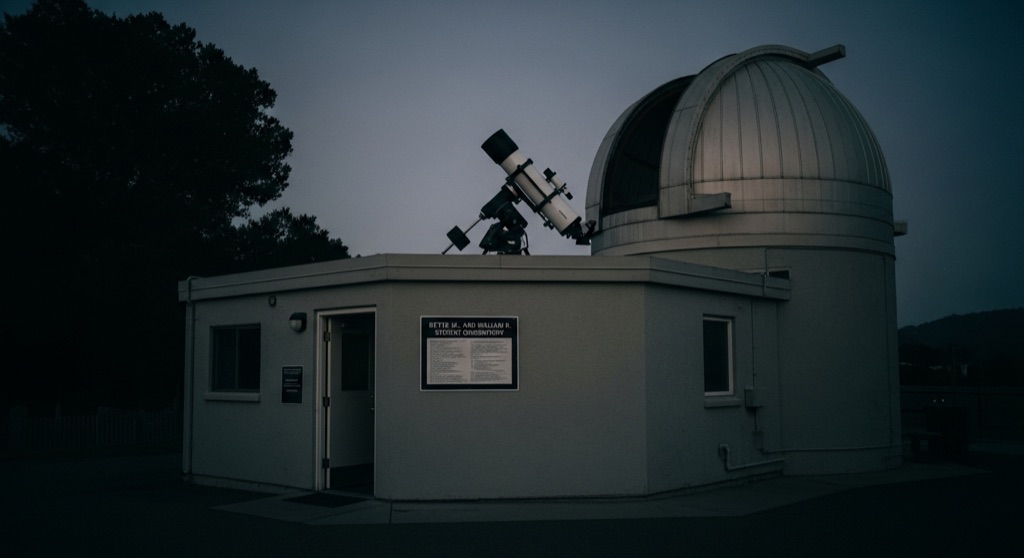
Richard W. Hamming Astronomy Center / Weaver Student Observatory
On the old Fort Ord army base, MIRA's Richard W. Hamming Astronomy Center houses the Bette M. and William R. Weaver Student Observatory, adjacent to CSU Monterey Bay — MIRA's real research telescope is a 36-inch reflector at the Oliver Observing Station atop 5,000-foot Chews Ridge in the Santa Lucia range. Free quarterly public lectures by local astronomers sometimes end with observing, and MIRA has hosted CSUMB students for lunar-eclipse watch parties.
→ Three at a time, never the same twice — explore weird Monterey
The story
Most people cruising past the repurposed barracks and coastal scrub on the former Fort Ord army base assume 200 Eighth Street is just another quiet stretch of California State University Monterey Bay's campus. Instead, it's the Richard W. Hamming Astronomy Center—the lowland headquarters for the Monterey Institute for Research in Astronomy (MIRA). While MIRA's flagship research tool is a massive 36-inch reflector stationed high above the fog atop 5,000-foot Chews Ridge in the Santa Lucia range, this Marina complex is where the institute keeps its scientific libraries, solar imaging setups, and public-facing scopes.
Founded as an independent astronomical research institute, MIRA maintains this Fort Ord site as a bridge between professional observatory science and the local community. Anchored by the Bette M. and William R. Weaver Student Observatory—named in part after co-founder Bruce Weaver—the center operates right beside the university, hosting free quarterly lectures and public watch parties for events like total lunar eclipses without charging admission.
What it's like
Show up at 200 Eighth Street on an evening when MIRA has a talk scheduled. You won't need to register or buy a ticket—just walk in and find a seat among a mix of CSUMB students, local skywatchers, and university researchers. After a presentation from an astronomer, if the Monterey fog holds off, the roof opens up and staff pivot the Weaver Observatory's 14-inch telescope toward the night's prime target. Keep in mind these public nights only pop up a few times a year, so checking MIRA's online calendar beforehand is mandatory.
The move: Show up to a free evening lecture (no registration needed) at 200 Eighth Street, stay after for the roof to open, and let the astronomy club swing the 14-inch scope onto the night's best target — check the calendar first, since these are scheduled just a few times a year.
- 📍 Marina (former Fort Ord)
- 💸 $
- ⚡ Low-key
- 🌗 Outdoors
Where: 200 Eighth St, Marina, CA 93933
Hours: Added 2026-07-20 — confirm current hours before you go.
⚠ Seasonal or scheduled — always check before you go.
Pair it with
- Night Market 831 — Pair an evening stargazing lecture in Marina with a First Friday run down to Sand City for open-air food, art, and pinball.
- Trident Room — Follow up an evening of army-base science with a drink inside another local defense landmark—a former Prohibition taproom tucked beneath the Naval Postgraduate School.
- Pacific Biological Laboratories ("Doc's Lab") — Contrast deep-space astronomy on Fort Ord with Monterey's historic tidal-pool biology preserved at Ed Ricketts' original Cannery Row laboratory.
More weird in Monterey
Good to know
Do I need tickets or reservations for the public lectures?
No. The quarterly evening lectures at the Hamming Center are completely free and walk-in, with no advance registration required.
Is this where MIRA does its primary scientific research?
Not quite. While the Hamming Center holds MIRA's administrative offices, libraries, and student scope, their main research instrument is a 36-inch reflector telescope located at the Oliver Observing Station on Chews Ridge.
What telescope is used during public viewing sessions?
When weather permits after-lecture viewing, staff open up the roof to use the Weaver Student Observatory's 14-inch telescope.
How often can you visit for observing?
The venue is not open for daily walk-in stargazing. Public observing only happens following their free quarterly lectures or during special astronomical watch parties.
Plan a visit & invite your people →
Further reading: mira.org · thelutrinae.com · montereycountynow.com
last checked: 2026-07-20