Entry No. 4 — the Milwaukee file — filed under: oddities
Milwaukee Public Museum (Carl Akeley Taxidermy Collection)
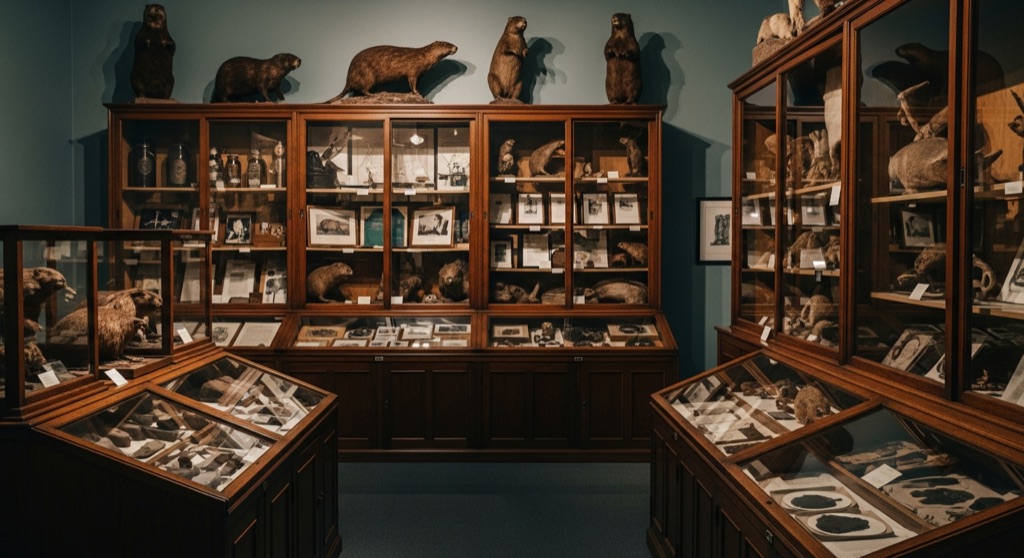
This historic museum is the birthplace of modern taxidermy, where Carl Akeley revolutionized display techniques in 1890 by creating the world's first habitat diorama cutaway of a muskrat den. Visitors can explore historic cabinets of curiosities, taxidermied Samson the gorilla, and 3,000-year-old Egyptian mummies.
→ Three more oddity shops & curiosities in Milwaukee — never the same twice
The story
Before Carl Akeley got his hands on the collection at the Milwaukee Public Museum, taxidermy was essentially upholstering hide with straw. Mounted animals sat stiffly on wooden stands like bloated cushions. Hired in the late 1880s when the institution was barely two years old, Akeley threw out the traditional stuffing methods and pioneered what became known as the 'Milwaukee style'—sculpting muscle tone, joints, and tendons in clay before stretching animal skin over the frame to capture genuine anatomical motion.
In 1890, Akeley completed a cutaway display of a muskrat den, creating the world's very first habitat diorama. Instead of isolating a mounted animal against a stark wall or empty case, he set the muskrats inside a synthesized slice of marshland, showing both the wetland plants above and the submerged burrowing tunnels beneath. It transformed natural history displays from static science specimens into realistic narrative storytelling.
That original muskrat den still stands on the first floor as the quiet birth site of modern museum display. Elsewhere in the building, you'll run into Samson—the famed gorilla preserved after decades at the Milwaukee County Zoo—alongside historic cabinets of curiosity and 3,000-year-old Egyptian mummies resting on the third floor.
What it's like
Navigating the building feels like exploring an archive of 19th- and 20th-century exhibit design. Most casual visitors head straight for the larger floor displays, meaning you can often inspect Akeley's original 1890 muskrat den on the first floor in relative quiet—look for it tucked right behind the glass curio cabinets. Afterwards, take the elevators straight to the third floor to hunt down the mummies and Samson the gorilla. Confirm hours online before heading over.
The move: Seek out Akeley's original 1890 muskrat den diorama hidden behind the first-floor curio cabinets, then examine the ancient Egyptian mummy displays on the third floor.
- 📍 Downtown
- 💸 $$
- ⚡ Up for anything
- 🌗 Indoors
Where: 800 W Wells St, Milwaukee, WI 53233
Hours: Added 2026-07-21 — confirm current hours before you go.
⚠ Seasonal or scheduled — always check before you go.
Pair it with
- The Safe House — Head half a mile east after viewing the mummies to whisper passwords and dodge spy gimmicks at Milwaukee’s iconic hidden bar.
- St. Joan of Arc Chapel — Walk six blocks west onto Marquette's campus to inspect an authentic 15th-century French Gothic chapel reassembled stone-by-stone.
- Grohmann Museum — Pair the origin of modern taxidermy with another hyper-focused collection less than a mile away—over 1,500 artworks dedicated to human labor.
- The Catacombs of Neto — Follow up the museum's ancient mummies with an underground art sanctuary designed to feel like subterranean catacombs.
More weird in Milwaukee
Good to know
Why is Carl Akeley's work at the Milwaukee Public Museum famous?
Akeley created the world's first complete habitat diorama here in 1890 with his muskrat den, pioneering the 'Milwaukee style' of taxidermy that used anatomically accurate clay armatures instead of basic straw stuffing.
Where in the museum is the original 1890 muskrat diorama located?
You'll find Akeley's muskrat den diorama on the first floor, nestled behind the historic curio cabinets.
What other specific oddities can you see here?
Notable stops include Samson the gorilla (a famous former Milwaukee County Zoo resident), Victorian-era cabinets of curiosity, and 3,000-year-old Egyptian mummies on the third floor.
Plan a visit & invite your people →
Further reading: mpm.edu · jsonline.com · wisconsinfrights.com · emke.uwm.edu
last checked: 2026-07-21