Entry No. 33 — the Miami file — filed under: cemetery
Miami City Cemetery
Miami's only municipal cemetery opened in 1897 with segregated white, Black, and (from 1915) Jewish sections still visibly divided by the old road grid, and it holds the only five oolitic-limestone gravestones known to exist anywhere in the world. "Mother of Miami" Julia Tuttle and three former mayors are buried among roughly 9,000 graves under a canopy of unmanaged tropical growth.
→ Three at a time, never the same twice — explore weird Miami
The story
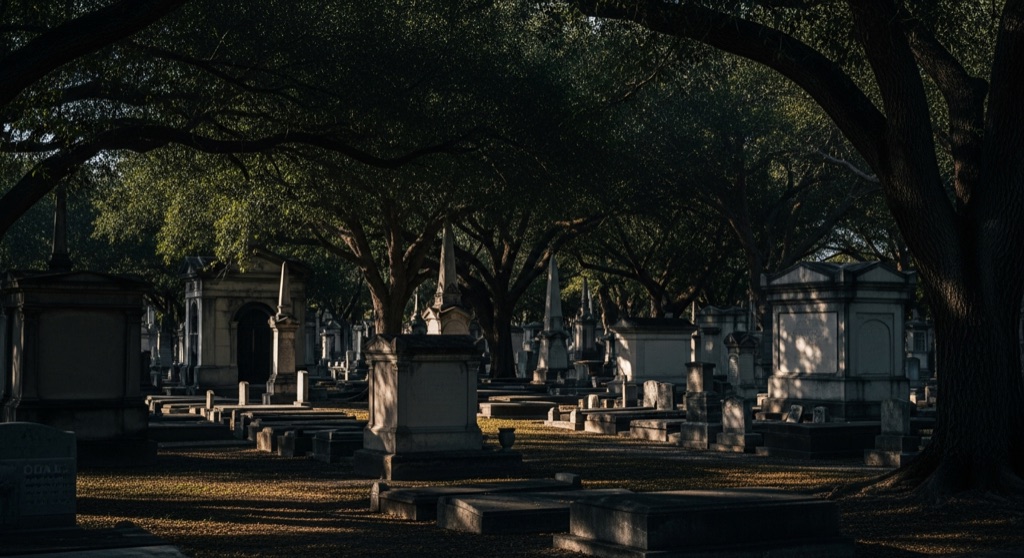
Founded in 1897 just a year after Miami incorporated, Miami City Cemetery is a stark, quiet blueprint of the city's early racial and social hierarchy sitting on the edge of Wynwood and Downtown. Walk through the entrance on NE 2nd Avenue and the grid layout immediately lays bare how early Miami was structured: rigid physical corridors laid out for white, Black, and—starting in 1915—Jewish burials. While the surrounding neighborhoods stripped away their past for high-rise towers and street art, these ten acres kept the segregation lines carved into the dirt and stone.
The graves themselves tell a peculiar architectural story. Buried among roughly 9,000 plots are city luminaries like "Mother of Miami" Julia Tuttle and three early mayors, but the real draw for tombstone hunters lies in the materials. Scattered across the grounds are the only five headstones known to exist anywhere on Earth carved out of native oolitic limestone, alongside unusual monuments like a grave famous for being entirely encased in concrete. Unmanaged tropical growth pulls at the perimeter, keeping the grounds shaded under banyans and palms that feel miles away from the surrounding traffic.
What it's like
It’s free, quiet, and open during daylight hours, though you should verify gate access before heading out. Don't expect manicured lawns or a gift shop; this is an unpolished urban cemetery maintained largely through volunteer efforts like the Friends of the Historic Miami City Cemetery. You can wander the grid hunting for the five razor-rare oolitic limestone markers or Julia Tuttle's burial site in relative isolation—you are far more likely to spot stray cats and neighborhood locals cutting through than crowds of tourists.
The move: Wander the grid on your own (it's free and open) hunting for the five limestone headstones and the segregation lines in the plot layout, then walk two minutes into Wynwood or Edgewater for coffee and compare notes on who you found.
- 📍 Downtown/Wynwood edge, Miami
- 💸 $$
- ⚡ Up for anything
- 🌗 Indoors
Where: 1800 NE 2nd Ave, Miami, FL 33132
Hours: Added 2026-07-19 — confirm current hours before you go.
Pair it with
- Kaona Room — After pacing the quiet pioneer grid, walk two minutes down NE 2nd Avenue to slip into a hidden, unmarked speakeasy.
- Bacardi Buildings / The Jewel Box — Trade 1890s limestone grave markers for 1960s Mid-Century Modern towers covered in blue azulejo ceramic tiles just four-tenths of a mile north.
- Museum of Graffiti — Head less than a mile into Wynwood to contrast Miami's earliest hand-carved burial stones with its modern outdoor aerosol art history.
More weird in Miami


Good to know
Is admission free?
Yes, entering and walking the cemetery grounds is completely free.
Who is buried at Miami City Cemetery?
The cemetery holds roughly 9,000 graves, including Miami founder Julia Tuttle, three former mayors, pioneer families, and early Black and Jewish residents in historically segregated plots.
What are the most notable headstones to look for?
Seek out the five unique gravestones carved from local oolitic limestone—the only ones in the world—and the grave encased entirely in concrete.
Are guided tours available?
While it is mostly a self-guided experience, HistoryMiami occasionally conducts official historical tours of the cemetery a few times a year.
Plan a visit & invite your people →
Further reading: Wikipedia · Official site · Atlas Obscura
last checked: 2026-07-19