Entry No. 15 — the Miami file — filed under: strange public art
Bacardi Buildings / The Jewel Box
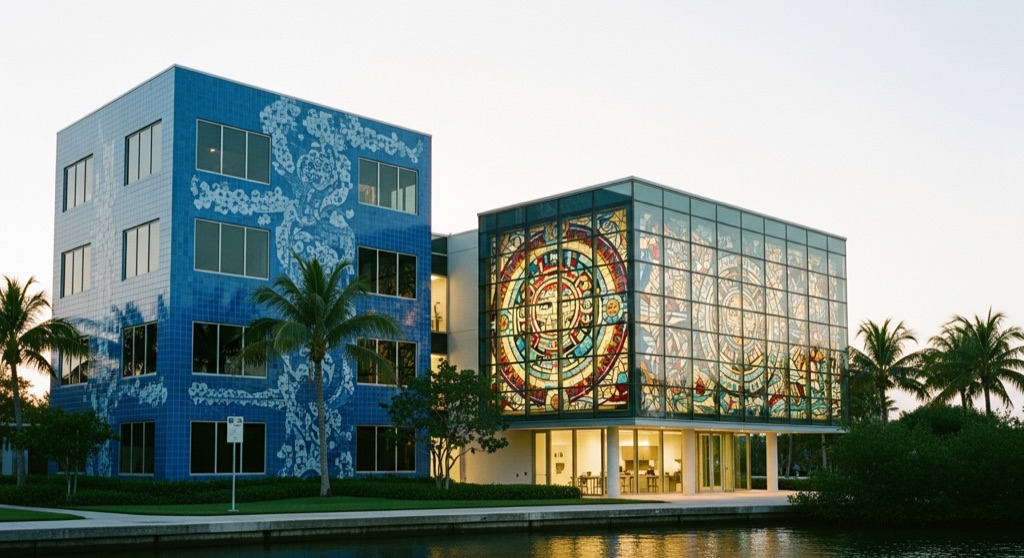
Two adjoining office buildings that look like nothing else on Biscayne Boulevard: a tower wrapped floor-to-roof in blue Brazilian azulejo tile murals by ceramist Francisco Brennand, next to a smaller glass-and-steel 'Jewel Box' annex whose walls are a hammered, backlit stained-glass mosaic of Mesoamerican imagery designed by German artist Johannes Dietz. It was Bacardi's rum headquarters; it's now the National YoungArts Foundation campus.
→ Three at a time, never the same twice — explore weird Miami
The story
When Bacardi set up shop on Biscayne Boulevard in 1963, they didn't just build an administrative office—they dropped an architectural flex right into Edgewater. The main seven-story tower appears to hover over its plaza on slender piers, its north and south walls completely encased in hand-painted blue-and-white azulejo tile murals created by Brazilian master ceramist Francisco Brennand. It looks less like a mid-century corporate office and more like a Portuguese sanctuary suspended over Miami traffic.
In 1970, they doubled down by adding the administration annex next door, affectionately dubbed the "Jewel Box." Designed by Coral Gables architect Ignacio Carrera-Justiz, its cantilevered upper square is enclosed on all four sides by thick walls of faceted, hammered stained glass. Designed by German artist Johannes Dietz, the mosaic depicts Mesoamerican imagery trapped inside heavy glass-and-steel frames. Bacardi eventually packed up and moved out, but the landmark complex avoided the wrecking ball when the National YoungArts Foundation stepped in to take over the campus.
What it's like
You don't need a ticket or an invitation to get the full impact here; the real show is entirely on the exterior. Pull up along Biscayne Boulevard around dusk when the streetlights kick on and the interior lights inside the Jewel Box illuminate the thick stained-glass panels from behind, turning the building into a glowing amber lantern next to the blue ceramic tower. You can easily circle the block on the public sidewalk to study the individual tile brushstrokes and heavy glass facets, though keep in mind the interior and plaza function as a working educational campus for YoungArts.
The move: Circle the block on foot at dusk when the Jewel Box glass panels light up from inside, then argue about which building — the blue tile tower or the glowing mosaic box — is the weirder one.
- 📍 Edgewater
- 💸 Free
- ⚡ Up for anything
- 🌗 Outdoors
Where: 2100 Biscayne Blvd, Miami, FL 33137
Hours: Added 2026-07-19 — confirm current hours before you go.
Pair it with
- Miami City Cemetery — Head less than half a mile south to contrast 1960s modernist tilework with 19th-century funerary monuments at Miami's oldest municipal burial ground.
- Kaona Room — Continue the hidden rum vibe by ducking half a mile south into a secret tiki speakeasy concealed behind an unmarked downtown doorway.
- Bakehouse Art Complex — Drive just over a mile north to see another repurposed Miami landmark—a 1930s industrial bakery transformed into working studios for over 100 artists.
More weird in Miami

Good to know
Can you go inside the buildings?
The interior operates as the active campus for the National YoungArts Foundation, so general public access indoors is usually restricted outside of specific scheduled events. The artwork, however, is entirely on the exterior and visible from the sidewalk.
What is the best time of day to view the complex?
Twilight and early evening are ideal. That's when the interior lighting of the Jewel Box cuts through the thick stained glass, backlighting the Mesoamerican designs.
Does it cost anything to see?
No, viewing the architecture and public tilework from Biscayne Boulevard and the surrounding sidewalks is completely free.
Who designed the two buildings?
Brazilian ceramist Francisco Brennand designed and crafted the blue tile murals on the 1963 tower. Architect Ignacio Carrera-Justiz designed the 1970 Jewel Box annex, featuring glass mosaic panels designed by German artist Johannes Dietz.
Plan a visit & invite your people →
Further reading: Wikipedia · youngarts.org · heraldtribune.com · miamitodaynews.com
last checked: 2026-07-19