Entry No. 27 — the Miami file — filed under: historic-village
Cauley Square Historic Village
Founded in 1903 as a Florida East Coast Railway depot village for W. H. Cauley's tomato-shipping operation, the settlement was completely abandoned after the catastrophic 1926 Miami hurricane and sat empty for more than two decades before a 1949 restoration brought it back — and it has since survived direct hits from Hurricanes Andrew, Katrina, and Wilma.
→ Three at a time, never the same twice — explore weird Miami
The story
Before South Miami-Dade turned into endless residential subdivisions and strip malls, it was an isolated frontier of red-clay tomato fields and pine scrub. In 1903, W. H. Cauley bought land in Goulds along Henry Flagler’s Florida East Coast Railway to build a 10-acre packing house and shipping hub. Around it sprang a tiny railroad town: two-story wooden dormitories for train crews, modest cottages for field hands, an executive office, and a commissary. Then came the Great Miami Hurricane of 1926. The storm obliterated the local agricultural trade, the railway traffic dried up, and every resident walked away. For twenty-three years, the entire hamlet sat completely empty, slowly dissolving into the subtropical brush.
In 1949, Mary Born Christiansen discovered the ghost town rotting beside Old Dixie Highway and bought the parcel to save it from demolition. She spent decades restoring the Dade County pine structures and turning them into an artists' enclave and antique village. The weather wasn't done testing the site, though. In August 1992, Hurricane Andrew placed Goulds in its direct eyewall, damaging every single cottage and stripping the canopy bare. Christiansen’s family rebuilt it piece by piece using reclaimed historic timber, only to get slammed again by Hurricanes Katrina and Wilma in 2005.
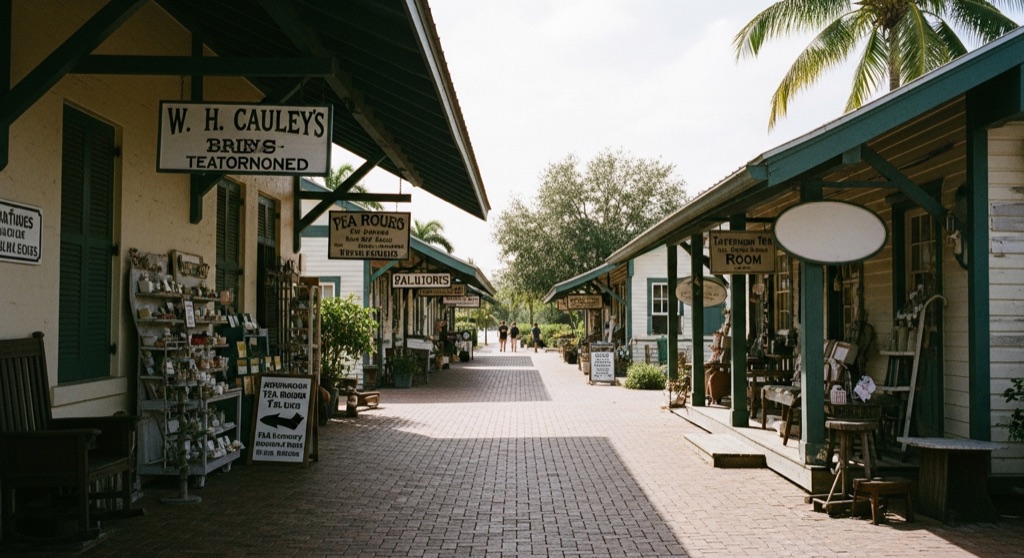
What remains today shouldn't strictly exist. Hemmed in by industrial supply yards and used-car lots, Cauley Square feels like an unauthorized tear in South Florida's geography. The wooden saltbox cottages, antique shops, and shaded brick paths operate on a strange, out-of-time frequency that feels less like a commercial plaza and more like sneaking onto a abandoned 1920s film set that nature keeps trying—and failing—to claim.
What it's like
You'll pull off Old Dixie Highway into a gravelly lot shaded by dense banyan and avocado trees. The grounds feel like a labyrinth of brick paths winding between historic red-and-white painted pine shacks, fountain courtyards, and aviaries filled with squawking birds. Expect individual antique shops crammed with estate jewelry, vintage stained glass, and oddities, alongside the Tea Room—a tea house operating inside a 1923 cottage with mismatched porcelain china and vintage wallpaper. The vibe is quiet and slightly surreal on weekdays, though weekend lunch rushes fill up the pathways quickly. Note that individual shop owners keep their own inconsistent hours, and the humidity beneath the thick foliage can get heavy by mid-afternoon.
The move: Walk the brick-and-wisteria walkways between the old depot buildings browsing the antique shops and galleries, have afternoon tea in the Tea Room housed in a century-old cottage, and ask a shopkeeper which building sat vacant longest.
- 📍 Goulds, South Miami-Dade
- 💸 $$
- ⚡ Up for anything
- 🌗 Indoors
Where: 22400 Old Dixie Highway, Miami, FL 33170
Hours: Added 2026-07-19 — confirm current hours before you go.
Pair it with
- Gold Coast Railroad Museum — Since Cauley Square started as a Florida East Coast Railway shipping depot, head four miles north to inspect the actual vintage locomotives and rolling stock from that same rail line.
- Coral Castle — Drive ten minutes south down US-1 to pair Cauley Square's hurricane-defying wooden cottages with Edward Leedskalnin’s hand-carved, 1,100-ton oolitic limestone monoliths.
- Deering Estate — Tequesta Burial Mound & Cutler Fossil Site — Trade Cauley Square's 1900s railroad history for 2,000 years of human memory at this nearby coastal estate holding a prehistoric Native American burial mound.
More weird in Miami

Good to know
Is there an admission fee to enter Cauley Square?
No. Walking the grounds, gardens, and browsing the shops is completely free; you only pay for food, drinks, or antique purchases.
What survived Hurricane Andrew in 1992?
None of the original structures escaped undamaged; Andrew tore off roofs and flattened major sections. The village was painstakingly rebuilt using salvaged original Dade County pine and era-appropriate materials.
Do I need a reservation for afternoon tea?
Yes, reservations are highly recommended for the Tea Room on weekends, as indoor seating inside the historic 1920s cottage is limited.
Are dogs allowed on the grounds?
Leashed dogs are welcome on the outdoor brick walkways and garden grounds, though individual boutique owners decide whether pets can come inside their shops.
Plan a visit & invite your people →
Further reading: Wikipedia · Official site
last checked: 2026-07-19