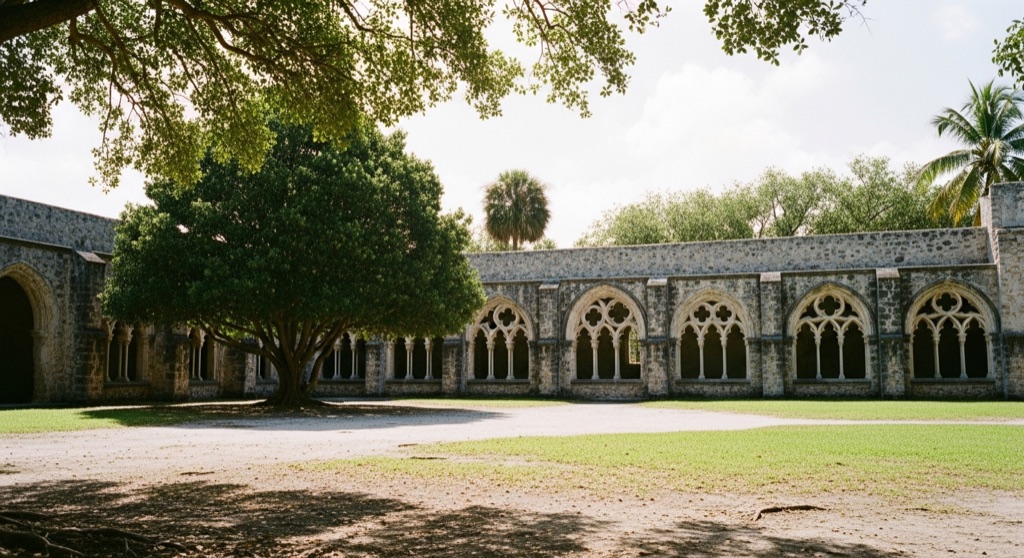
Entry No. 2 — the Miami file — filed under: oddities
Ancient Spanish Monastery (St. Bernard de Clairvaux Church)
Built by Cistercian monks in Sacramenia, Spain between 1133 and 1141, the monastery was seized and gutted during 1830s Spanish anti-clerical unrest, then bought by William Randolph Hearst in 1925, dismantled stone-by-stone into 11,000 numbered crates, and shipped to Brooklyn — where a hoof-and-mouth quarantine scrambled the labels and left it crated in a warehouse for 26 years before it was finally reassembled in Florida in 1952-64, a project Time called "the biggest jigsaw puzzle in history."
→ Three at a time, never the same twice — explore weird Miami
The story
In 1133, Cistercian monks began laying hand-carved limestone blocks in Sacramenia, near Segovia in northern Spain. For over seven centuries, the Monastery of Our Lady, Queen of the Angels, stood quietly in the Spanish countryside. That ended in the 1830s when anti-clerical decrees forced the church to forfeit its properties, and the cloisters were seized, gutted, and repurposed into granaries and farm stables.
Enter publishing tycoon William Randolph Hearst in 1925. Smitten by medieval architecture, Hearst bought the cloisters and outbuildings, had them systematically dismantled stone-by-stone, and packed the fragments into 11,000 numbered wooden crates bound for New York. But when the shipment hit the Brooklyn docks, disaster struck: US health officials feared the straw used for packing carried hoof-and-mouth disease. Quarantined workers broke open every single crate, burned the straw, and shoved the stones back into boxes—completely scrambling the numbered tags.
Bankrupt by the Great Depression, Hearst couldn't pay to rebuild his box of medieval rocks, leaving the crates sitting in a Brooklyn warehouse for 26 years. In 1952, two Miami businessmen bought the inventory and brought it south. Over 19 months of grueling assembly—a venture Time magazine famously called "the biggest jigsaw puzzle in history"—stonemasons pieced the monastery back together in North Miami Beach. Because of the missing labels and lost stones, workers had to improvise, leaving a scattered paper trail written into the stone walls.
What it's like
Stepping off West Dixie Highway onto the monastery grounds feels like dropping through a trapdoor in South Florida history. You're surrounded by 12th-century Romanesque stone arches, carved capitals, and medieval cloisters wrapped around a palm-filled courtyard. Because it doubles as an active Episcopal church (St. Bernard de Clairvaux), you will likely share the space with quiet garden wanderers and weekend wedding photographers. Go on a clear weekday morning when the grounds are empty. As you walk the cloister hallways, trace the limestone blocks: where quarantine workers burned the packing straw and lost the numbering, masons had to make educated guesses, resulting in mismatched stone grains, inverted carved reliefs, and odd fills where original pieces went missing.
The move: Walk the 800-year-old cloisters and courtyard on a quiet weekday, then try to spot the mismatched or oddly-placed stones that hint at where the lost labels left gaps in the 20th-century reconstruction.
- 📍 North Miami Beach
- 💸 $$
- ⚡ Up for anything
- 🌗 Indoors
Where: 16711 West Dixie Highway, North Miami Beach, FL 33160
Hours: Added 2026-07-19 — confirm current hours before you go.
⚠ Seasonal or scheduled — always check before you go.
Pair it with
- Holistic Salt Therapy Center — After examining centuries-old stone masonry, head just down the road to soak in pharmaceutical-grade dry salt sound sessions.
- Hattie's House — Trade medieval Catholic parish history for a modern, Black-owned metaphysical shop stocking candles, crystals, and herbal supplies.
- Hollywood Hot Glass — Contrast 800-year-old carved limestone architecture with live molten glassblowing in nearby Hollywood's ArtsPark.
More weird in Miami
Good to know
Where did the monastery originate?
It was built between 1133 and 1141 in Sacramenia, a village near Segovia in northern Spain.
Why was the reassembly called 'the biggest jigsaw puzzle in history'?
During a 1920s hoof-and-mouth quarantine in Brooklyn, health inspectors opened all 11,000 crates to burn the straw packing, scrambling the numbered identification tags on the individual stones.
Is the monastery an active church or just a museum?
It operates as both: it is an open museum for visitors and an active parish within the Episcopal Diocese of Southeast Florida.
How long did it sit in storage before being rebuilt?
The crates sat in a Brooklyn warehouse for 26 years before two developers purchased them in 1952 to begin reassembly in Florida.
Plan a visit & invite your people →
Further reading: Wikipedia · Official site
last checked: 2026-07-19