Entry No. 60 — the Los Angeles file — filed under: outdoor
Desert Christ Park
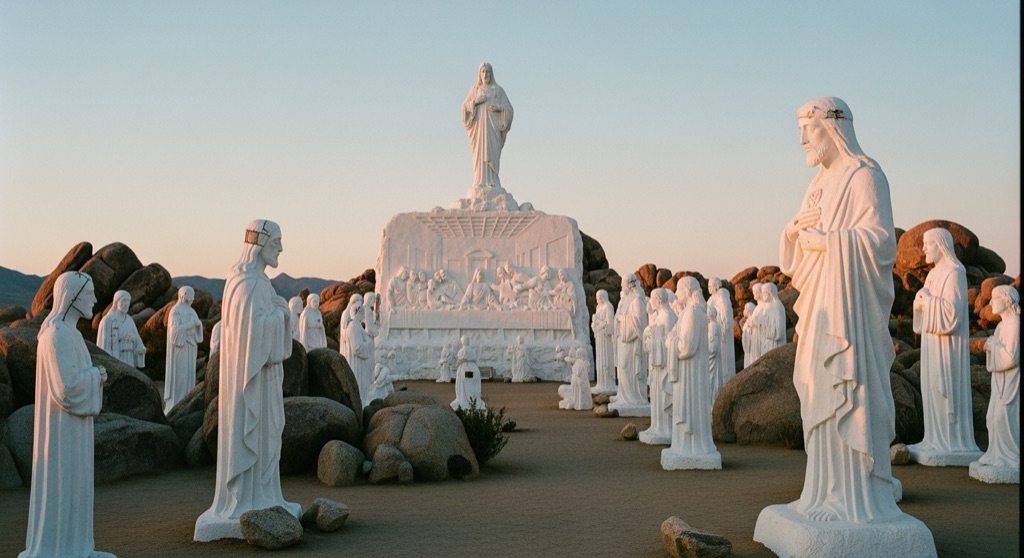
Sculptor Antone Martin spent 1951 to 1961 installing snow-white concrete figures of Christ and biblical scenes across this high-desert hillside, conceiving them during the Cold War atomic-bomb scare as a message of peace. More than forty statues stand among the boulders, including a three-story, 125-ton Last Supper bas-relief built into a 32-foot wall and a 15-foot Jesus. The 1992 Landers earthquake knocked the heads and hands off many figures; volunteers keep patching them.
→ Three more haunted places & dark-history spots in Los Angeles — never the same twice
The story
In 1951, aircraft worker and sculptor Antone Martin took a ten-ton concrete Jesus he’d fashioned in his Los Angeles garage—originally intended for the Grand Canyon, then dubbed "the unwanted Christ" after local sites turned it down—and hauled it on a flatbed truck out into the high desert. Cold War atomic bomb scares were dominating the news, and Martin was convinced nuclear ruin was imminent. His singular response was to spend the next decade installing white concrete figures across a barren Mojave hillside as an overt plea for world peace.
By 1961, Martin had transformed 3.5 acres of Yucca Valley slope into an eerie, open-air sanctuary with over forty snow-white figures. The scale was absurd for a solo builder: along with a 15-foot standing Jesus, he engineered a three-story, 125-ton bas-relief of the Last Supper built into a 32-foot concrete wall. Working with heavy rebar, plaster, and concrete, he poured his nuclear anxiety directly into the desert rocks, leaving his stark biblical scenes entirely exposed to the wind and sun.
Then came June 1992, when the magnitude 7.3 Landers earthquake violently shook the Yucca Valley floor. The quake sheared off concrete arms, decapitated figures, and sent stone fingers tumbling down the dirt slopes. Instead of letting the site turn to rubble, local volunteers stepped in with mortar and rebar. Today, those visible repair seams, pinned necklines, and patched limbs only amplify the uncanny vibe—a surreal, earthquake-scarred testament to mid-century survivalism.
What it's like
You turn off Highway 62 onto Sunnyslope Drive and find a quiet 3.5-acre hillside rising above the valley, populated by dozens of chalk-white figures standing silently among granite boulders and Joshua trees. There are no ticket booths or formal gates; you simply walk the free dirt trails at your own pace. Up close, you'll see the brutalist reality of Martin's handiwork—rough-poured concrete texture, steel rebar sticking out from vintage repairs, and massive figures looming overhead. Aim for late afternoon when the sun sinks behind the mountains, turning the desert sky pink and casting sharp, theatrical shadows across the 125-ton Last Supper wall.
The move: Take the free self-guided walk among the eerie white figures as the sun sets and the desert turns pink behind them.
📍 Before you go Free, open daily roughly 7am-6pm. About 120 miles east of LA near the entrance to Joshua Tree; pair it with the Integratron.
- 📍 Yucca Valley
- 💸 Free
- ⚡ Up for anything
- 🌗 Outdoors
Where: 56200 Sunnyslope Dr, Yucca Valley, CA 92284
Hours: Added 2026-06-23 — confirm current hours before you go.
Pair it with
- The Integratron — Combine two mid-century High Desert obsession projects built just 12 miles apart—one aiming for cosmic anti-gravity rejuvenation, the other seeking atomic-age salvation in concrete.
- Cabazon Dinosaurs — Construct the ultimate concrete roadside tour by pairing Antone Martin's high-desert figures with Claude Bell's massive roadside dinosaurs along your drive from LA.
- Elmer's Bottle Tree Ranch — Pair this site with another essential high-desert folk-art environment born from decades of intense, single-minded obsession under the desert sun.
More weird in Los Angeles
Good to know
How much does it cost to visit Desert Christ Park?
It is completely free to enter and open daily roughly from 7:00 AM to 6:00 PM, though local volunteers rely on donations to keep patching the concrete.
Why do many of the statues look cracked or patched up?
The powerful 7.3-magnitude Landers earthquake in 1992 snapped off heads, hands, and limbs across the hillside. Community volunteers have spent decades pinning the concrete pieces back together with rebar and fresh plaster.
How did the statues get to this remote location?
Antone Martin hauled his initial 10-ton concrete statue from Los Angeles on a flatbed truck in the early 1950s. Once he secured the hillside plot in Yucca Valley, he constructed the remaining 40-plus statues right on site over the next ten years.
Where is it located relative to Joshua Tree?
It sits at 56200 Sunnyslope Dr in Yucca Valley, about 120 miles east of downtown Los Angeles and just minutes off the main highway leading directly into Joshua Tree National Park and Pioneertown.
Plan a visit & invite your people →
Further reading: Wikipedia · Official site · Atlas Obscura · Roadside America · moranmorangallery.com · californiathroughmylens.com
last checked: 2026-06-23