Entry No. 10 — the Los Angeles file — filed under: haunted
Colorado Street Bridge (Suicide Bridge)
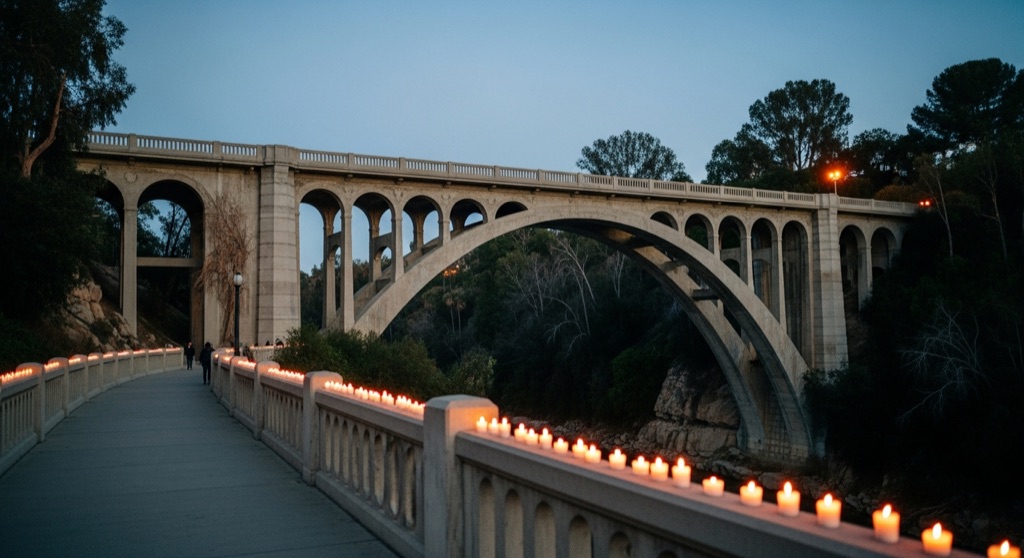
Opened in 1913 as the highest concrete bridge in the world, this Beaux-Arts span of eleven sweeping arches rises 150 feet over the Arroyo Seco. Its grim nickname comes from a documented wave of more than 100 deaths, many during the Great Depression, beginning with the first recorded leap in 1919. A persistent legend holds that a construction worker fell into the wet concrete and was never recovered, and the bridge is a fixture on Pasadena ghost tours.
→ Three more haunted places & dark-history spots in Los Angeles — never the same twice
The story
When it opened in 1913, Pasadena's Beaux-Arts span was celebrated as the highest concrete bridge in the world—a 150-foot-high ribbon of eleven sweeping arches crossing the Arroyo Seco. It did not stay purely monumental for long. The first recorded leap occurred in 1919, launching a grim chapter that saw more than 100 documented deaths, with a heavy spike during the Great Depression.
That body count birthed a web of local myth. The most enduring legend insists that during construction, a worker fell into a wet concrete pour and was permanently entombed in one of the bridge's massive piers. While historians treat that as pure urban lore, the bridge remains a staple on local paranormal walks, complete with claims of mist-shrouded figures along the parapets.
Today, the restored structure carries daily traffic over the Arroyo while walking a tightrope between historic preservation and public safety. Suicide-prevention mesh barriers and crisis helpline signs now line the sidewalk, serving as a physical reminder that this turn-of-the-century landmark carries a heavy second history.
What it's like
Walking the sidewalk puts you right against two competing realities: grand turn-of-the-century lamp posts looking out over the Arroyo Seco canyon, framed by tall suicide-prevention barriers and crisis-line placards. The street is open public right-of-way, so you can walk across for free at any hour, though dusk offers the best light over the canyon before the streetlamps ignite. Cars move quickly right beside the narrow pedestrian paths, so do not expect a tranquil park promenade—you are taking an atmospheric walk across high concrete with a hundred years of dark history right underfoot.
The move: Walk the bridge's restored arched walkway at dusk for the Arroyo views, then join a Pasadena ghost tour that pairs it with nearby Castle Green.
📍 Before you go The bridge is a public, free, walkable landmark; suicide-prevention barriers and crisis-line signage are present. Guided ghost tours are scheduled separately.
- 📍 Pasadena
- 💸 $$
- ⚡ Up for anything
- 🌗 Indoors
Where: Colorado Blvd over Arroyo Seco, Pasadena, CA 91105
Hours: Added 2026-06-23 — confirm current hours before you go.
Pair it with
- Heritage Square Museum — Pair the bridge's 1913 concrete architecture with a walk among eight saved Victorian-era buildings tucked further down the Arroyo corridor.
- Highland Park Bowl — Head just under three miles south for a drink at LA's oldest bowling alley, opened in 1927 when medicinal whiskey was prescribed upstairs.
- Pico House at El Pueblo — Double down on early LA spectral history at this grand 1870 hotel built by Alta California's last Mexican governor.
More weird in Los Angeles
Good to know
Is the Colorado Street Bridge free to visit?
Yes, it is a public thoroughfare with pedestrian sidewalks on both sides, free and accessible 24/7.
Why is it called the Suicide Bridge?
The nickname originated after a wave of over 100 documented fatal leaps began in 1919, peaking during the Great Depression. High suicide-prevention barriers now line the entire span.
Is someone actually buried in the bridge's concrete?
That is a long-standing local legend—that a worker fell into wet concrete during the 1912–1913 construction—though official records show no evidence of an unfound worker.
How can I take a ghost tour of the bridge?
Independent Pasadena ghost tour operators regularly include the bridge on nighttime itineraries, often pairing it with stories of nearby historic spots like Castle Green.
Plan a visit & invite your people →
Further reading: Wikipedia · nps.gov · legendsofamerica.com
last checked: 2026-06-23