Entry No. 8 — the Kansas City file — filed under: haunted
Glore Psychiatric Museum
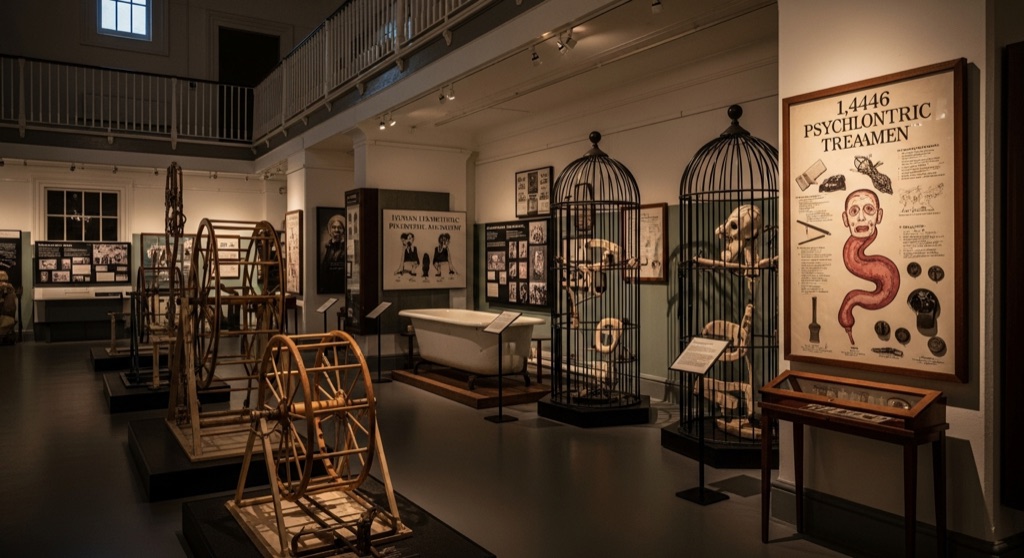
Housed in a building adjacent to a former state lunatic asylum, this world-renowned museum chronicles the history of psychiatric treatment with chilling honesty. Exhibits feature historical treatment devices like a 'human hamster wheel,' bath restraint cages, and a famous display of 1,446 swallowed items recovered from a single patient's stomach.
→ Three more haunted places & dark-history spots in Kansas City — never the same twice
The story
In 1967, a Missouri Department of Mental Health employee named George Glore constructed a few full-scale replicas of historical psychiatric devices for a Mental Health Week display. What started as a temporary educational project spiraled into a lifetime obsession, eventually building into the world's largest collection of psychiatric history. Housed in a building adjacent to what was once State Lunatic Asylum No. 2, the Glore Psychiatric Museum lays out 150 years of institutional treatment without flinching or tidying up the dark corners.
The particulars are what stick with you long after you leave. You’ll stand inches from a glass shadowbox displaying 1,446 swallowed objects—buttons, safety pins, thimbles, pocketknives, and salt shaker tops—surgically removed from a single patient's stomach in 1955. Nearby sit crude mechanical instruments of early containment: wooden bath restraint cages, a sensory-deprivation 'tranquilizer chair' fitted with an integrated head restraint, and a giant wooden wheel designed to run hyperactive patients into physical exhaustion like a human hamster wheel.
The museum's real weight, however, comes from the quiet artifacts left behind by former residents. You’ll find intricate hand-stitched needlework crafted from frayed mop threads, secret notes carved into plaster, and art installations built from thousands of discarded cigarette packs collected by an inmate over decades. It doesn't rely on cheap sensationalism; it simply presents a methodical, unsettling record of how society attempted to treat minds it did not yet comprehend.
What it's like
Plan for at least two hours to walk the multi-floor complex at 3406 Frederick Avenue in St. Joseph, roughly an hour north of Kansas City. The self-guided route winds through tile-lined corridors and former hospital rooms that carry a heavy, sterile quiet. Take your time reading the handwritten patient logs and exhibit placards—that's where the most revealing details hide. If you want to experience the halls in a different light, keep an eye on their calendar for ticketed after-hours paranormal tours or immersive 'Murder at the Asylum' game nights.
The move: Take a day trip to St. Joseph to walk through the eerie galleries, and if you're brave, book tickets for one of their immersive 'Murder at the Asylum' game nights or paranormal after-hours tours.
- 📍 St. Joseph, MO
- 💸 $$
- ⚡ Up for anything
- 🌗 Indoors
Where: 3406 Frederick Ave, St. Joseph, MO 64506
Hours: Added 2026-07-21 — confirm current hours before you go.
Pair it with
- National Silk Art Museum — On your way back toward Kansas City, balance the stark medical history with a stop in nearby Weston to see rare 18th-century French woven tapestries inside an old bank building.
- Belvoir Winery & Inn — Keep the historic institutional atmosphere going by heading to Liberty for a drink on the grounds of a haunted 1900 Jacobean Revival compound.
- S.D. Strong Distilling — Decompress after the heavy museum galleries by stopping in Parkville for a drink 65 feet underground at the world's only cave-based distillery.
More weird in Kansas City
Good to know
Where is the Glore Psychiatric Museum located?
It's located at 3406 Frederick Ave in St. Joseph, Missouri, about an hour's drive north of downtown Kansas City on the main St. Joseph Museums campus.
What is the single most famous display in the museum?
The shadowbox arrangement holding 1,446 metallic objects—including safety pins, thimbles, nails, and keys—surgically removed from a single patient's stomach in 1955.
Does the museum offer evening or after-hours events?
Yes, the museum periodically hosts ticketed after-hours paranormal investigation tours and interactive 'Murder at the Asylum' game nights.
Is the museum suitable for children?
While educational, the museum displays historical restraint devices, lobotomy tools, and honest depictions of mental health treatments that may be disturbing for younger visitors.
Plan a visit & invite your people →
Further reading: Official site · kansastravel.org · Atlas Obscura · Wikipedia
last checked: 2026-07-21