Entry No. 2 — the Houston file — filed under: observatory
George Observatory — Saturday Stargazing
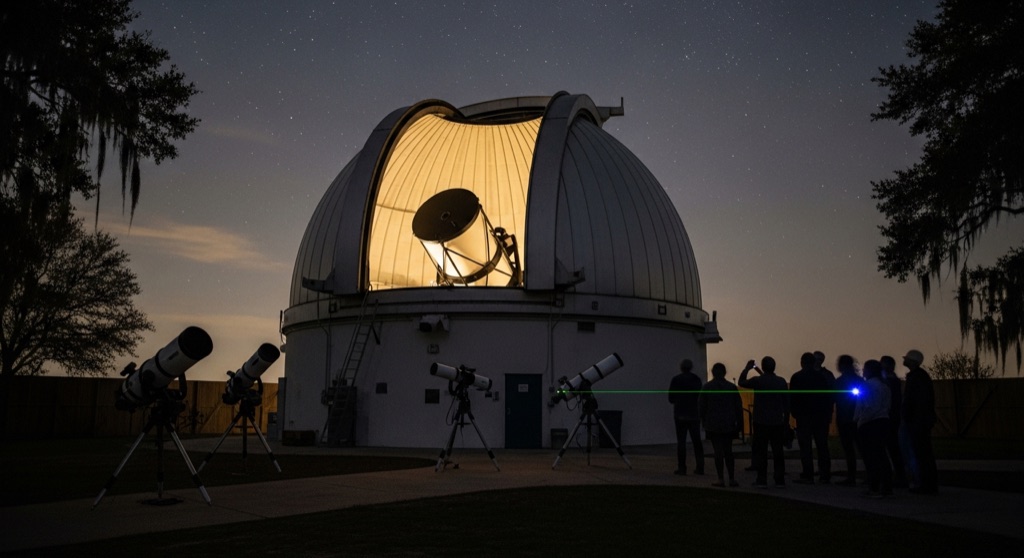
Inside Brazos Bend State Park sits a working research dome housing the 36-inch Gueymard telescope — one of the largest scopes in the country that ordinary people can look through on a regular weekly schedule, not just a once-a-year open house.
→ Three at a time, never the same twice — explore weird Houston
The story
An hour south of Houston's highway light wash, FM 762 dead-ends into live oaks, Spanish moss, and alligator-filled wetlands inside Brazos Bend State Park. Hidden deep within this preserve is a legitimate research facility operated by the Houston Museum of Natural Science: the George Observatory. While most high-caliber observatories lock their primary optics behind steel gates for visiting academics, this facility opens its doors to the public every Saturday night.
The crown jewel sitting inside the main dome is the 36-inch Gueymard Research Telescope—one of the largest optical scopes in the country that ordinary people can look through on a regular weekly schedule, rather than during a once-a-year open house. Outside the central dome, volunteer astronomers line the observatory deck with their own specialized setups, training lenses on Saturn's rings, faint nebulae, and galaxy clusters. Inside the Discovery Center, you can literally handle space debris—touching authentic meteorites and lunar samples—before stepping back under the pitch-black Texas sky.
What it's like
Plan ahead or you'll be turned away at the gate: you need two separate advance reservations booked online before you head out—a Brazos Bend State Park day pass and a timed Saturday Stargazing ticket from the HMNS website. Aim to arrive before dark so you can navigate the park roads without blinding astronomers or alarming the local gator population. Once night falls, kill white lights to protect everyone's night vision, then cycle between the queue for the 36-inch eyepiece, talking shop with amateur scope operators on the deck, and following green laser pointers during outdoor constellation tours.
The move: Buy timed Saturday-night tickets online in advance (a separate state-park day pass is required), then split the evening between the dome's 36-inch eyepiece, deck telescopes trained on Saturn or a nebula, and a laser-pointer constellation tour outside before ducking into the Discovery Center to handle real meteorites and lunar samples.
- 📍 Needville / Brazos Bend State Park
- 💸 $
- ⚡ Low-key
- 🌗 Outdoors
Where: 21901 FM 762 Rd, Needville, TX 77461
Hours: Added 2026-07-19 — confirm current hours before you go.
⚠ Seasonal or scheduled — always check before you go.
Pair it with
- Edith L. Moore Nature Sanctuary — Friday Night Hikes — Turn your weekend into a two-part nocturnal study by listening for owls in West Houston on Friday night before peering into deep space in Needville on Saturday.
- Palace of the Golden Orbs (Chong Hua Sheng Mu Holy Palace) — Pair deep-space astronomy with a daytime detour to an uncanny, massive Taoist monument sitting silent in an Alief neighborhood.
- Eclectic Menagerie Park — Spot two dozen oversized scrap-steel animals lining the highway on your drive back up toward central Houston.
More weird in Houston
Good to know
Do I need tickets in advance?
Yes. You must purchase a timed Saturday Stargazing pass online from the Houston Museum of Natural Science, plus a separate park day pass through Texas Parks & Wildlife.
What happens if it's cloudy or raining?
Stargazing is strictly weather permitting. Check official HMNS updates before making the drive down to Needville, as heavy cloud cover or rain halts outdoor dome and deck viewing.
What can I see through the telescopes?
Depending on celestial alignment and atmospheric clarity, you can view planetary details on Saturn or Jupiter, glowing nebulae, star clusters, and the lunar surface.
What is inside the facility besides the main dome?
The indoor Discovery Center houses genuine meteorite specimens and moon rocks that visitors are allowed to physically touch.
Plan a visit & invite your people →
Further reading: george.hmns.org · houstoniamag.com
last checked: 2026-07-19