Entry No. 62 — the Fort Collins file — filed under: after-dark
Jackson Lake State Park (International Dark Sky Park)
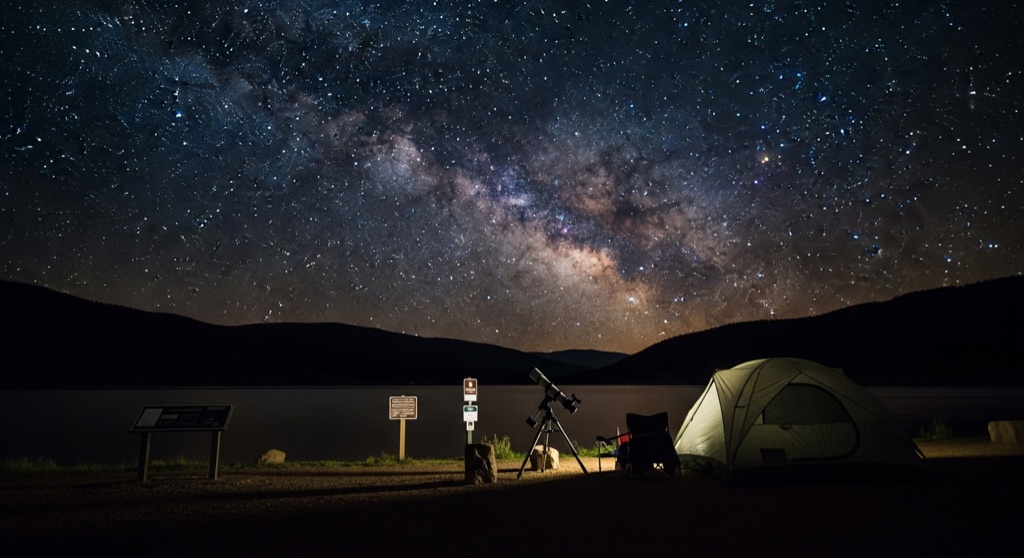
Jackson Lake was certified Colorado's first International Dark Sky State Park, with a Bortle Class 2 sky dark enough that the Milky Way is plainly visible to the naked eye. All park lighting is fully shielded and blue-light-free to protect the night. The park owns a self-aligning telescope and partners with the Northern Colorado Astro Society to run periodic star parties (typically scheduled in late summer and early fall), and the lakeshore campsites make it easy to stay out under the stars all night.
→ Three more after-dark & night-sky spots in Fort Collins — never the same twice
The story
Out on the high prairie of Morgan County, where the eastern plains bleed into empty agricultural flats, Jackson Lake feels like a mirage—until the sun drops below the horizon and the sky turns terrifyingly clear. In 2020, the International Dark-Sky Association designated this reservoir park as Colorado’s very first International Dark Sky State Park. While southern Colorado boasts high-desert dark sky havens, Jackson Lake pulled off something much harder: preserving a Bortle Class 2 sky barely 80 miles from the massive light pollution footprint of the Front Range urban corridor.
To earn and keep that designation, the park overhauled every fixture on site. Ordinary streetlamps and campsite lights were replaced with fully shielded, downward-facing, low-kelvin fixtures that drop warm, amber glow rather than throwing harsh blue light into the atmosphere. The result is a night sky where the band of the Milky Way casts actual shadows across the water on a moonless summer night, unmarred by city glow unless you look all the way to the western horizon.
What it's like
Arrive well before sunset to settle into your spot, because once darkness falls, headlights become the enemy—park rangers and serious stargazers actively frown on white flashlights, so bring red-lens torches or red tape for your phone. The vibe on the sandy shoreline during new moon weekends is quiet and reverent, populated by a mix of local campers and amateur astronomers unpacking massive Dobsonian telescopes. Campers on Reddit note that summer nights on the plains come with a heavy tax of mosquitoes near the water, so bug spray and long layers are non-negotiable if you plan to stay out past midnight.
The move: Book a lakeside campsite for a moonless weekend, hit a ranger-led telescope program, then lie back on the shore and watch the Milky Way arc over the water.
📍 Before you go About 70-80 miles from Fort Collins; standard state-park pass required. Most astronomy programs run May-August, and the darkest views are around the new moon.
- 📍 Orchard / Morgan County
- 💸 $
- ⚡ Low-key
- 🌗 Outdoors
Where: 26363 County Rd 3, Orchard, CO 80649
Hours: Added 2026-06-23 — confirm current hours before you go.
⚠ Seasonal or scheduled — always check before you go.
Pair it with
- Dearfield Ghost Town — Stop at the silent wooden ruins of Colorado's historic Black homesteading colony off Highway 34 on your drive east toward the reservoir before sunset.
- Lee Maxwell Washing Machine Museum — Pair an afternoon examining thousands of antique mechanical agitators in Eaton with an evening under unpolluted high-plains skies.
- Bruce's Bar — Grab a basket of fried Rocky Mountain oysters at Severance's notorious watering hole as fuel for your night on the reservoir shore.
More weird in Fort Collins
Good to know
How far is Jackson Lake from Fort Collins?
It is roughly 70 to 80 miles southeast of Fort Collins, taking about an hour and twenty minutes via CO-14 East and Weld County roads.
Do I need a special permit or ticket to view the stars?
No special astronomy ticket is required, but you will need a standard Colorado State Parks daily pass or annual keep-it-wild pass for your vehicle.
When are the organized star parties held?
The park collaborates with the Northern Colorado Astronomical Society for public telescope viewing events, typically scheduled between May and October around new moons.
Can I stay in the park all night without camping?
Night viewing is permitted, but booking a lakeside campsite (like those in the Cove or Pelican campgrounds) makes it much easier to stay out under the stars through the darkest hours without leaving the park.
Plan a visit & invite your people →
Further reading: cpw.state.co.us · 5280 · go-astronomy.com · Official site · Reddit
last checked: 2026-06-23