Entry No. 19 — the Fort Collins file — filed under: outdoor
Dearfield Ghost Town
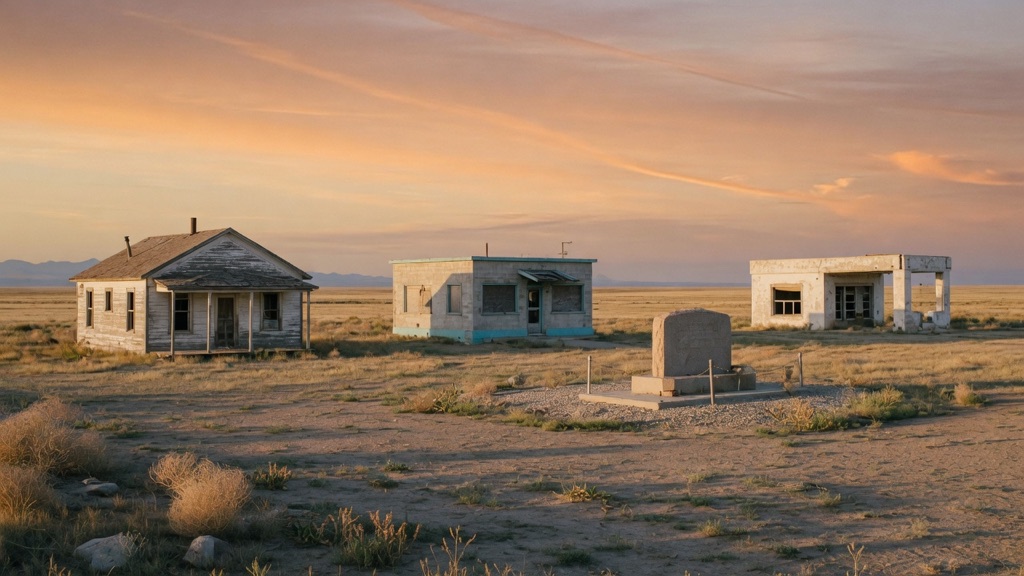
In 1910, Oliver Toussaint Jackson filed a homestead claim on the Weld County plains and built the largest Black agricultural colony in Colorado. At its 1921 peak, Dearfield held 300 residents, two churches, a school, a restaurant, a concrete-block factory, and farmland yielding sugar beets, alfalfa, and watermelons through dry-farming techniques. The Great Depression and Dust Bowl collapsed the community; by 1940 only twelve people remained, and Jackson died in 1948 as the last holdout. Listed on the National Register of Historic Places in 1995, the site preserves three original structures — a gas station, a diner, and Jackson's own home — alongside a 2010 monument that contextualizes what was once appraised at over one million dollars.
→ Three more abandoned & forgotten places in Fort Collins — never the same twice
The story
In 1910, Oliver Toussaint Jackson—a messenger for Colorado governors and an entrepreneur inspired by Booker T. Washington—filed a homestead claim on the sun-bleached plains east of Greeley. He called it Dearfield, because the land was dear to them. What started as seven families in dugouts grew into the premier Black dry-farming colony in the West, holding 300 residents at its 1921 peak with two churches, a school, a hotel, a concrete-block factory, a restaurant, and a valuation pushing past a million dollars.
The trick was dry farming: pulling sugar beets, alfalfa, and watermelons out of soil that received barely 14 inches of rain a year without irrigation. But when the rain stopped entirely in the 1930s, the Dust Bowl and Great Depression crushed the market and blew the topsoil away. The town evaporated. By 1940, only twelve people remained. Jackson stayed behind as the ultimate holdout, living in his house until his death in 1948.
Today, US-34 cuts right past what's left. Most drivers fly past at 65 mph without slowing down, leaving three graying wooden skeletons—Jackson's house, the filling station, and a diner—standing quiet in the prairie grass under a massive, flat Colorado sky.
What it's like
Pulling off US-34 onto the gravel shoulder, the first thing that hits you is the silence and the prairie wind. The three surviving structures are fenced off to prevent further collapse and vandalism, so you won't be stepping inside, but you can walk the perimeter and look straight through the open doorframes and weathered floorboards. There are no gift shops, no docents, no shade trees, and no bathrooms—just a stone monument erected in 2010 and the rattling prairie grass. Spend 20 minutes walking the grounds, read the historical marker, and absorb the eerie isolation before heading back out.
The move: Drive out on a flat-sky plains afternoon, read the monument together, and walk slowly around the three surviving buildings. The remoteness and silence give the history real weight — bring snacks and plan to talk on the drive home about what you saw.
📍 Before you go No facilities, shade, or services on site — bring water and sunscreen. The site sits on open plains and can be intensely hot in summer. Two-wheel-drive vehicles handle the access fine. The Black American West Museum in Denver manages preservation efforts; checking their site before visiting is worthwhile. No admission fee. Year-round access. From Fort Collins, budget about 1.5 hours each way via I-25 south to US-34 east.
- 📍 Orchard (Weld County)
- 💸 $$
- ⚡ Up for anything
- 🌗 Indoors
Where: 42468 US-34, Orchard, CO 80649
Hours: Added 2026-06-11 — confirm current hours before you go.
Pair it with
- Jackson Lake State Park (International Dark Sky Park) — Drive ten miles further east down US-34 after sunset to pair the silence of the ghost town with some of the darkest, stargazing-certified skies in Weld County.
- Greeley History Museum — Rattlesnake Kate's Snakeskin Collection — Break up the drive back toward Fort Collins by stopping in downtown Greeley to see another wild piece of 1920s eastern plains folklore.
- Lee Maxwell Washing Machine Museum — If you are already out in rural Weld County hunting down forgotten local history, this farm full of thousands of antique washing machines fits the offbeat plains itinerary.
More weird in Fort Collins
Good to know
How much does it cost to visit Dearfield?
It is completely free and open to the public year-round.
Can you go inside the buildings?
No. The surviving buildings are structurally fragile and fenced off for safety and preservation, though you can easily view them up close from the exterior.
Who owns and manages the site now?
The site is owned and preserved by the Black American West Museum & Heritage Center in Denver, with ongoing efforts to stabilize the remaining structures.
What amenities are on site?
None. There are no restrooms, trash cans, drinking water, or shade, so bring everything you need for the trip.
Plan a visit & invite your people →
Further reading: Wikipedia · nps.gov · uncovercolorado.com · pehc.colostate.edu · historycolorado.org · The Denver Post
last checked: 2026-06-11