Entry No. 97 — the Denver file — filed under: history
Ninth Street Historic Park
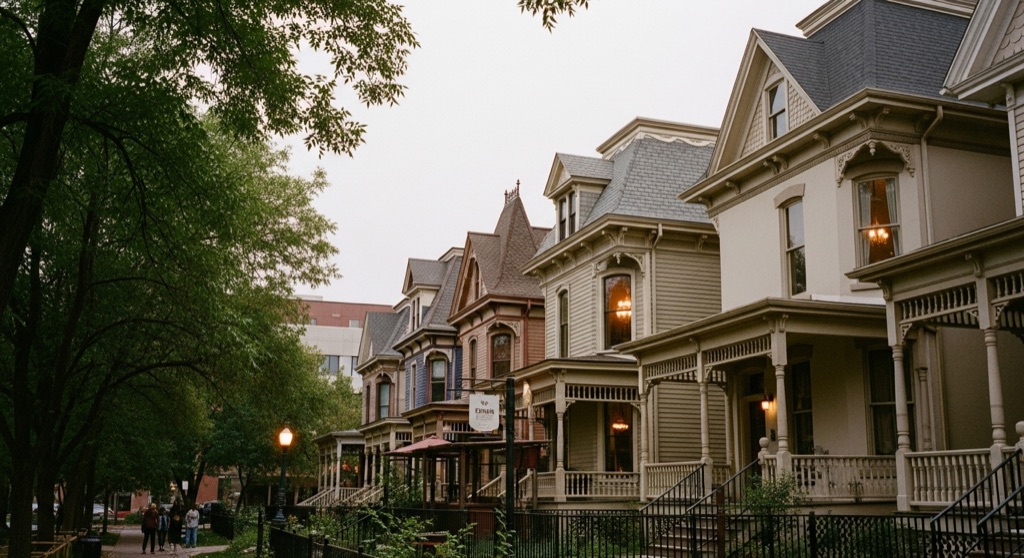
Tucked into the middle of a sprawling commuter campus is one intact block of 1870s-1900s Victorian houses — mansard roofs, scroll-sawn brackets, covered porches — that survived demolition by a grassroots fight in 1970. It's the oldest restored residential street in Denver, sitting on land that was an Arapaho meeting place and the original 1858 settlement of Auraria that became Denver. Almost nobody who isn't a student walks it; the cars on Speer and Colfax blow right past. The street between the homes is now a leafy pedestrian greenway with a couple of campus eateries tucked in.
→ Three more weird outdoor & roadside oddities in Denver — never the same twice
The story
In October 1858, prospectors pitched camp at the confluence of Cherry Creek and the South Platte River, naming their settlement Auraria—a full month before Denver City was established on the opposite bank. Long before gold hunters claimed it, the land served as an Arapaho meeting place. Once Denver annexed Auraria, wealthier residents migrated east, leaving West Denver to working-class German, Irish, Jewish, and Hispano families who raised modest Italianate and Victorian homes here between 1872 and 1906. Five of the structures went up before Colorado even achieved statehood in 1876, built of brick right after an 1874 city ordinance banned framed timber construction to prevent urban infernos.
When a devastating flood inundated Auraria in June 1965, the Denver Urban Renewal Authority saw a pretext to wipe the area clean. They planned to clear 169 acres to build the Auraria Higher Education Center campus. Hundreds of residents were relocated, but in 1970, a grassroots effort led by Historic Denver, Inc. drew a line along Ninth Street. Preservationists fought to spare one intact face block—14 historic homes and a 1906 corner grocery store—ripping up the asphalt road, laying down grass, and saving Denver's oldest residential street from demolition.
Today, Ninth Street operates as a secret enclave inside a sprawling commuter campus shared by three colleges. The homes—complete with mansard roofs, scroll-sawn brackets, and shaded front porches—aren't preserved behind velvet museum ropes; they house university administrative offices and campus eateries like Los Molinos. Thousands of commuters zip past on Speer Boulevard and Colfax Avenue every morning, unaware that an entire 19th-century residential block is hiding just beyond the concrete parking structures.
What it's like
Stepping off the downtown pavement onto Ninth Street feels like slipping through an unadvertised seam in the city grid. You won't find tourist signs pointing the way—aim for 9th Street between Champa and Curtis at the southwest corner of the Auraria Campus. In place of a paved street, you'll find a lush pedestrian lawn flanked by Victorian porches and brass plaques detailing the working-class families who lived in each house. On weekdays, university staff step between front doors and students eat lunch on porch steps, while weekends bring a quiet time-capsule silence. Park in a campus visitor lot or take the short walk over from downtown, grab a coffee or a bite inside the old 1906 corner store, and take twenty minutes to wander a block city planners almost erased.
The move: Wander the block reading the house plaques, then grab coffee or a bite at one of the campus cafes built into the old homes — a 20-minute time-capsule detour most Denver dates never make.
📍 Before you go The block sits at the southwest edge of Auraria, the shared campus for three Denver colleges, so there's no signage pointing tourists to it — aim for 9th Street between Champa and Curtis (near 1068 9th St) and you'll find the row. Easiest arrival is on foot from downtown or Larimer; if you drive, use a campus visitor lot or garage and walk in (rates and lot hours shift, so check ahead). Warm months are best, when the porches and shade trees do their work. While you're on campus, the historic 1864 Tivoli building (now the student union) is a short walk, and Ball Arena and Larimer Square are close enough to fold into the same outing.
- 📍 Auraria, Downtown Denver
- 💸 Free
- ⚡ Low-key
- 🌗 Indoor or outdoor
Where: 9th Street between Champa and Curtis, Auraria Campus, Denver (around 1068 9th St); southwest corner of campus, walkable from downtown.
Hours: Outdoor block is freely accessible; campus businesses inside the houses keep their own hours. Best on a weekday when the campus is alive, or a quiet weekend for the time-capsule feel.
Pair it with
- Understudy — A ten-minute walk northeast across Speer Boulevard pairs this saved 19th-century residential strip with another odd architectural space carved out of downtown Denver: an experimental art gallery tucked into a stairwell wedge inside the Colorado Convention Center.
- Ghost Saloon — Walk five minutes across Cherry Creek into Larimer Square to trade the daytime quiet of 1870s Victorian homes for a Prohibition-era speakeasy hidden behind a welcome room.
- Recollect Records — Head less than a mile south into Lincoln Park to follow up one surviving slice of West Denver's residential history with a crate-digger's vinyl sanctuary hidden inside a row-house storefront.
More weird in Denver
Good to know
Where is Ninth Street Historic Park located and how do I get there?
It sits on the southwest edge of the Auraria Campus at 9th Street between Champa and Curtis Streets (around 1068 9th St). It's a short walk from downtown Denver or Larimer Square; if driving, park in an Auraria Campus visitor lot or garage.
What are the hours and cost to visit?
The outdoor pedestrian greenway and park area are free and accessible year-round. The university offices and campus eateries operating inside the individual historic houses set their own business hours, generally open during weekdays.
What makes Ninth Street Historic Park historically significant?
Built between 1872 and 1906, it is the oldest restored residential block in Denver. It sits on land that was an Arapaho gathering area and part of the original 1858 Auraria townsite, surviving a 1970 urban renewal project that leveled 169 surrounding acres.
Can you go inside the historic houses?
The interiors are repurposed for Auraria Higher Education Center administrative offices, university spaces, and small campus dining options like Los Molinos (inside the 1906 grocery store building), so indoor entry depends on individual weekday business hours.
Plan a visit & invite your people →
Further reading: aurariacampus.edu · Wikipedia · uncovercolorado.com · coloradoencyclopedia.org · history.denverlibrary.org · Reddit
last checked: 2026-06-07