Entry No. 106 — the Denver file — filed under: history
Morrison Natural History Museum
“baby Stegosaurus tracks small enough to be covered by a coffee mug”
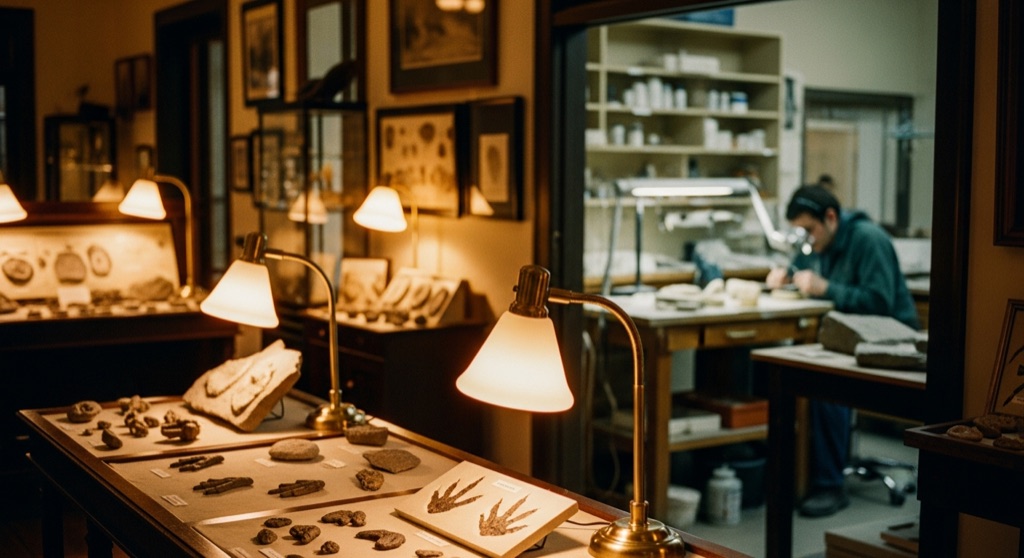
This storefront-sized museum south of Morrison is so small you'd drive past it on the way to Red Rocks, but its staff actually discovered baby dinosaur trackways in the foothills — including running infant-sauropod prints and baby Stegosaurus tracks small enough to be covered by a coffee mug. There's an open fossil-preparation lab where you can watch researchers chip rock under a magnifier, and many of the specimens out front were found within a few miles. It punches so far above its size that the discoveries made national science press.
→ Three more oddity shops & curiosities in Denver — never the same twice
The story
In 1877, a local schoolmaster named Arthur Lakes uncovered massive fossilized bones in the sandstone hogbacks surrounding Morrison, sparking the infamous 'Bone Wars' between rival paleontologists O.C. Marsh and Edward Drinker Cope. Lakes shipped specimens back East, helping name the world's first Stegosaurus and Apatosaurus skeletons, before reportedly covering or blowing up his legendary 'Quarry 10' to keep Cope from looting it. The exact site sat lost for 123 years until 2002, when Morrison Natural History Museum director Matthew Mossbrucker decoded Lakes' original 19th-century field notes and watercolor sketches to relocate the forgotten dig.
You wouldn't expect a venue squeezed into a modest building along Colorado Highway 8 to rewrite scientific literature, but its researchers continually outpunch their size. Scrutinizing local Late Jurassic rock layers that larger expeditions had walked past for decades, museum staff uncovered the trace footprints of baby dinosaurs. Their discoveries include running infant sauropod tracks—proving young long-necked brontosaurs could sprint on their hind legs 148 million years ago—and baby Stegosaurus footprints so small you can completely cover one with a standard coffee mug.
Rather than stashing bones behind glass walls, the museum functions as a working research laboratory. The upper floor houses an open fossil-preparation lab where visitors watch staff chip rock away under magnifiers, inspect unstudied dig materials, and talk paleontology directly with researchers—including volunteer curator Dr. Robert T. Bakker. Between hands-on fossil touchables and tour guides who actively participate in local digs, it offers direct access to active fieldwork inside a space barely bigger than a single-family home.
What it's like
Pulling up to 501 Colorado Highway 8 just south of downtown Morrison, you will find free on-site parking outside a building that looks more like a small municipal office than a major paleontology center. Admission includes an hourly guided walk-through, so time your visit around the tour schedule or check the town's site beforehand to avoid waiting around. The guide leads you through touch-friendly fossil displays before ending upstairs at the prep lab, where staff field questions while dusting matrix off real dinosaur bones. It gets cozy inside when full, but the small tour groups mean you get direct access to actual researchers without pushing through a crowd.
The move: Spend an hour geeking out over coffee-mug-sized dino footprints and watching the prep-lab work, then drive ten minutes up to Red Rocks for sunset — small-museum charm followed by a big view.
📍 Before you go It sits right on Colorado Highway 8 (CO-8) in south Morrison, on your right as you head out of downtown — easy to blow past on the Red Rocks run, so watch for the sign. There's free parking on-site. This is a small, tour-led museum: admission includes a guided walk-through and a prep-lab visit, with tours at set times through the day, so aim to arrive aligned with one (times shift seasonally — check ahead). It's an indoor stop, good year-round and a solid rainy-day pick. Pair it with Red Rocks Park or nearby Dinosaur Ridge, then wander historic downtown Morrison's cafes a couple of minutes north.
- 📍 Morrison
- 💸 $
- ⚡ Low-key
- 🌗 Indoors
Where: Morrison Natural History Museum, 501 Colorado Highway 8, Morrison, CO (just south of downtown Morrison)
Hours: Small museum with a modest admission fee; hours are limited (typically daily but check the town of Morrison site before going). Tours and the prep lab are part of the visit.
Pair it with
- Mount Morrison South Ridge Trail — Hike the steep, unofficial south ridge of Mount Morrison looming directly over Red Rocks right after learning about the Jurassic rock layers beneath it.
- Tiny Town & Railroad — Trade 148-million-year-old baby dinosaur trackways for a century-old collection of 100-plus hand-crafted miniature buildings just three and a half miles down the road.
- Walker Mansion Ruins and Unfinished Summer White House — Head two miles up Mount Falcon to see the lightning-gutted stone chalet ruins of John Brisben Walker after exploring Morrison's prehistoric history.
- Piggin' Out Smokehouse — Grab smoked brisket in a converted red shack in Lakewood less than five miles east along Morrison Road to round out a low-key outing.
More weird in Denver
Good to know
Where is the Morrison Natural History Museum located?
It sits at 501 Colorado Highway 8 in Morrison, Colorado, just south of downtown Morrison on the right side of the road.
Do I need a guided tour to see the museum?
Admission includes a guided tour led by museum staff or paleontology interns, which runs on an hourly schedule throughout the day and covers the exhibits and prep lab.
What major paleontological discoveries happened here?
Museum staff relocated Arthur Lakes' lost 1877 Quarry 10 using historic field journals, and discovered rare Late Jurassic infant dinosaur tracks, including running baby sauropod prints and coffee-mug-sized baby Stegosaurus footprints.
Are visitors allowed to touch the fossils?
Yes. Unlike typical museums, touchable specimens are built directly into the guided experience, allowing visitors to feel real fossilized bones and observe researchers working in the prep lab.
Plan a visit & invite your people →
Further reading: Wikipedia · Official site · Atlas Obscura · eurekalert.org · sciencedaily.com · smithsonianmag.com
last checked: 2026-06-07