Entry No. 135 — the Denver file — filed under: haunted
Lafayette Vampire Grave (Fodor Glava)
“the tree growing from his plot … said to have sprouted from that very stake”
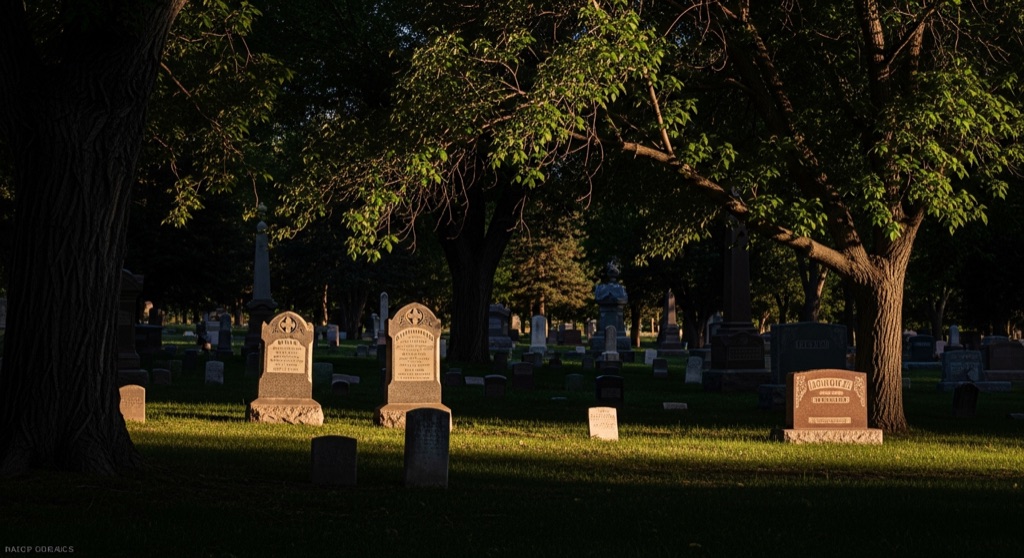
Teodor "Fodor" Glava, a Transylvanian coal miner who died in the 1918 flu pandemic, was buried here and became Lafayette's enduring vampire legend — locals allegedly staked his exhumed body, and the tree growing from the center of his plot is said to have sprouted from that very stake. Visitors still regularly leave roses, rosaries, and tokens on the grave, making it a living piece of Colorado folklore.
→ Three more haunted places & dark-history spots in Denver — never the same twice
The story
In December 1918, a 41-year-old Romanian immigrant named Teodor "Fodor" Glava died of the flu while working as a coal miner at Lafayette's Simpson Mine. He was buried in the pauper's section of the municipal cemetery, sharing a flat concrete headstone made by a friend with fellow Romanian miner John Trandafir. The slab was roughly carved with Glava's name, year of death, and his birthplace: Transylvania. In a small Colorado coal town in the early 20th century, that single geographical detail was all it took to set off decades of paranoid lore.
The legend gained momentum in the mid-20th century—first as a scare tactic local parents used to enforce curfews, then morphing into full gothic melodrama. According to the town rumor mill, suspicious residents exhumed Glava's body, mistook the natural signs of body decomposition (blood near the mouth and receding gums) for proof of vampirism, and drove a wooden stake through his chest. A tree allegedly sprouted from that very stake, while a nearby rose bush was said to grow straight from his ever-lengthening fingernails.
The reality is far more bittersweet than blood-drinking: Glava was just a hardworking miner who succumbed to a global pandemic thousands of miles from his wife back home. Yet the inscription "trandofir"—the Romanian word for rose—carved into his stone continues to draw night owls and lore hunters. They still gather at the plot to leave coins, rosaries, and fresh cut flowers on the flat headstone.
What it's like
Finding the spot in the cemetery's older northwest section takes a watchful eye—the marker rests flat in the turf roughly 20 feet south of the paved exit road coming from the Bob Burger Recreation Center. You'll spot the tree standing near the headstone and a small mound of coins, rosaries, and withered flowers left by curious travelers. This is an active municipal cemetery, so keep your voice low and respect the grounds. Go at dusk during late autumn for the best slanting light and eerie atmosphere, then take the five-minute drive into Old Town Lafayette for dinner.
The move: Visit the grave in the older NE section of Lafayette Municipal Cemetery at dusk, leave a rose as tribute (the Romanian word "trandofir" meaning rose is carved on his stone), then walk the quiet historic cemetery before heading to nearby Lafayette's downtown for a late dinner — the whole outing takes under two hours and pairs eerie atmosphere with genuine local history.
📍 Before you go The cemetery sits at 111th and Baseline (north of Baseline/Hwy 7, about a half-mile east of US 287); park along the lane inside or by the adjacent Bob Burger Recreation Center. Glava's grave is in the older northwest third, in the Potter's Field area roughly 20 feet south of the paved exit road from the rec center — look low, as it's a flat, easy-to-miss flat marker reading "Transylvania" among the trees. This is an active municipal cemetery, so keep voices down and be respectful of other visitors and graves. Dusk and the autumn Halloween stretch draw the most pilgrims and the eeriest light. Downtown Lafayette's Old Town strip is a five-minute drive for dinner after.
- 📍 Lafayette
- 💸 $$
- ⚡ Up for anything
- 🌗 Indoors
Where: Lafayette Municipal Cemetery, 290 N 111th St, Lafayette, CO 80026
Hours: Mined 2026-06-07 — confirm current hours before you go.
Pair it with
- Little Horse Vintage (and the Electric Room) — Follow up a quiet twilight graveyard stroll with a dive into vinyl stacks and hidden drinks in neighboring Louisville.
- Niwot Tree Carvings (Eddie Running Wolf) — Pair the lore of the grave's tree with massive wooden figures carved from dead willow stumps by Arapaho artist Eddie Running Wolf.
- Fiske Planetarium Laser & Liquid Sky Shows — Trade macabre ground-level folklore for an evening under CU Boulder's 65-foot dome catching trippy laser and light shows.
- Dickens Opera House — Double down on Boulder County's haunted history with dinner and drinks inside Longmont's restored 1881 Victorian opera house.
More weird in Denver
Good to know
Where is the grave located inside the cemetery?
It sits in the older northwest third (the Potter's Field area) near 111th and Baseline, about 20 feet south of the paved exit path from the Bob Burger Recreation Center.
Who was Fodor Glava in real life?
He was Teodor "Fodor" Glava, a 41-year-old immigrant coal miner from Romania who worked at the Simpson Mine and died during the 1918 flu pandemic.
Did townspeople actually stake his body?
No. Local historians confirm the exhumation and staking stories are urban legends that originated decades after his death, inspired by his Transylvanian origin on the stone.
What should I bring as a tribute?
Visitors traditionally leave small coins, rosaries, or red roses on the flat headstone (a nod to "trandofir," the Romanian word for rose carved into the concrete).
Plan a visit & invite your people →
Further reading: Atlas Obscura · Roadside America · Official site · Wikipedia · Westword · Reddit
last checked: 2026-06-07