Entry No. 75 — the Denver file — filed under: park
Carpio-Sanguinette Park (Former Sewage Treatment Plant)
“You're literally picnicking on top of where Denver's waste used to bubble”
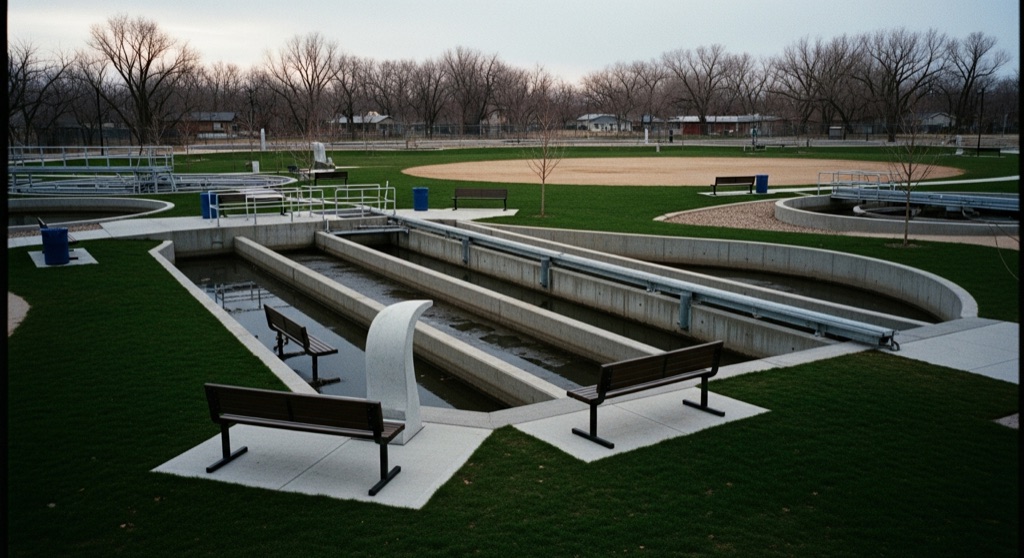
On the north bank of the South Platte in Globeville sits a park almost nobody visits, built directly on top of a 1937 sewage treatment plant. When the city reclaimed it in 1999 they didn't bulldoze the infrastructure — they kept the concrete settling ponds, aeration raceways, and sand-filter walls and turned them into benches, sculptures, and the boundaries of the ball fields. It quietly won an American Society of Landscape Architects design award for the reuse. You're literally picnicking on top of where Denver's waste used to bubble.
→ Three more weird outdoor & roadside oddities in Denver — never the same twice
The story
In 1937, Denver built the Northside Wastewater Treatment Facility along a quiet bend of the South Platte River in Globeville to process the city's raw waste. By 1966, larger downstream facilities made the plant obsolete, and city officials simply locked the gates and walked away. For nearly thirty years, the concrete settling basins, aeration raceways, and sand-filter vats sat rotting behind overgrown weeds—a fenced-off industrial wasteland dubbed 'Pirate Island' by local kids who snuck in to spray-paint the crumbling tanks.
When Denver finally set out to reclaim the 13-acre parcel in 1995, standard civic playbooks called for bulldozing the remains. Instead, landscape architecture firm Wenk Associates took a surprisingly thrifty approach: keep the bones. They sliced concrete settling ponds into retaining walls, turned circular holding tanks into outfield perimeters for ball fields, and repurposed aeration channels into long park benches. In 2001, the American Society of Landscape Architects gave the design a merit award for proving you can turn a decommissioned sewage plant into public green space without obliterating its raw history.
In 2017, the city officially renamed the space Carpio-Sanguinette Park, honoring former city councilman Sal Carpio and the pioneer Sanguinette family who homesteaded in Globeville back in 1876. You didn't hear it from us, but this remains one of the weirdest public parks in Colorado: an open-air industrial ruin where neighborhood quotes are stamped directly into concrete slabs that once held millions of gallons of Denver's wastewater.
What it's like
Visiting Carpio-Sanguinette Park feels less like visiting a standard city park and more like taking a walk through an abandoned infrastructure plant that someone happened to mow. Tucked away in Globeville between heavy railyards and the I-70/I-25 interchange, the park is open, wind-swept, and rarely crowded. You can enter off Washington Street or pedal in via the South Platte River Trail, wandering past giant concrete arcs and former sand filters still plastered with local street art. Wear sturdy walking shoes and visit during daylight to read the old plant structures—and keep in mind that on hot summer afternoons, ambient smells from nearby industrial rendering plants will quickly remind you you're in the working heart of the city.
The move: Bring coffee and walk the grounds reading the old plant structures like an industrial scavenger hunt, then link onto the South Platte River Trail / 9 Creeks Loop for a longer riverside stroll.
📍 Before you go This is a quiet, easy-to-miss 14-acre park in Globeville, on the north bank of the South Platte just above the National Western Complex (the Stock Show grounds) — easiest to find via the entrance and parking lot on the northeast side, with a second access point to the southwest. Globeville is a working industrial-residential pocket boxed in by railyards and the I-70/I-25 interchange, so it feels off the map; come in daylight to actually read the old plant structures, and steer clear of late January when the Stock Show packs the area. Wear real shoes — it's open and exposed, best in milder shoulder-season weather. Pair it with a walk or ride on the adjoining South Platte River Trail / 9 Creeks Loop, which runs south toward Confluence Park. No admission; hours are standard city-park daylight, but check ahead.
- 📍 Globeville
- 💸 Free
- ⚡ Low-key
- 🌗 Outdoors
Where: Carpio-Sanguinette Park, Globeville, Denver, CO — north bank of the South Platte River (near the 4900-5000 block of N. Washington St / Globeville Rd area), built atop the former Northside Wastewater Treatment Facility
Hours: Public city park, generally accessible during daylight / standard Denver park hours (roughly 5am-11pm). No admission. Best in daylight to actually read the old plant structures.
Pair it with
- Laughing Escalator — Follow up your walk through repurposed sewage basins with another strange piece of municipal infrastructure—a downtown escalator that cackles at riders from underneath its steps.
- Old Elitch Carousel Dome (with floor labyrinth) — Pair one salvaged 20th-century landmark with another by heading over to Berkeley to inspect a 1926 amusement park carousel pavilion adapted for neighborhood life.
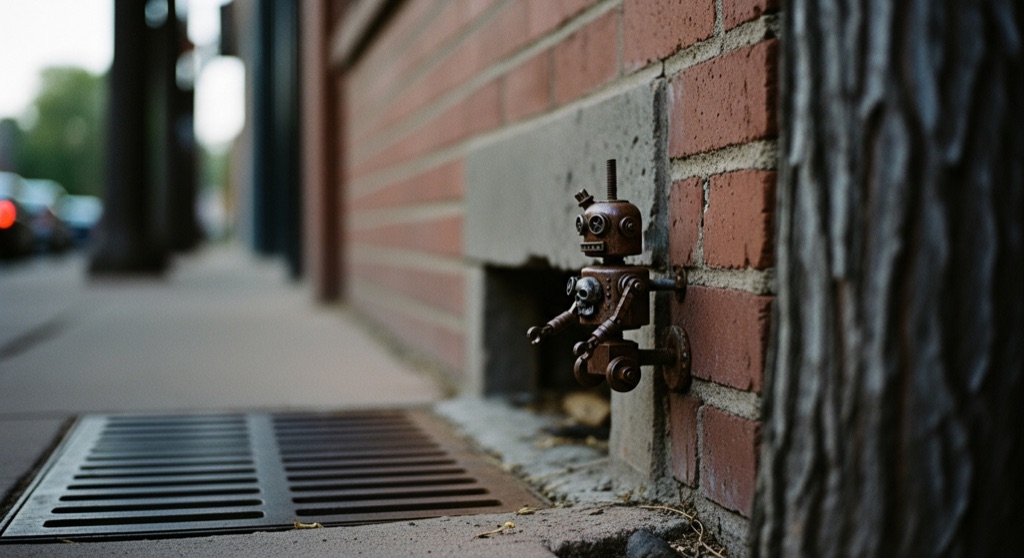
- Impossible Winterbourne Steampunk Street Sculptures — Keep the industrial salvage theme going by hunting for tiny, hand-sculpted metal robots bolted onto utility posts across central Denver.
More weird in Denver
Good to know
Where is Carpio-Sanguinette Park located?
It is located on the north bank of the South Platte River in Denver's Globeville neighborhood, near the 4900-5000 block of North Washington Street and Globeville Road [1.1.1].
Why are there concrete structures inside the park?
The park was built on the site of the 1937 Northside Wastewater Treatment Facility; when redeveloped in the late 1990s, original settling tanks, walls, and filtration beds were retained and converted into benches, walls, and field boundaries.
Does the park still smell like sewage?
No, the sewage plant closed in 1966. However, Globeville remains an active industrial pocket, so nearby rendering and recycling facilities can produce heavy odors on warm, windless days.
What are the hours and cost to visit?
It is a free public Denver city park open during standard daylight hours, roughly 5:00 AM to 11:00 PM.
Who are Carpio and Sanguinette?
The park was renamed in 2017 to honor Sal Carpio, one of Denver's early Hispanic city council members, and the Sanguinette family, who first settled in Globeville in 1876.
Plan a visit & invite your people →
Further reading: Atlas Obscura · globevillestory.blogspot.com · etbtravelphotography.com · tclf.org · Reddit
📷 We made a card for this one on Instagram →
last checked: 2026-06-07