Entry No. 27 — the Dallas file — filed under: brothel-history
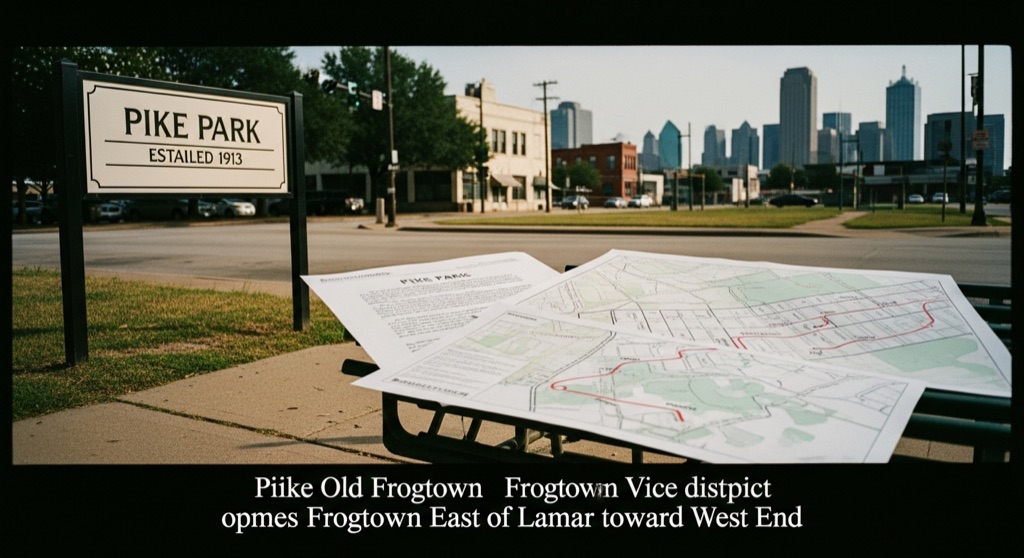
Pike Park (last trace of Frogtown red-light district)
“some 400 women worked until… ordered out by 6pm on November 3, 1913”
By 1910 city ordinance, Dallas penned its prostitution into a vice district nicknamed 'Frogtown' (for the frogs croaking along a Trinity-fed branch), where some 400 women worked until the women were ordered out by 6pm on November 3, 1913. The district was bulldozed into today's West End and Uptown; Pike Park, opened in 1913 as Summit Play Park, survives as one of the few structures left from that vanished red-light era.
→ Three more haunted places & dark-history spots in Dallas — never the same twice
The story
In 1910, Dallas city officials decided to stop pretending and officially penned the city’s red-light trade into a swampy, ten-block enclave north of downtown. The neighborhood earned its nickname—Frogtown—from the thousands of frogs croaking along Dallas Branch Creek, a Trinity-fed stream that regularly flooded the cheap tenements. Some 400 women worked the brothels here under official municipal tolerance until moral reformers and the Dallas Council of Churches finally backed city hall into a corner, forcing an ultimatum: clear out by 6:00 PM on November 3, 1913, or go to jail.
When the brothels were cleared, the land didn't stay vacant. The exact same marshy ground had already housed Eastern European Jewish refugees fleeing 1890s pogroms (who knew the area as Goose Valley or Little Jerusalem), and by 1911, thousands fleeing the Mexican Revolution moved in, transforming the precinct into Little Mexico. Seeking to clean up the former vice zone, city leaders opened Summit Play Park on the site in 1913, building a red-tile-roofed Mission Revival field house and a central gazebo in 1914.
Subsequent urban renewal and the construction of the Dallas North Tollway smashed through Little Mexico and erased nearly every physical trace of Frogtown, swallowing the old vice blocks into modern Uptown and the West End. Renamed in 1927, Pike Park survives as the sole physical anchor sitting directly on ground that held a 19th-century immigrant haven, a city-sanctioned brothel district, and the original cultural core of Dallas's Mexican-American community.
What it's like
You will pull into a small parking lot directly off Harry Hines Boulevard, where the park sits sandwiched between modern office towers and highway access ramps. The 1914 field house with its distinct red-tile roof and the historic gazebo anchor the green, but because the recreation building itself is permanently closed to the public, treat this as a daylight, open-air historical stop. It remains an active neighborhood park with shade trees and a little league diamond, so keep your visit respectful of locals using the space. The best way to experience it is as a starting point: inspect the field house and gazebo, then walk east toward Lamar Street and into the West End, reading up on the 1910s brothel history as you trace the ghost perimeter of the vanished vice district before grabbing a drink.
The move: Make it a walking history scavenger hunt: meet at Pike Park, then trace the old Frogtown footprint east of Lamar toward the West End while reading the lurid 1910s brothel history aloud. End with a drink in the West End and debate which buildings might be the 'handful' of originals still standing.
📍 Before you go Pike Park sits at the Uptown edge near the West End, just off Harry Hines Boulevard with its own small parking lot — easy to reach but easy to drive past, so look for the red-tile-roofed 1914 field house and gazebo, the landmark structures that anchor the green. The recreation building has long been closed, so treat this as an open-air, daylight stop. The same ground later became Little Mexico, layering Jewish, Mexican, and red-light history. Go in cooler months to walk comfortably east toward the West End and Uptown, where bars make a natural finish. It is a working neighborhood park, so be respectful of anyone using it.
- 📍 Uptown (near the West End)
- 💸 Free
- ⚡ Up for anything
- 🌗 Outdoors
Where: 2807 Harry Hines Blvd (Pike Park), Dallas, TX
Hours: Public park, daylight hours; Frogtown itself no longer exists -- this is a history-walk, not a single site.
Pair it with
- Freedman's Cemetery Memorial — Pair this stop with another heavily erased piece of Dallas history just over a mile away, where a historic 1860s Black burial ground was paved over by highway expansion.
- AKAI (at Musume) — After tracing the ghost footprint of Frogtown on foot, head less than a mile south into the Arts District for a covert drink tucked behind a sushi restaurant kitchen.
- Giant Eye Sculpture (Joule Hotel) — Continue your history walk south toward downtown to view a surreal, 30-foot fiberglass eyeball staring out from a hotel courtyard.
- Room 520 — Cap off an open-air trek through former vice territory with a cocktail inside a tiny, 15-seat speakeasy disguised as a hotel guest room.
More weird in Dallas
Good to know
Where is Pike Park located?
It sits at 2807 Harry Hines Boulevard on the boundary between Uptown and the West End, featuring a small dedicated parking lot right off the main road.
Can you go inside the historic field house?
No, the 1914 recreation building is closed to the public, meaning Pike Park is strictly an outdoor, daylight visit.
Why was the red-light district called Frogtown?
It was named for the noisy frog population along Dallas Branch Creek, a low-lying Trinity River tributary that frequently flooded the surrounding streets.
When was Frogtown officially shut down?
Under pressure from church leaders, city authorities gave the brothel workers a firm deadline to evacuate by 6:00 PM on November 3, 1913.
Plan a visit & invite your people →
Further reading: davidkirkpatrick.wordpress.com · dmagazine.com · cityofdallaspreservation.wordpress.com · preservationdallas.org
last checked: 2026-06-06