Entry No. 33 — the Dallas file — filed under: cemetery
Freedman's Cemetery Memorial
“the headstones removed and the land turned into a lawn”
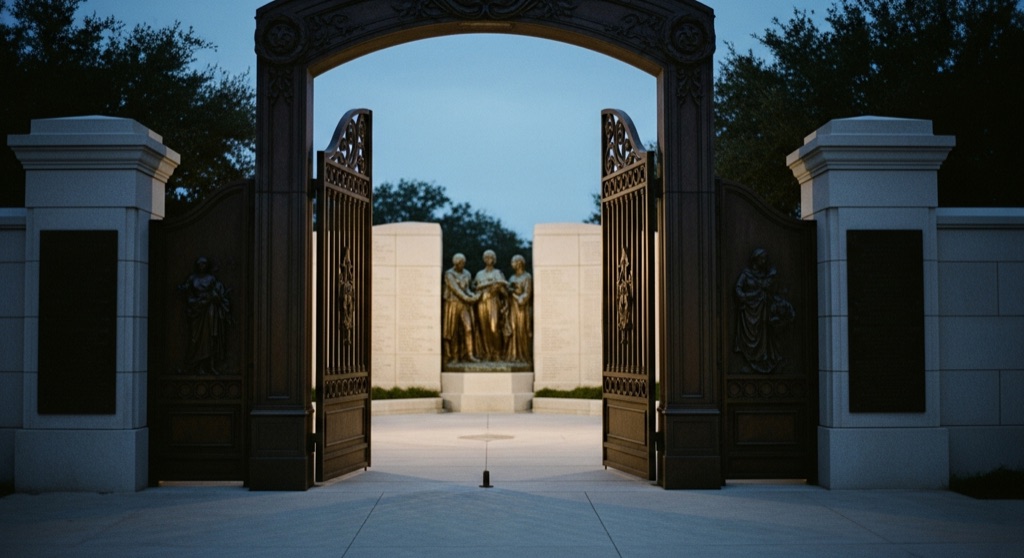
An 1860s burial ground for Dallas's formerly enslaved community that was literally paved over by the North Central Expressway in the 1940s -- the headstones removed and the land turned into a lawn -- until a 1990 road project rediscovered some 800 marked and an estimated 1,200 unmarked graves. The land is now a haunting bronze-and-granite memorial gateway.
→ Three more haunted places & dark-history spots in Dallas — never the same twice
The story
Drive up the North Central Expressway frontage road at 50 mph and you'll pass two acres of bronze and granite tucked between a strip mall and the highway ditch. You're looking at what city planners tried to pave over. Established in the 1860s as a burial ground for Dallas's formerly enslaved community, Freedmen's Cemetery became the final resting place for over 5,000 Black residents [1.1.2]. By the 1940s, the city wanted a highway, so they stripped away the headstones, turned the land into a smooth lawn, and poured asphalt over the graves for the North Central Expressway. Out of sight, out of mind—until a 1990 road expansion project forced Dallas to dig back into its own past.
When state archaeologists surveyed the dirt for the widening project, they uncovered what officials had conveniently forgotten: over 1,000 intact remains, including 800 marked graves and an estimated 1,200 unmarked ones. The city couldn't simply scrape them away a second time. Instead, Detroit sculptor David Newton was brought in to design a permanent memorial. He framed the perimeter with massive bronze figures—including the Sentinel holding a West African ceremonial machete pointed at the dirt and the Prophetess clutching a harp—and embedded poems written by local school children directly into the granite walls.
What stands here today is less of a polished city park and more of an open-air confrontation with municipal amnesia. Right across the grass sits the still-active Temple Emanu-El Cemetery, offering a stark visual contrast in how different communities were permitted to protect their dead. You won't find a visitor center or docents handing out brochures here—just thousands of forgotten souls beneath your feet and the dull, relentless hum of commuter traffic echoing off the concrete highway barrier.
What it's like
Finding the memorial takes concentration because it sits right in the tight elbow where Lemmon Avenue meets the US-75 frontage road, easy to overshoot if you're keeping pace with highway traffic. Park in the shopping center lot directly to the south, walk up to the arched granite gateway, and the roar of six lanes of traffic immediately surrounds you. There are no restrooms, shade structures, or staff on site. Plan your visit for late afternoon or dusk, when the lower sun highlights the bronze sculptures and makes the engraved children's poetry legible on the granite walls. Treat the ground respectfully—it remains an active burial site—and take twenty solemn minutes to walk the perimeter before slipping into the quiet streets of the adjacent State-Thomas historic district.
The move: Visit at dusk to walk through the dramatic bronze entry gates and read the sculpted figures and inscriptions; it's a sobering, conversation-deep stop. Pair it with a quiet stroll through the adjacent State-Thomas historic homes afterward.
📍 Before you go The memorial is small, roughly two acres, and sits at the southwest corner where Lemmon Avenue meets North Central Expressway in Uptown — easy to blow past at highway speed, so slow down on the frontage and aim for the arched granite gateway as your landmark. It's a fully exposed, roadside open-air site with no visitor center or facilities, and there's parking in the shopping center just south of it. Daylight makes the inscriptions and figures legible; any season works. This is a real burial ground and a solemn memorial, not a picnic park, so keep it low and respectful. It's one of a cluster of four historic Uptown cemeteries here — the still-active Temple Emanu-El Cemetery sits immediately west.
- 📍 Uptown / State-Thomas
- 💸 Free
- ⚡ Low-key
- 🌗 Outdoors
Where: Calvary St & N Central Expressway, Dallas, TX
Hours: Outdoor memorial; daylight hours recommended.
Pair it with
- Dolly Python — After contemplating forgotten history, head half a mile east to Dolly Python to browse taxidermy, postmortem photography, and oddities collected from Dallas's past.
- La Viuda Negra — Decompress after a sobering walk at this tiny speakeasy mezcaleria tucked discreetly behind a bridal shop storefront in Old East Dallas.
- Pike Park (last trace of Frogtown red-light district) — Follow the thread of erased Dallas history a mile west to Pike Park, the last physical trace of the city's 1910 sanctioned vice district.
More weird in Dallas

Good to know
Where do I park when visiting Freedman's Cemetery Memorial?
Park in the retail shopping center lot immediately south of the memorial. The site sits on a two-acre roadside corner with no dedicated parking lot or visitor facilities.
Is there an admission fee, and what are the hours?
It is completely free and open to the public. Because it is an unlit outdoor memorial without staff or indoor facilities, visiting during daylight hours or dusk is recommended.
Are people still buried beneath the memorial ground?
Yes. While archaeologists excavated and carefully documented over 1,000 graves during the 1990s highway project, the site remains the permanent burial ground for thousands of early Dallas residents.
Can I hold a picnic or gather socially on the lawn?
No. This is a real historic cemetery and a solemn memorial, not a recreational park. Visitors are expected to remain respectful and keep noise levels low.
Plan a visit & invite your people →
Further reading: Wikipedia · dallaspioneer.org · texasobserver.org
last checked: 2026-06-06