Entry No. 47 — the Coeur d'Alene file — filed under: roadside-oddity
Treaty Rock
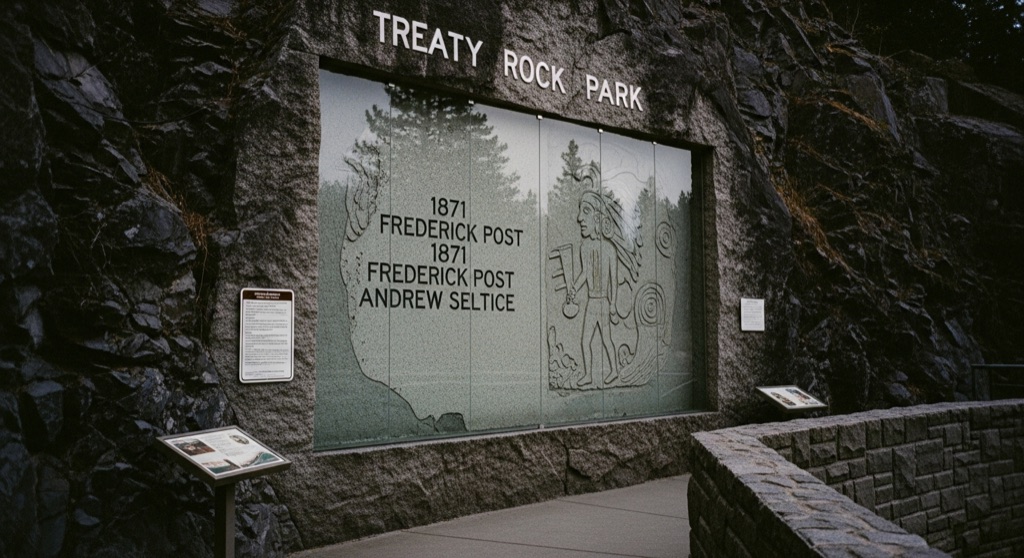
Tucked into a small park off a residential street is a granite cliff face inscribed with the record of an 1871 land deal between settler Frederick Post and Coeur d'Alene leader Andrew Seltice for the riverside acreage where Post built his mill. Carved into the rock are Post's name, the date June 1, 1871, and pictograph figures, an unusual bit of frontier documentation. The engraved section is now shielded behind plexiglass and reached by a short walking trail in Treaty Rock Park, which is on the National Historic Register.
→ Three more weird outdoor & roadside oddities in Coeur d'Alene — never the same twice
The story
In June 1871, most frontier land transactions involved reams of legal paper and federal bureaucrats who took years to file a deed. German-born settler Frederick Post took a far more permanent approach. Needing water rights along the Spokane River to construct a sawmill, Post struck a verbal land deal with Chief Andrew Seltice of the Coeur d'Alene Tribe. To mark the agreement, someone walked over to a granite cliff face with a chisel and carved the terms directly into the stone.
What makes the cliff face strange isn't just the medium—it's the collision of worlds on a single rock slab. Etched into the granite are the block letters of Post's name, the date "June 1, 1871," and traditional Native American pictographs. It stands as a rare piece of frontier documentation where a private land deal and indigenous rock markings exist side-by-side on the exact same outcrop.
As decades passed, the sawmill spawned the town of Post Falls, and the granite cliff was eventually surrounded by suburban housing. Today, Treaty Rock sits inside a dedicated public park on the National Register of Historic Places, its historic carvings preserved behind a heavy shield of clear plexiglass to keep modern vandals from altering the 1871 contract.
What it's like
You will pull up to a suburban street in Post Falls, step onto a short, shaded trail through ponderosa pines, and find yourself face-to-face with a granite ledge flanked by backyard fences. The carved section sits behind a sheet of plexiglass that can produce heavy glare on sunny afternoons, so you may need to tilt your head to clearly make out the chiseled '1871' and the nearby pictograph markings. It is a quick ten-minute stop with no crowds, perfect for standing in the quiet shadow of a rock wall while reading a 150-year-old real estate deal.
The move: Take the short trail to the carved rock together, read the strange stone 'contract,' then continue down to the Spokane River falls that gave the town its name.
📍 Before you go From I-90 exit 5, head north on Spokane St then follow signs to Treaty Rock Rd; a short walking trail leads to the rock.
- 📍 Post Falls, Idaho
- 💸 Free
- ⚡ Up for anything
- 🌗 Outdoors
Where: 701 N. Compton St., Post Falls, ID
Hours: Added 2026-06-24 — confirm current hours before you go.
Pair it with
- The Racketeer Lounge — Located just half a mile down the road, you can follow up a stone frontier contract with a poured absinthe in a low-lit cigar bar.
- Old School Liquor Bar — Drive four miles east to continue the regional historical tour inside a repurposed 1920 brick schoolhouse.
- Guardians of the Lake (Giant Feathers) — Head toward Coeur d'Alene to see another physical marker of local tribal culture in the form of two 25-foot steel feathers.
More weird in Coeur d'Alene
Good to know
What is actually chiseled into Treaty Rock?
The rock face features the surname 'Post,' the date 'June 1, 1871,' and several Native American pictograph figures and symbols carved into the granite.
How do you find the park?
Take Exit 5 off I-90, head north on Spokane Street, and follow the road signs toward Treaty Rock Road. The trailhead and park are located at 701 N. Compton Street.
Is there an entry fee?
No, Treaty Rock Park is a free public city park open to visitors year-round during daylight hours.
Why is the rock covered in plastic?
A transparent plexiglass barrier was mounted over the carved surface to protect the historic inscriptions from graffiti and physical weathering.
Plan a visit & invite your people →
Further reading: hmdb.org · spokanehistorical.org · postfallsidaho.org · history.idaho.gov · museumni.org · Atlas Obscura
last checked: 2026-06-24