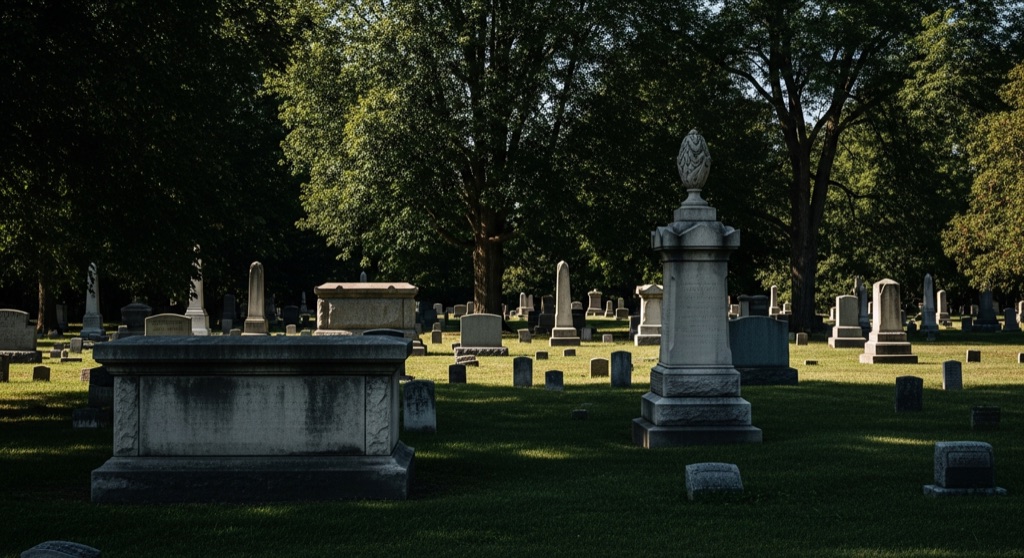
Entry No. 96 — the Chicago file — filed under: haunted
Read-Dunning Memorial Park
This quiet 3-acre park sits on top of roughly 38,000 unmarked dead -- 19th-century Cook County poorhouse residents, insane-asylum patients, Great Chicago Fire victims, and Civil War veterans -- a potter's field that vanished from public memory until 1989, when construction crews digging nearby hit bone and uncovered three separate burial grounds.
→ Three more haunted places & dark-history spots in Chicago — never the same twice
The story
If you walk down West Belle Plaine Avenue on Chicago's Northwest Side, you're standing on top of roughly 38,000 unmarked bodies. Starting in 1854, Cook County set aside 320 acres here for a poorhouse, infirmary, tuberculosis hospital, and insane asylum—a dumping ground for anyone the city couldn't or wouldn't care for. Unclaimed victims of the 1871 Great Chicago Fire, Civil War veterans, destitute immigrants, and institutionalized asylum patients were buried here without individual headstones, trench after trench, for over sixty years.
When the county closed the potter's field in the 1910s, officials didn't bother reburying the dead—they simply stopped talking about them. Over the next eighty years, state administrators sold off chunks of the property, records were destroyed in a basement flood, and memory faded until 1989, when construction crews laying pipe for new housing dug straight into human bones. A backhoe even unearthed the intact body of a Civil War soldier preserved by 19th-century arsenic embalming. Archaeologists soon realized three separate forgotten burial grounds sat beneath the dirt, paved over by Oak Park Avenue, parking lots, and suburban yards.
It took over a decade of community activism to preserve even three acres from commercial redevelopment. Dedicated in 2001, Read-Dunning Memorial Park exists so the city can no longer pretend this mass grave isn't here. At the center of the lawn sits the salvaged 1884 cornerstone from the original Cook County Poor Farm building, encircled by eight historical markers and seven concrete memorial rings dedicated to the groups buried under your feet.
What it's like
Arriving at Belle Plaine and Neenah feels surreal because the three-acre park looks like a quiet, ordinary neighborhood lawn surrounded by homes rather than a site containing thousands of remains. There are no spooky iron gates or gothic arches—just open grass, seven concrete circles set into the turf, and plaques surrounding the weathered 1884 building cornerstone. It is rarely crowded; you'll likely encounter local dog walkers rather than tour groups. Visit in the late afternoon when the sun sets over the prairie grass, and take time to read each marker to grasp the sheer scale of the history buried directly beneath your shoes.
The move: Walk the seven concrete memorial circles and read the eight historic markers, each naming a different group buried here, then grab dinner nearby and talk about how this was one of Chicago's best-kept dark secrets for eighty years.
- 📍 Dunning, Northwest Side
- 💸 $$
- ⚡ Up for anything
- 🌗 Indoors
Where: W Belle Plaine Ave & N Neenah Ave, Chicago, IL
Hours: Added 2026-07-19 — confirm current hours before you go.
Pair it with
- Patio Theater — Pair the quiet open lawn of Chicago's forgotten potter's field with a 1927 movie palace whose auditorium ceiling projects a glowing night sky.
- Bohemian National Cemetery — Compare an erased, markerless mass grave with a grand 1877 monumental cemetery established after a woman was denied traditional Catholic burial.
- National Veterans Art Museum — Connect the unmarked Civil War veterans resting under Dunning with veteran-created art, including a massive installation made of over 58,000 hand-stamped dog tags.
- Botanica Adde Eggun — Contrast Dunning's erased institutional history with an active neighborhood botanica devoted to living spiritual practices and ancestral honor.
More weird in Chicago


Good to know
How much does it cost to visit the park?
It is completely free to visit.
Are human remains still buried underneath the surrounding neighborhood?
Yes. An estimated 38,000 people were buried across the original 320-acre county grounds between 1854 and 1912. The three-acre memorial park covers only a tiny portion of the historical cemetery footprint, meaning remains still lie under nearby streets, parking lots, and private properties.
How was the forgotten cemetery rediscovered?
In 1989, construction workers excavating land for a residential housing project uncovered human bones, triggering archaeological digs that uncovered three separate historic burial sites.
What are the hours for Read-Dunning Memorial Park?
The park generally follows standard Chicago Park District hours, but confirm current open hours before visiting.
Plan a visit & invite your people →
Further reading: Wikipedia · latimes.com · hmdb.org · Reddit
last checked: 2026-07-19