Entry No. 82 — the Chicago file — filed under: roadside-oddity
Monument to the Great Northern Migration
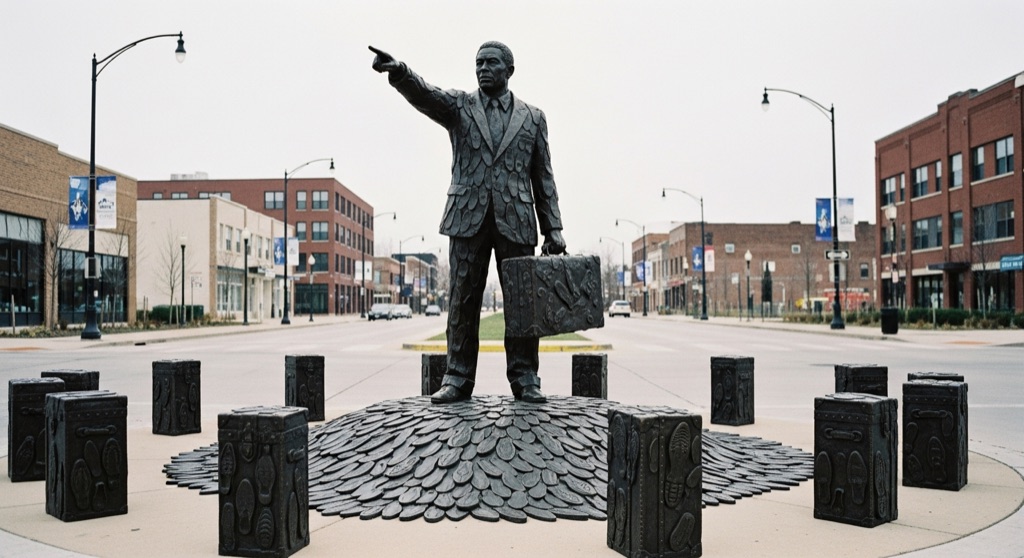
A 15-foot bronze man built entirely from cast, worn-out shoe soles — his suit, the mound he rises from, even the ground texture all rendered as hundreds of hole-punched soles — points north with a battered suitcase at the historic gateway to Bronzeville. Surrounding bollards are textured like vintage travel trunks.
→ Three more weird outdoor & roadside oddities in Chicago — never the same twice
The story
If you drive down Dr. Martin Luther King Jr. Drive without paying attention, you might mistake it for just another roadside bronze figure stuck on a grassy median. Step onto the curb and you'll catch what most passersby miss. The 15-foot man waving toward the North Shore isn't wearing a standard sculpted suit—artist Alison Saar cast his coat, trousers, and the very mound beneath his feet from hundreds of actual worn-out shoe soles, complete with punch holes, heel wear, and visible nails from real journeys.
Installed in 1996 at 26th Place, the sculpture stands as the physical entrance to historic Bronzeville, marking the destination where millions of African Americans arrived during the Great Migration from the Jim Crow South. Saar—daughter of legendary assemblage artist Betye Saar—didn't just build a monument; she constructed a textured archive of relentless walking. Look down at the bollards encircling the median, and you'll find they aren't standard municipal post markers either, but bronze travel trunks stamped with tin-ceiling patterns harvested from early 20th-century buildings.
What it's like
You are standing on a narrow, exposed grass median in the middle of active traffic along King Drive, so mind the cars turning off 26th Place. There are no gates, tour guides, or admission fees here—just open sidewalk and bronze. Walk directly up to the base to trace the tread marks, heel pegs, and worn leather textures cast into the figure's clothes and surrounding trunk bollards. Traffic hums on both sides, making this a quick, striking ten-minute stop rather than a quiet park sit; go in the morning when sunlight hits the raised textures on the southern face of the bronze.
The move: Walk the median between 25th and 26th and count individual carved soles in the bronze before circling the trunk-textured bollards ringing the statue.
- 📍 Bronzeville
- 💸 Free
- ⚡ Up for anything
- 🌗 Outdoors
Where: S. Martin Luther King Jr. Drive at 26th Place (median), Chicago, IL 60616
Hours: Added 2026-07-19 — confirm current hours before you go.
Pair it with
- Nine Bar — Head less than a mile west into Chinatown to slip through the back room of Moon Palace Express for a late cocktail.
- Augustine's Spiritual Goods — Drive a few minutes southwest into Bridgeport to explore a South Side apothecary specializing in traditional hoodoo items and hand-blended oils.
- Gulliver in Wonderland (Hector Duarte's House) — Head west into Pilsen to see another massive public artwork built into the neighborhood fabric, where muralist Hector Duarte wrapped his entire house in canvas.
- Doane Observatory (Adler Planetarium) — Drive a mile and a half northeast to the lakefront edge to peer through Chicago's largest public telescope.
More weird in Chicago

Good to know
Where exactly is the monument located?
It sits in the grassy median of S. Martin Luther King Jr. Drive at 26th Place, marking the northern entrance to the Bronzeville neighborhood.
How much does it cost to visit and what are the hours?
It is completely free and permanently accessible 24 hours a day in an open public street median, though daylight visits offer the best viewing of the bronze details.
Who created the sculpture and when was it installed?
It was created by artist Alison Saar and dedicated in 1996.
What materials were used to make the statue?
The entire 15-foot monument, figure, base, and surrounding suitcase bollards are cast in bronze, molded using patterns from worn-out shoe soles and vintage tin ceiling panels.
Plan a visit & invite your people →
Further reading: Roadside America · Time Out · chicago.gov
last checked: 2026-07-19