Entry No. 29 — the Chicago file — filed under: roadside-oddity
Gulliver in Wonderland (Hector Duarte's House)
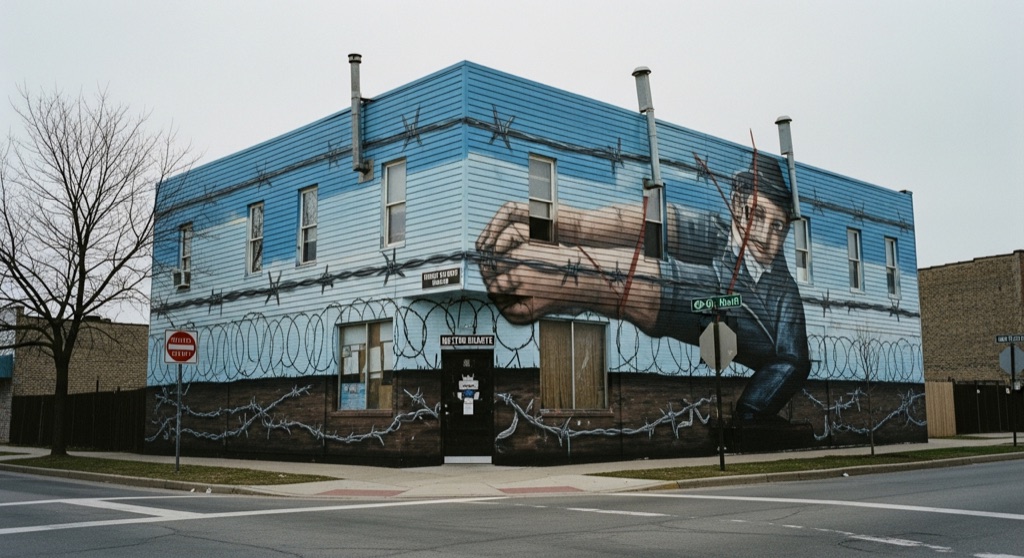
Muralist Hector Duarte wrapped his own Pilsen home-studio in a nearly 3,500-square-foot painting that turns the entire corner building into a single artwork. A giant Latinx Gulliver lies pinned across the aluminum siding, straining against painted barbed wire, a vivid allegory of the immigrant experience rendered in saturated blues and reds. Duarte still lives and works behind the walls, making this a genuine one-person-built environment rather than a commissioned public piece.
→ Three more weird outdoor & roadside oddities in Chicago — never the same twice
The story
Most people pass standard residential aluminum siding without giving it a second look, but on the corner of Cullerton and Wolcott, artist Hector Duarte turned his entire two-story home and studio into a nearly 3,500-square-foot canvas. Born in Michoacán, Mexico, in 1952, Duarte trained in 1977 at the workshop of legendary Mexican muralist David Alfaro Siqueiros before moving to Chicago in 1985 [1.1.1]. In 2005, without waiting for a municipal grant or landlord permission, he painted Gulliver en el país de las Maravillas (Gulliver in Wonderland) directly across the exterior walls of his own house.
The painting repurposes Jonathan Swift's classic satire into a sharp allegory of Mexican migration. Rendered in saturated blues and deep reds, a giant Latinx laborer lies bound and pinned under painted barbed wire, his head near the roofline and his feet stretching along Wolcott Avenue while the Chicago skyline looms in the distance. The giant wears a worker's cap and face mask—symbolizing factory and agricultural labor alongside the systemic erasure of Mexican identity upon arrival. The scale tells the story: crossing a border requires giant effort, yet the reward is often finding yourself bound by cultural barriers, language gaps, and hostility in 'Wonderland'.
Duarte constructed the composition so that anyone walking down the public street becomes an unwitting participant in the artwork—stepping right into the role of the Lilliputians who bound the giant to the earth. Because Duarte still lives and works behind those painted walls, the corner remains a completely self-funded, single-person folk-art environment that holds its ground while the surrounding neighborhood gentrifies.
What it's like
Stand across the street at the southeast corner of Cullerton and Wolcott for the complete view before stepping closer to inspect the painted barbed wire and concrete textures. Remember that this is a private residence and working studio; you are expected to take in the entire wraparound mural from the public sidewalk without knocking on the door or trespassing. Give yourself fifteen minutes to walk the perimeter and trace the giant's outline, then cut north toward 18th Street to grab tacos and check out Pilsen's broader network of street murals.
The move: Walk the corner of Cullerton and Wolcott together to read the whole wraparound Gulliver, then wander into Pilsen for tacos and more murals.
📍 Before you go It's a private residence; admire and photograph from the public sidewalk and don't disturb the artist.
- 📍 Pilsen
- 💸 Free
- ⚡ Up for anything
- 🌗 Outdoors
Where: 1900 W. Cullerton St, Chicago, IL 60608
Hours: Added 2026-06-23 — confirm current hours before you go.
Pair it with
- Punch House — Walk under a mile east along 18th Street to follow your street-art stroll with drinks in a wood-paneled 1970s basement bar under Thalia Hall.
- ChiTown Drive-In — Pair an afternoon viewing Duarte's outdoor siding with a night watching movies from your car less than a mile away in Pilsen.
- Jane Addams Hull-House Museum — Drive under two miles north to connect Duarte's visual narrative of immigrant struggle to Chicago's historic 19th-century settlement house.
- Jem Junkies — Head just over a mile east to Lacuna Lofts to trade admiring Duarte's exterior brushwork for hands-on craft workshops.
More weird in Chicago
Good to know
Where is Hector Duarte's house located?
It sits on the corner of Pilsen at 1900 W. Cullerton St (at Wolcott Ave), Chicago, IL 60608 [1.1.1].
Can you tour the inside of the house or studio?
No. It is a private residence and active artist studio. You should view and photograph the mural entirely from the public sidewalk.
What does the Gulliver mural represent?
Painted in 2005, the mural uses Jonathan Swift's giant to symbolize the Mexican immigrant experience. Crossing borders demands giant strength, but immigrants often arrive only to find themselves bound by physical barbed wire, language barriers, and economic hardship.
Is there an admission fee or set hours to view the house?
No. Because it is an exterior street mural, it is free and accessible 24/7 from the public sidewalk.
Plan a visit & invite your people →
Further reading: wttw.com · Official site · theclio.com
last checked: 2026-06-23