Entry No. 6 — the Charleston file — filed under: submarine
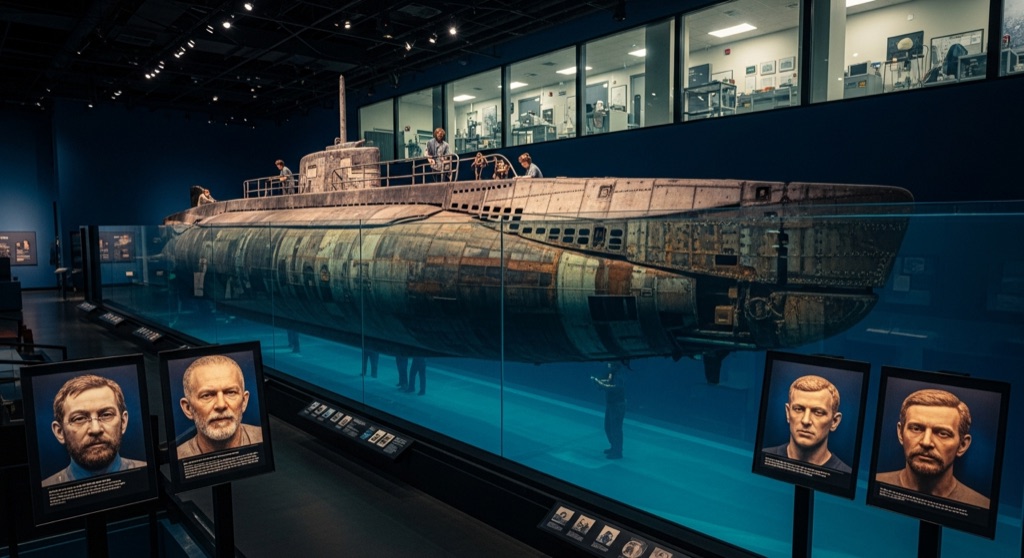
H.L. Hunley Submarine (Warren Lasch Conservation Center)
The world's first successful combat submarine sank three times and killed its own inventor before it vanished for over a century off Sullivan's Island; it now sits suspended in a 75,000-gallon freshwater tank while conservators fight to stop 19th-century iron from dissolving. Crew commander Lt. George Dixon carried a $20 gold coin that had already stopped a bullet at Shiloh — it was found bent in his pocket, right where the shot had struck. Open weekends only (Sat and Sun).
→ Three more unusual museums & collections in Charleston — never the same twice
The story
Before the H.L. Hunley made history on February 17, 1864, by becoming the first submarine to sink an enemy warship in combat—the USS Housatonic off Sullivan's Island—it was already an iron coffin. The 40-foot, hand-cranked vessel sank twice during trial runs in Charleston Harbor, killing thirteen crew members including its primary builder and namesake, Horace Lawson Hunley. It was salvaged both times, wiped out, and sent back into service. Eight men crammed shoulder-to-shoulder inside a tube less than four feet wide, hand-turning a heavy iron crankshaft to drive a bow-mounted spar torpedo through black water. They struck the Housatonic, detonated the charge, and promptly vanished into the Atlantic seabed for 131 years.
When conservators raised the hull in 2000 and delivered it to the former Navy Base in North Charleston, excavators found the crew still sitting at their bench stations, crushed by mud but showing no signs of a panicked rush to the escape hatches. Inside the pocket of captain Lt. George Dixon, researchers pulled out a warped 1860 Liberty Head $20 gold piece inscribed 'Shiloh April 6, 1862 My life Preserver G.E.D.'—the coin had literally deflected a bullet that would have killed him two years prior at Shiloh. Today, the sub sits suspended in a 75,000-gallon chemical and freshwater tank where Clemson University scientists use subcritical extraction techniques to leach out a century of absorbed ocean salt before the wrought iron crumbles. If you ask about who actually found the wreck, be prepared for two competing claims: underwater archaeologist Dr. E. Lee Spence claims he located it in 1970, while Clive Cussler's NUMA team officially documented the site in 1995.
What it's like
Because the Warren Lasch Conservation Center functions as an active materials research facility Monday through Friday, public tours are strictly weekend-only. The experience feels more like entering a forensic crime lab than a standard museum. You walk past interactive exhibits and forensic facial reconstructions molded from 3D skull casts before climbing an elevated gallery to view the actual submarine resting in its massive tank through glass. Out front, a full-scale steel replica lets you crawl inside to get a claustrophobic sense of turning an iron crank alongside seven other men in total dark. Check ahead to see if conservators are actively working in the tank during your visit, and confirm operating hours before heading up Supply Street.
The move: Book the weekend-only tour, watch conservators work through the lab glass on the actual hull, then study the facial reconstructions of the eight-man crew and argue over who found the wreck first — there are two competing discovery claims.
- 📍 North Charleston
- 💸 $
- ⚡ Up for anything
- 🌗 Indoors
Where: 1250 Supply Street, North Charleston, SC 29405
Hours: Added 2026-07-20 — confirm current hours before you go.
⚠ Seasonal or scheduled — always check before you go.
Pair it with
- Magnolia Cemetery — Pair the lab tour with the historic Victorian cemetery 2.9 miles down the road where all eight Hunley crew members were buried in 2004.
- Smokin Rose Speakeasy — Drive 1.6 miles south along Meeting Street Road after your tour for bourbon and cigars at a hidden, low-key speakeasy.
- Confederate Museum at Market Hall — Contrast this high-tech scientific conservation facility with a traditional single-room 19th-century military relic collection in downtown Charleston.
More weird in Charleston

Good to know
When is the museum open to visitors?
Saturdays and Sundays only. During the week, the facility operates strictly as a working conservation and materials science laboratory for Clemson University.
Is the submarine kept under water?
Yes. The Hunley is kept submerged in a 75,000-gallon freshwater solution treated with chemicals to stabilize the iron, though conservators occasionally drain the tank during active treatment phases.
Where are the submarine's crew buried?
All eight crew members were excavated from the submarine, forensically analyzed, and buried with military honors in 2004 at Magnolia Cemetery in Charleston, right beside the crews from the sub's earlier fatal test runs.
Can you see Lt. Dixon's bullet-bent gold coin?
Yes. The actual warped $20 gold piece—bearing the bullet dent from the Battle of Shiloh and Dixon's hand-carved inscription—is on display in the exhibit hall alongside other recovered crew artifacts.
Plan a visit & invite your people →
Further reading: Official site · Wikipedia · news.clemson.edu · live5news.com
last checked: 2026-07-20