Entry No. 53 — the Butte file — filed under: historic
Steward Mine
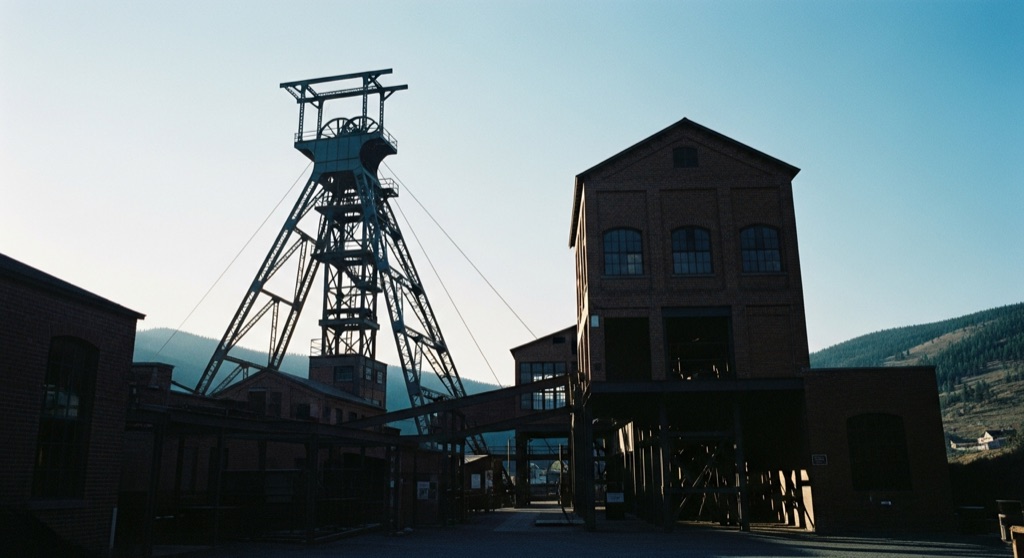
The Steward Mine was one of Butte's most productive copper and silver mines, operating from 1877 until the 1970s and reaching a depth of over 3,600 feet. Today, its iconic steel headframe and historic brick hoist house stand as striking monuments on the Butte landscape. Though the underground workings are sealed and the yard is fenced, the structures remain highly visible from the adjacent street and walking trail.
→ Three more abandoned & forgotten places in Butte — never the same twice
The story
If you stand at the intersection of North Main and East Woolman streets, you are looking at an 80-ton, 126-foot steel skeletal headframe erected in 1902 for less than $9,000. Originally discovered in 1877 by John Marshall Steward, the mine was bought in the early 1880s by Copper King William A. Clark. Clark loathed losing expensive steam hoisting engines to underground fires, so he constructed the hoist house out of thick red brick—an architectural footprint you can still spot straight through the chain-link fence.
Below the surface, the Steward plunged over 3,600 feet deep and was infamous among miners as one of the hottest, most suffocating underground operations in Butte. One particularly sweltering drift earned the disparaging nickname "the Chinese Laundry." Yet in 1909, management hosted an underground banquet on the 2,100-foot level for visiting street railway executives, treating them to a formal menu featuring named dishes like "Never Sweat lobster" and "Merry Widow drill sauce" in the dark.
The Anaconda Copper Mining Company took over the mine in 1910 and ran it into the 1970s. Over its operational lifespan, 79 miners lost their lives in the Steward before the underground workings were sealed shut. Today, the steel headframe and historic brick engine house stand locked behind security fencing, quiet, preserved, and completely off-limits.
What it's like
You cannot step inside the mine yard—the perimeter fence is locked tight around the sealed shaft, and local security takes trespassing seriously. Instead, pull off along North Main Street or walk the paved BA&P recreation trail that skirts right along the fence line. You will get clear, close-up angles of the steel gallows frame and brick engine house against the sky. It is usually quiet and uncrowded, making it an easy, stark stop for photographing Butte's heavy industrial ruins.
The move: Walk along the nearby BA&P recreation trail or North Main Street to photograph the towering steel headframe and historic brick hoist house against the Montana sky.
📍 Before you go The mine yard is fenced and closed to the public to prevent trespassing and ensure safety around the sealed shaft, but the historic structures are easily viewed from North Main Street and the adjacent BA&P recreation trail.
- 📍 Butte
- 💸 Free
- ⚡ Low-key
- 🌗 Outdoors
Where: Steward Mine, Butte, MT 59701, USA
Hours: Added 2026-07-20 — confirm current access before you go.
Pair it with
- Butte's Lit Headframes (Gallows Frames) — After checking out the Steward by daylight, stick around Uptown until dark when Butte lights up its surviving steel headframes across the hill.
- Mountain Consolidated Mine — Compare the Steward's 3,600-foot depth with 'The Con' just 0.4 miles away, which plunged over 5,200 feet deep.
- Old Butte Historical Adventures - City Underground Tour — Since you can't go down the Steward's sealed shaft, head 0.3 miles into Uptown to tour the historic subterranean spaces you can actually enter.
- Bell-Diamond Mine — Walk 0.7 miles up the hill to see the Diamond Mine headframe, erected in 1898 as the oldest steel headframe still standing in Butte.
More weird in Butte

Good to know
Can you go inside the Steward Mine yard or hoist house?
No. The entire yard is fenced off and closed to the public to prevent trespassing around the sealed 3,600-foot shaft.
Where is the best place to view and photograph the mine?
You can get unobstructed views directly from North Main Street near East Woolman Street or from the adjacent BA&P recreation trail.
How deep was the Steward Mine?
The underground shaft reached a depth of over 3,600 feet.
Why is the hoist house built of brick instead of wood?
Owner William A. Clark built the hoist house out of brick in the 1880s specifically to protect his expensive hoisting engines from fire.
Plan a visit & invite your people →
Further reading: storyofbutte.org · hmdb.org
last checked: 2026-07-20