Entry No. 53 — the Bozeman file — filed under: after-dark
Montana Learning Center Observatory (Mike & Lynn Rice Astronomical Park)
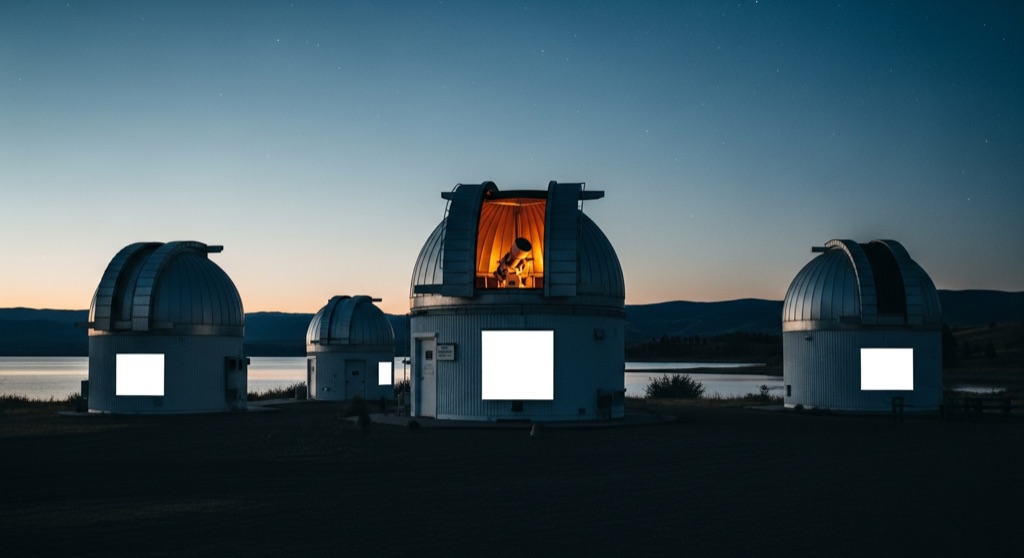
Three observatories on the shore of Canyon Ferry Lake house Montana's largest publicly accessible telescope, a 32-inch view-only instrument, with each dome built to explore a different part of the sky. From June through September the center opens its observatories at sunset one weekend a month, each night featuring a different guest astronomer, a live talk and Q&A, and up-close views through the big scope. They also run private 90-minute star parties for small groups guided by the center's director from May to October. (Located at 7653 Canyon Ferry Road, Helena, MT 59602.)
→ Three at a time, never the same twice — explore weird Bozeman
The story
You don't expect to find Montana's largest public eye on the deep cosmos sitting beside a reservoir east of Helena, but the Mike & Lynn Rice Astronomical Park doesn't care about expectations. Built on the shoreline of Canyon Ferry Lake, the Montana Learning Center houses three separate domes, each engineered for a distinct astronomical job. Rather than pointing a single generalist telescope at everything, executive director Ryan Hannahoe—who learned the trade running remote scopes in New Mexico for benefactors Mike and Lynn Rice—helped build a setup that splits duties between deep space photography, planetary imaging, and direct visual observing.
The crown jewel for visual stargazers is a 32-inch view-only scope inside the center's second dome—the largest glass instrument open to the public anywhere in Montana. Instead of projecting a digital rendering onto a screen, it gathers raw photons through an f/3.6 mirror so you can look directly through the eyepiece at faint nebulae and distant galaxies. Beside it, another dome houses a 14-inch Planewave Delta Rho robotic scope wired to a 24-megapixel camera for deep-sky photography, while a third dome holds a custom 24-inch robotic telescope, a 14-inch lunar scope, and a 4-inch spectroheliograph built specifically to capture light spectra from the Sun.
Because the facility operates primarily as a STEM education center affiliated with NASA and the Montana Space Grant Consortium, you can't just wander onto the grounds on a whim. Most of the year, the domes are reserved for student science camps and research projects. But during four summer weekends between June and September, the center opens its gates at sunset for public viewing nights, bringing in guest scientists and pairing them with volunteers from the Helena Astronomical Society to pilot the instruments.
What it's like
Arriving along Canyon Ferry Road as the sun drops behind the mountains feels less like visiting a tourist spot and more like slipping into an active research station. You'll park on the lakefront campus, check in for the limited-capacity gathering (capped at 100 guests), and start with an indoor presentation from that evening's featured astronomer. Once night settles over the water, staff and Helena Astronomical Society volunteers take over the domes. The line for the 32-inch visual scope moves steadily, but a clever move is stepping over to watch the live imaging feeds coming off the robotic camera dome while your eyes adjust to the darkness. Check weather forecasts before making the drive from Bozeman—cloud cover cancels visual observing—and pack heavy wind layers, because the air off Canyon Ferry Lake turns frigid fast after dark.
The move: Time a summer weekend to a public stargazing night, arrive at sunset, and take turns peering at planets and nebulae through Montana's biggest public telescope.
📍 Before you go On Canyon Ferry Lake near Helena (a real drive from Bozeman); public nights are one weekend per month June-September, ticketed (~$25 adult), capped at 100 guests, and observing is weather-permitting. Private star parties run May-October by reservation.
- 📍 Helena (Canyon Ferry Lake)
- 💸 $
- ⚡ Low-key
- 🌗 Outdoors
Where: 57 Old US Hwy 287, Helena, MT 59602
Hours: Added 2026-06-24 — confirm current hours before you go.
⚠ Seasonal or scheduled — always check before you go.
Pair it with
- Goose Bay Handblown Glass — Stop in Townsend on your drive up Highway 287 to watch molten glass turn into custom pie dishes before heading up the lake for nightfall.
- Bleu Horses — Spot the herd of 39 blue-painted steel horses frozen on a Three Forks hillside during your daytime drive north along Highway 287.
- Elkhorn State Park (ghost town) — Take a daytime dirt-road detour into the hills near Boulder to see two 19th-century silver-boom halls before heading to the observatory for a very different kind of ancient light.
- Headwaters Heritage Museum — Browse through a 1910 former bank packed with local headwaters-area oddities in Three Forks before continuing north toward Canyon Ferry Lake.
More weird in Bozeman
Good to know
When are the observatories open to the public?
Public stargazing nights run one weekend per month from June through September for the 'Beyond the Big Sky' series, beginning right around sunset. Private 90-minute star parties for small groups can also be reserved from May through October.
How much do tickets cost and do I need reservations?
Public nights require advance ticket purchase (~$25 per adult) and are strictly capped at 100 guests per evening. Private star parties cost $500 for a group of up to 10 people and are led directly by the center's executive director.
What happens if the weather is cloudy or bad?
Telescope viewing is strictly weather-permitting. The center monitors conditions using an on-site weather station and 24/7 all-sky camera, but heavy clouds or rain will prevent visual telescope observation.
Which telescopes will visitors actually get to see?
The park houses three domes: one with a 32-inch visual scope (Montana's largest public telescope), a second with a 14-inch Planewave robotic astrophotography scope, and a third containing a 24-inch custom robotic telescope, a 14-inch planetary scope, and a solar spectroheliograph.
Where is the center located relative to Bozeman?
It sits about 85 miles north of Bozeman along Canyon Ferry Lake near Helena, at 7653 Canyon Ferry Road (off Old US Hwy 287).
Plan a visit & invite your people →
Further reading: Official site · southwestmt.com
last checked: 2026-06-24