Entry No. 58 — the Bozeman file — filed under: roadside-oddity
Elkhorn State Park (ghost town)
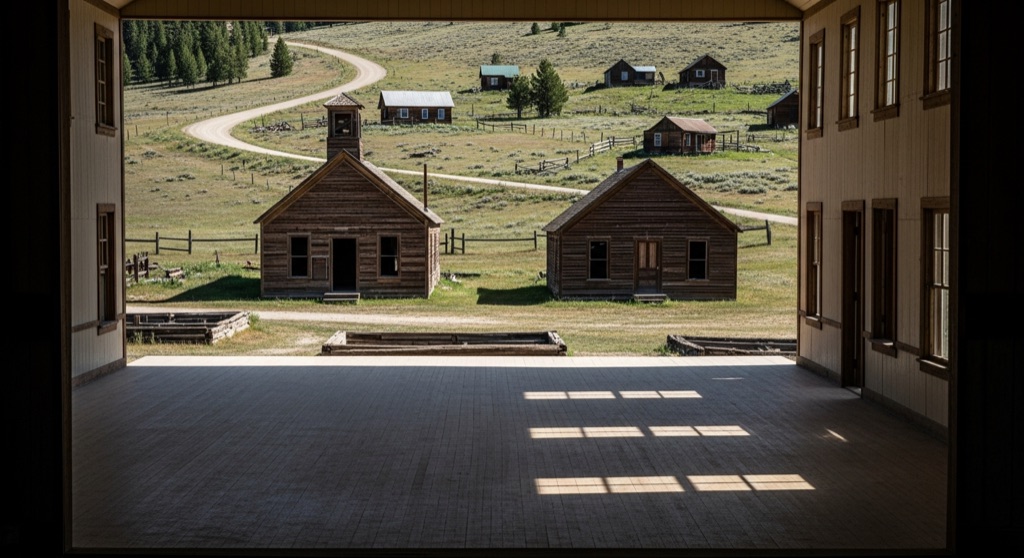
Montana's smallest state park is just two preserved buildings, Fraternity Hall and Gilliam Hall, standing among the remnants of a silver-boom town that peaked around 2,500 people in the 1880s and 90s. About ten people still live in the surrounding cluster of private cabins, so the ghost town is genuinely half-alive. You can walk into both halls (just close the doors behind you) where dances, saloon nights, and meetings once happened. The drive up winds through ranchland and state forest.
→ Three more hidden bars & speakeasies in Bozeman — never the same twice
The story
Most state parks give you miles of hiking trails and entry booths; Montana's smallest state park gives you less than an acre of mountain dirt and two wooden halls. High in the Elkhorn Mountains, this silver-boom settlement peaked at roughly 2,500 residents in the late 1880s and 1890s before the Silver Panic of 1893 and a devastating diphtheria epidemic gutted the population. The Northern Pacific pulled up its rail lines in 1931, but the town never completely went dark. Today, about ten residents still live in refurbished cabins scattered among the ruins, making Elkhorn a ghost town that is uncomfortably half-alive.
The state owns exactly two structures on the main dirt strip: Fraternity Hall and Gilliam Hall. Fraternity Hall, built in 1893, looks like a Greek Revival opera house dropped onto a logging road, finished with an ornate neoclassical balcony where miners once watched prize fights, dances, and meetings for lodge groups like the Masons and Knights of Pythias. Next to it stands Gilliam Hall, a two-story 1880s structure that served as a store, saloon, and dance hall. While the surrounding cabins are strictly private residences—where modern locals chop firewood and park their trucks—these two state-owned halls sit unlocked for anyone willing to turn the knob.
What makes Elkhorn genuinely strange is the quiet social tension between historic preservation and everyday mountain life. You are stepping onto a dirt street where private residents go about their days past 140-year-old mine remnants, and where three-quarters of a mile up the road sits a hillside cemetery filled with tiny markers from the 1889–1890 diphtheria outbreak. There are no gift shops, no velvet ropes, and no tour guides—just two hollow frontier halls standing shoulder-to-shoulder with modern mountain recluses.
What it's like
The roughly two-hour drive from Bozeman takes you north off Highway 69 onto White Bridge Road and winds up gravel backcountry roads through working ranchland into Beaverhead-Deerlodge National Forest. When you roll into town, park along the road and remember that almost every cabin surrounding the state park land is a private home. You can step directly inside both Fraternity Hall and Gilliam Hall to explore their empty floors, but pull the heavy doors shut tightly when you leave to keep out the mountain wind and wildlife. Afterwards, walk three-quarters of a mile up the main road to reach the town cemetery. Bring your own water and fuel up in Boulder before headling up; the park has seasonal picnic tables and a portable latrine, but zero commercial services or on-site staff.
The move: Drive the back road up, step inside Fraternity Hall's empty dance floor, and imagine the band that once played there.
📍 Before you go Roughly 2 hours from Bozeman; most buildings are private homes, so respect property and only enter the two state-park halls.
- 📍 Boulder (Elkhorn)
- 💸 Free
- ⚡ Up for anything
- 🌗 Outdoors
Where: Elkhorn Rd, Boulder, MT 59632
Hours: Added 2026-06-24 — confirm current hours before you go.
Pair it with
- Bleu Horses — Pair the ghost-town silence of the Elkhorns with a hillside along Highway 287 where 39 life-and-a-half-size steel horses stand frozen in blue paint.
- Lewis & Clark Caverns State Park — Pair Montana's smallest state park above ground with a guided two-mile subterranean trek through one of the region's largest limestone cavern systems.
- Ringing Rocks — Follow up a quiet walk through 1890s silver-boom halls by taking a hammer out to tap a field of boulders that chime like metal bells.
- Headwaters Heritage Museum — Combine your trip to Elkhorn's preserved fraternal halls with a detour through a volunteer-run museum crammed with regional oddities inside a 1910 bank building.
More weird in Bozeman
Good to know
How much does it cost to visit Elkhorn State Park?
There is no entrance fee booth or day-use charge at the park site. Keep in mind there are no stores, gas stations, or food vendors in Elkhorn.
Which buildings are you allowed to go inside?
You may only enter Fraternity Hall and Gilliam Hall, which comprise the state park property. The rest of the buildings and cabins in Elkhorn are private homes and property, so keep out and stick to public roads.
Why are visitors asked to close the doors when leaving the halls?
The state keeps Fraternity Hall and Gilliam Hall unlocked for public walk-in access, but harsh winter weather, high winds, and local mountain wildlife will damage the interior woodwork if the doors are left open.
What are the road conditions like getting to Elkhorn?
The final stretch climbs via unpaved dirt and gravel county roads through the mountains. While manageable for standard vehicles in dry summer weather, check road conditions and snowpack before heading up in winter or early spring.
Plan a visit & invite your people →
Further reading: fwp.mt.gov · Atlas Obscura · southwestmt.com · Wikipedia · historicmt.org · historynet.com
last checked: 2026-06-24