Entry No. 27 — the Boston file — filed under: outdoor
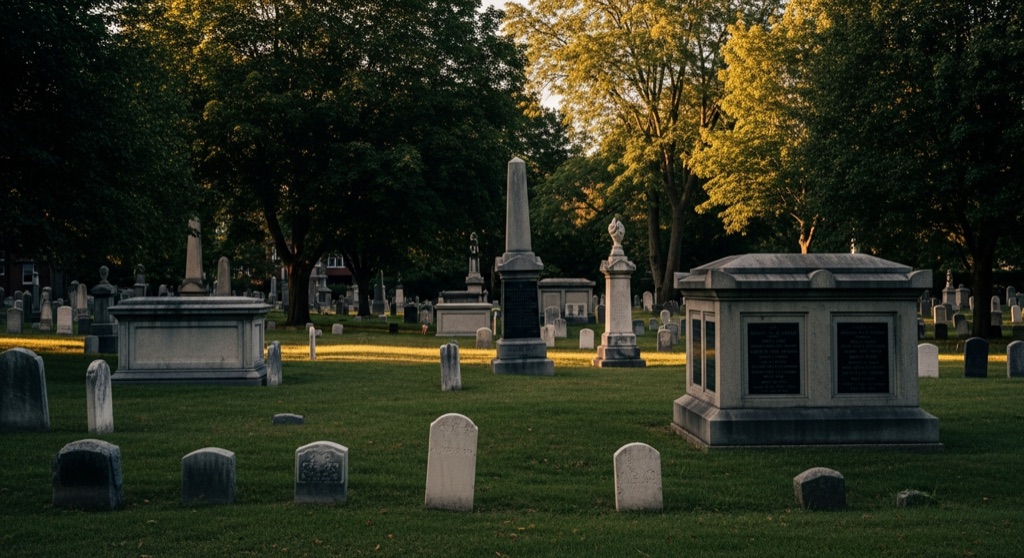
Forest Hills Cemetery
A 275-acre 'garden cemetery' that doubles as a nationally significant outdoor sculpture collection, including Daniel Chester French's unsettling 'Death Staying the Hand of the Sculptor' and work by Martin Milmore and Thomas Ball — a museum-grade collection you can walk into free, any morning starting at 8am.
→ Three at a time, never the same twice — explore weird Boston
The story
Long before Boston opened its Museum of Fine Arts in 1870, it established Forest Hills Cemetery in 1848 as a 275-acre outdoor gallery disguised as a park. Founded by Roxbury Mayor Henry A.S. Dearborn, this was one of America's early Victorian 'garden cemeteries'—a landscape engineered to reframe death from terrifying judgment into eternal, gentle sleep. Instead of cramped colonial churchyards, you get winding avenues, mature oaks, and Lake Hibiscus, framed by a massive collection of 19th-century bronze and marble monuments you can explore for free without a museum ticket.
The draw isn't just the quiet landscape; it's the high-grade sculpture hiding in plain sight. The cemetery's crown jewel is Daniel Chester French's bronze relief 'Death Staying the Hand of the Sculptor', created for the grave of Irish-born sculptor Martin Milmore and his brother Joseph. It depicts a young artist caught mid-chisel as a hooded, winged figure gently halts his arm. Keep walking along White Oak Avenue toward a rocky outcropping, however, and you'll hit 'Neighbors'—a 2006 installation by artist Christopher Frost featuring miniature concrete houses scattered across the stone. Each tiny building is an exact scale replica of a house once lived in by someone buried on these grounds, ranging from poet Anne Sexton to Ralph Martin, a wagon-driver killed in Boston's 1919 Great Molasses Flood.
Alongside Victorian industrialists and unknown 19th-century Bostonians, you're walking among some of American literature's most famously bleak figures—playwright Eugene O'Neill and poet E.E. Cummings are both buried here. Though it feels like a peaceful, romantic park, Forest Hills remains an active cemetery, meaning modern headstones are still quietly appearing right next to Victorian obelisks.
What it's like
Arriving through the Gothic Revival entrance at 95 Forest Hills Avenue instantly cuts off the surrounding city noise. Make your first stop the kiosk right at the main gate to pick up the printed visitor's guide mapping out over 60 points of interest; navigating 275 acres without it will turn your search for specific bronzes or miniature houses into a multi-hour maze. The vibe is hushed and deeply solemn, but don't confuse the picturesque landscape with a municipal park. Security strictly enforces rules against dogs, jogging, bicycling, and picnics, so keep your visit to a slow, respectful walk and give active burial services a wide berth.
The move: Pick up the visitor's guide at the main gate kiosk (it maps 60+ points of interest) and go hunting for the French and Milmore sculptures at your own pace, no ticket or tour required.
- 📍 Jamaica Plain, Boston
- 💸 Free
- ⚡ Up for anything
- 🌗 Outdoors
Where: 95 Forest Hills Ave, Boston, MA 02130
Hours: Added 2026-07-20 — confirm current hours before you go.
Pair it with
- Franklin Park - Overlook Shelter Ruins — Follow up your walk through Forest Hills' 275 acres of Victorian cemetery art with a trip next door to see Frederick Law Olmsted's fire-gutted 1890s stone fieldhouse ruins.
- Botanica San Miguel — Head less than a mile up South Street to shift from 19th-century bronze grave monuments to a working botanica stocked with spiritual candles, herbs, and cleansing supplies.
- Eliot Burying Ground — Visit Roxbury's cramped 1630s burial ground to see the exact kind of overcrowded colonial churchyard that inspired Roxbury's leaders to build Forest Hills Cemetery in 1848.
More weird in Boston
Good to know
Is there an entry fee to visit Forest Hills Cemetery?
No, admission is completely free. You can walk through the main entrance gates daily starting at 8:00 AM.
Can I bring my dog, go jogging, or ride a bike through the grounds?
No. Because Forest Hills is an active cemetery and place of remembrance, dog-walking, jogging, bicycling, and recreational sports are strictly prohibited.
Where are the famous sculptures and miniature houses located?
Pick up the self-guided map at the main gate kiosk. Daniel Chester French's sculpture marks the Milmore family lot, while Christopher Frost's miniature concrete neighborhood ('Neighbors') is located on a rocky ledge along White Oak Avenue between Primrose and Rock Maple Avenue.
Who are some notable people buried at Forest Hills?
Interments include Nobel Prize-winning playwright Eugene O'Neill, poets E.E. Cummings and Anne Sexton, and Civil War monument sculptor Martin Milmore.
Plan a visit & invite your people →
Further reading: Wikipedia · Official site · Atlas Obscura · nps.gov
last checked: 2026-07-20