Entry No. 28 — the Boston file — filed under: immersive historic house
Yin Yu Tang: A Chinese Home
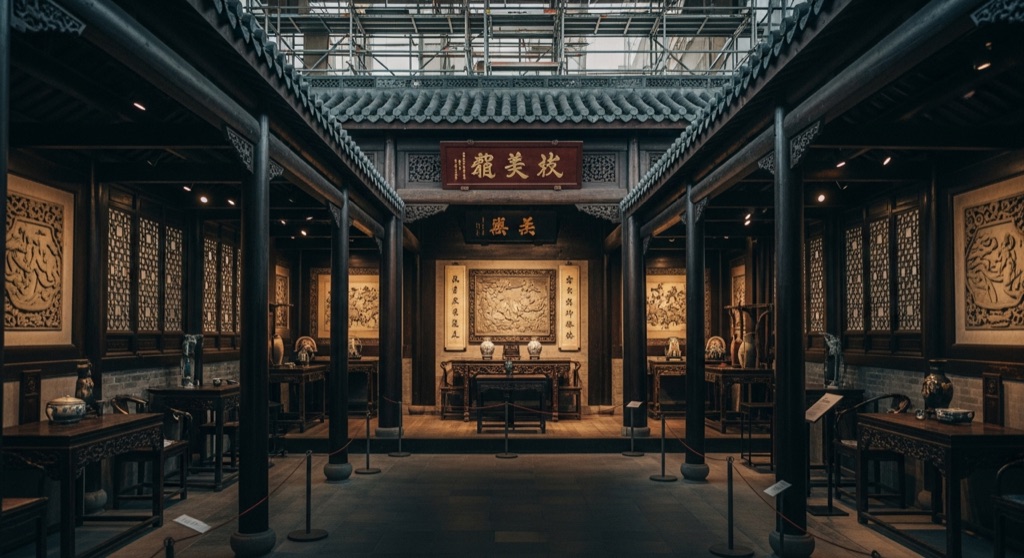
An entire 200-year-old, 16-bedroom Qing-dynasty merchant house from Anhui province, China — dismantled beam by beam, shipped across the ocean, and rebuilt whole inside a Salem museum. It's the only historic Chinese vernacular dwelling in North America you can actually walk through: carved lattice windows, furniture from eight generations of the same family, feng shui baked into the floor plan. Timed tours are required and roof/masonry preservation work sometimes means scaffolding is visible inside.
→ Three more unusual museums & collections in Boston — never the same twice
The story
In 1996, art historian Nancy Berliner was traveling through Huang Cun, a village in China's southeastern Anhui province, when she came across an empty 16-bedroom residence. Built around 1800 by a prosperous merchant named Huang, the five-bay, two-story timber-and-brick home had been named Yin Yu Tang—the "Hall of Plentiful Shelter"—with the intention of sheltering generations of his lineage. Eight generations of the Huang family lived, worked, and raised children inside its walls before the last descendants moved away in 1982. Rather than letting the structure decay, Chinese local authorities and the Huang descendants agreed to sell and relocate the house to the Peabody Essex Museum in Salem.
What landed on the Massachusetts coast seven years later was not a sanitized museum display, but an entire 200-year-old living environment. Chinese and American craftspeople spent years reassembling the original sandstone walls, tile roofs, and timber framing beam by beam. Inside, you are walking through the exact intimate details left behind by the family: carved wooden lattice windows facing internal fish ponds, coins tucked under structural columns according to feng shui practices to bring good fortune, ancestral altars, and even 20th-century newspapers and political posters still pasted to the bedroom walls.
Salem is famous for colonial clapboards and witch trials, which makes stepping into an authentic Huizhou vernacular merchant home in the middle of East India Square feel almost surreal. It stands as the only historic Chinese vernacular dwelling in North America you can physically walk through, giving you direct access to the daily routines, domestic privacy, and architectural traditions of an Anhui merchant family.
What it's like
Entry requires an advance timed reservation on top of your general museum admission, so do not expect to just walk in off Essex Street. Plan to pick up your audio guide at the information desk ten minutes before your ticketed slot and bring your own headphones. As you walk through, watch your step over the raised wooden thresholds and uneven stonework, and keep your jacket on during colder months—the central courtyard (Tian Jing) is open to the sky, letting in outside air just as it did in Anhui. You may also see internal scaffolding or active preservation work underway as stonemasons and conservators continue maintenance on the roof tiles and exterior walls.
The move: Book the timed self-guided audio tour, then linger in the ancestral hall trying to find where each of the eight generations of the Huang family would have slept, cooked, and prayed.
- 📍 Salem
- 💸 $$
- ⚡ Up for anything
- 🌗 Indoors
Where: Peabody Essex Museum, East India Square, 161 Essex Street, Salem, MA 01970
Hours: Added 2026-07-20 — confirm current hours before you go.
⚠ Seasonal or scheduled — always check before you go.
Pair it with
- Wenham Museum (doll & model-train collection) — Pair a walk through a transported 18th-century Chinese home with a short drive to a 1655 North Shore colonial house packed with thousands of antique dolls.
- Dillon's Russian Steam Bath — Trade the quiet courtyards of Qing-dynasty architecture for an intense 180-degree soak inside America's oldest operating steam bath in Chelsea.
- Modern Underground — Follow up an afternoon exploring two centuries of Chinese domestic history by slipping beneath a North End cannoli counter for a speakeasy cocktail.
More weird in Boston
Good to know
How did a 200-year-old house from China end up in Salem?
After the last Huang family descendants moved out in 1982, local Chinese cultural authorities and the family agreed to relocate the home. In 1997, it was disassembled piece by piece, shipped across the ocean, and reerected at the Peabody Essex Museum, opening to the public in 2003.
Do I need a separate ticket or reservation for Yin Yu Tang?
Yes. Entry requires a timed-entry tour reservation in addition to general Peabody Essex Museum admission, as group sizes per time slot are strictly limited.
Is the house indoors or climate-controlled?
It is reassembled inside the museum complex, but the central courtyard is open air to replicate its original feng shui design. Temperatures inside can reflect the outdoor weather, so dress accordingly in winter.
How long did the Huang family live in the home?
Eight generations of the Huang family lived in Yin Yu Tang over a span of more than 200 years, from its construction around 1800 until 1982.
Plan a visit & invite your people →
Further reading: pem.org · Wikipedia
last checked: 2026-07-20