Entry No. 64 — the Boise file — filed under: abandoned
Black Hornet Mine
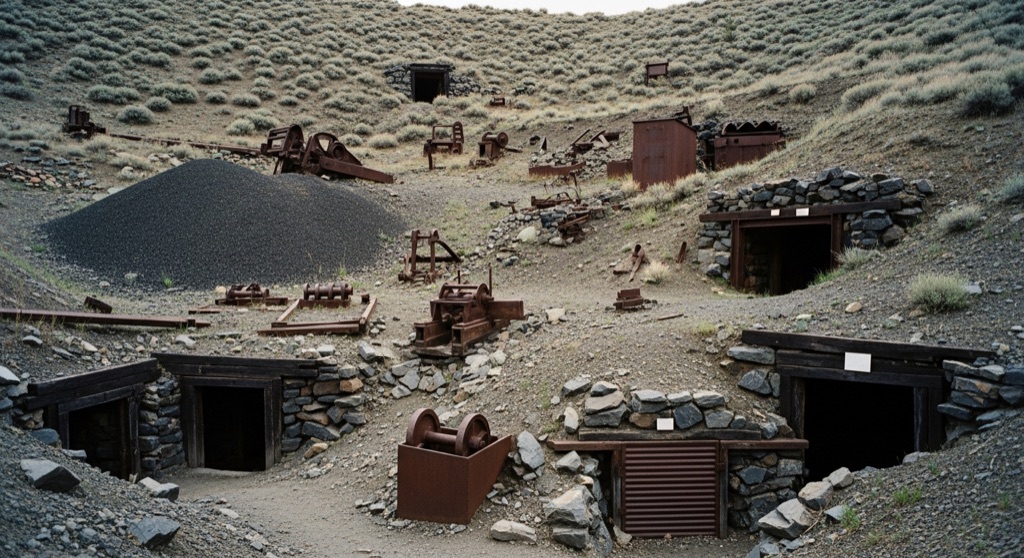
Discovered in 1891 in the Boise foothills, the Black Hornet Mine was a modest gold-mining operation that saw a brief investment boom in the mid-1890s. Though production largely ceased by World War II, the site still retains historical remnants of its mining past. Today, hikers can find old tailing piles, rusted machinery parts, and sealed or open adits scattered across the rugged terrain.
→ Three more abandoned & forgotten places in Boise — never the same twice
The story
In the winter of 1891, prospectors probing the granite ridges of Shaw Mountain above Lucky Peak hit gold-bearing quartz. Word spread, and by the fall of 1895, a syndicate of Denver investors dropped $100,000 on the Black Hornet claims. For a brief moment, daily carloads of $40-per-ton ore rolled out of the gulch, and local newspapers went wild when a $69 gold nugget was plucked from the district two years later. You didn't hear it from us, but most of that turn-of-the-century mountain fever was short-lived—the vein ran thin, base metals complicated extraction, and by World War II, the drills fell silent for good.
What remains in the Boise River Wildlife Management Area isn't a manicured historical site with velvet ropes or gift shops. It is a rough scatter of late 19th-century industrial ruins dissolving back into the Cretaceous granite of the Idaho Batholith. Thousands of feet of underground workings lie collapsed or hidden beneath the soil, marked on the surface by massive waste-rock tailing dumps clinging to steep draws, rusted metal machinery fragments, stone wall footings, and iron ore-car tracks poking out from rock adits.
What it's like
Reaching the mine site means hiking sun-baked dirt roads and steep trails up East Highland Valley Road within the Boise River Wildlife Management Area. There is no shade along the exposed foothills, so go early in the morning and carry plenty of water. When you arrive, the vibe is isolated and eerie: sagebrush grows through twisted scrap metal, and dark stone adit portals gape from the hillside. Squeezing into the tunnels is stupid—these old shafts are unmaintained, timbered with rotten wood, and prone to cave-ins. Keep your distance, keep an eye out for rattlesnakes in the summer brush, and enjoy the high-desert view looking back toward Lucky Peak.
The move: Hike up the scenic trails of the Boise River Wildlife Management Area to view the historic tailing piles and rusted mining relics from a safe distance.
📍 Before you go Located on public land within the Boise River Wildlife Management Area, but the mine shafts, adits, and surrounding structures are highly unstable and hazardous to enter.
- 📍 Black Hornet Mine
- 💸 Free
- ⚡ Low-key
- 🌗 Outdoors
Where: Black Hornet Mine, Idaho 83716, USA
Hours: Added 2026-07-20 — confirm current access before you go.
Pair it with
- Adelmann Mine — Hike further up the same foothills trail system to contrast Black Hornet's raw ruins with the towering five-story timber gold mill at Adelmann Mine.
- Old Idaho Penitentiary — Pair an isolated foothill mine trek with a walk inside the sandstone prison walls down at the base of the ridge.
- Idaho Museum of Mining & Geology — Stop by this free volunteer-run museum down in the Old Pen historic district to see real quartz and gold samples taken from these exact foothills.
- Bonneville Point — Extend your historical loop just east along Highway 21 to stand on the bluff where deep 19th-century wagon-wheel ruts from the Oregon Trail remain cut into the dirt.
More weird in Boise



Good to know
Is it safe to go inside the mine tunnels at Black Hornet Mine?
No. The open shafts and stone adits are unstable, unmaintained, and extremely hazardous. All historic ruins and tunnel openings should be viewed strictly from a safe distance outside.
Where is the Black Hornet Mine located?
It sits on public land managed within the Boise River Wildlife Management Area in the Boise foothills, northeast of Boise near Lucky Peak Reservoir off Highway 21.
How do you access the trail to the mine?
You reach the mine by hiking dirt roads and trails (such as East Highland Valley Road and the Hornet Loop network) branching into the Boise River WMA off Highway 21.
What relics can you see at the site?
Hikers can view large waste-rock tailing piles, rusted iron equipment scraps, stone foundation remnants, and rock-cut adit portals.
Plan a visit & invite your people →
Further reading: idahostatesman.com · Reddit
last checked: 2026-07-20