Entry No. 19 — the Baltimore file — filed under: witchy
Witch Board Museum Baltimore
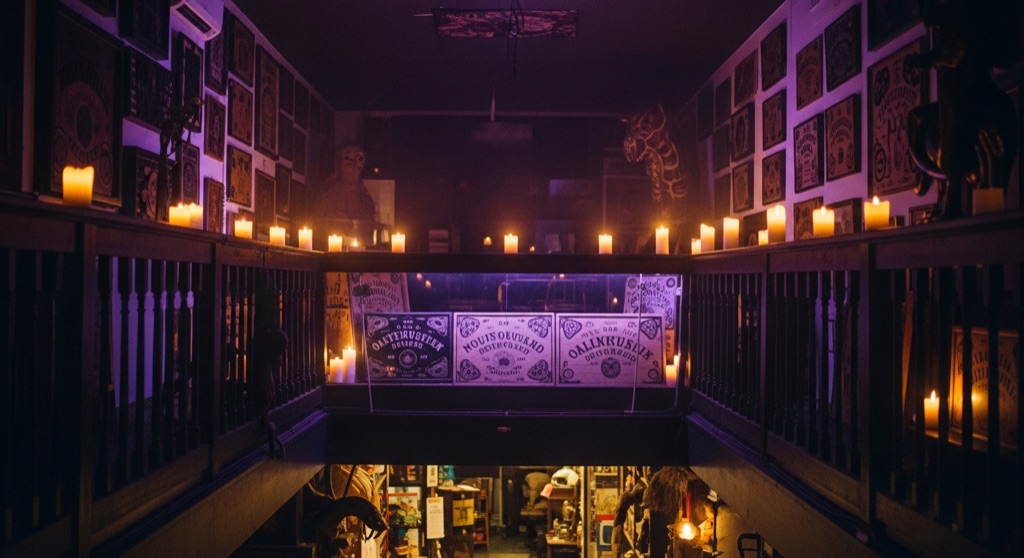
Located above the oddities shop Bazaar, this hyper-niche museum chronicles the history of the Ouija board, which was patented right here in Baltimore in 1890 [2.1.1].
→ Three at a time, never the same twice — explore weird Baltimore
The story
Most people assume the Ouija board was dreamed up by a Hollywood prop department, but its paper trail leads straight to 19th-century Baltimore. In 1890, local entrepreneur Charles Kennard and attorney Elijah Bond filed the patent for a wooden board paired with an alphabet and a teardrop planchette right here in town. According to local lore, medium Helen Peters asked the board what it wanted to be called during an 1890 séance inside a Baltimore boarding house; it spelled out O-U-I-J-A and, when asked what that meant, offered only 'Good luck.' (If you want to complete the circuit, Bond's headstone over in Greenmount Cemetery is carved to look like the board itself).
Curator John Kozik—a board member of the Talking Board Historical Society who also runs a museum in Salem, Massachusetts—opened this Baltimore location in May 2024 upstairs from Hampden's oddities shop, Bazaar. Rather than leaning into carnival haunt-house gimmicks, the collection treats talking boards as historical evidence of America's obsession with spiritualism. The display cases pull together rare vintage boards spanning over a century, charting how a Victorian parlor trend turned into a mass-market toy eventually bought by Parker Brothers.
What it's like
You enter through Bazaar on Chestnut Avenue, navigate past display cases of preserved specimens and antique medical glass, and take the stairs to the second floor. The museum spans a pair of quiet rooms lined with glass cases showing off early wooden talking boards, original patent drawings, and pop-culture spinoffs. Admission is $8 per person, and you'll spend about 30 to 45 minutes reading through the display labels. It's a low-key, self-guided stop, meaning you won't be elbowing through tour groups or forced to listen to spooky sound effects on a loop.
The move: Browse the bizarre taxidermy and medical antiques downstairs at Bazaar, then head upstairs to peer at vintage talking boards and learn how the board supposedly named itself.
- 📍 Hampden
- 💸 $
- ⚡ Up for anything
- 🌗 Indoors
Where: 3534 Chestnut Avenue, Baltimore, MD 21211
Hours: Added 2026-07-21 — confirm current hours before you go.
Pair it with
- Bazaar Baltimore — Head downstairs after viewing the talking boards to browse preserved specimens, taxidermy, and medical antiques.
- Crystals, Candles, & Cauldrons — Walk one block down Chestnut Avenue to stock up on candles, tarot decks, and ritual supplies at Hampden's long-running metaphysical shop.
- W.C. Harlan — Follow up your spirit-board history lesson with candlelit cocktails inside a speakeasy hidden behind an unmarked door in nearby Remington.
More weird in Baltimore
Good to know
Where is the Witch Board Museum located?
It sits on the second floor directly above Bazaar at 3534 Chestnut Avenue in the Hampden neighborhood.
How much does admission cost?
Tickets are $8 per person.
How is the Ouija board connected to Baltimore?
The board was patented in Baltimore in 1890 by Elijah Bond and Charles Kennard, and local lore holds that the board spelled out its own name during an 1890 Baltimore séance.
How long does a visit take?
The museum occupies two compact rooms, so most visitors spend about 30 to 45 minutes browsing the collection.
Plan a visit & invite your people →
Further reading: Official site · Atlas Obscura
last checked: 2026-07-21