Entry No. 16 — the Albuquerque file — filed under: museums
UNM Meteorite Museum
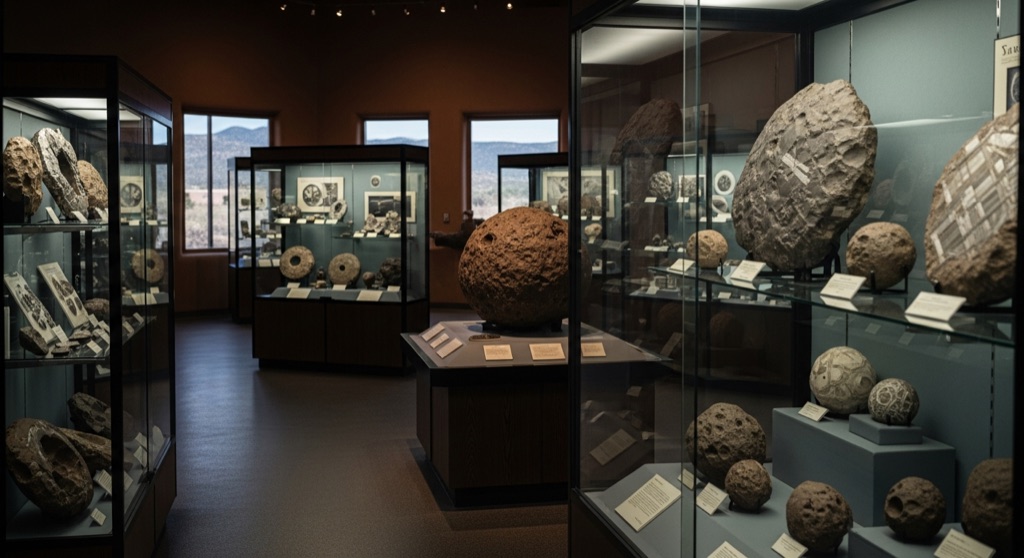
Tucked inside UNM's Northrop Hall, this specialized university museum displays over 5,000 extraterrestrial specimens, featuring rare fragments from the Moon and Mars and a massive 1,000-kilogram stony meteorite from Kansas.
→ Three more oddity shops & curiosities in Albuquerque — never the same twice
The story
UNM's Institute of Meteoritics opened in 1944 as the world's first research center dedicated exclusively to studying meteorites [1.1.3]. In 1974, the institute opened a single-room public museum on the ground floor of Northrop Hall—the Earth and Planetary Sciences building at 221 Yale Blvd NE. While the university's full research collection holds over 5,000 extraterrestrial specimens studied by scientists worldwide, the public display condenses solar system history into a compact space tucked inside a working campus building.
The centerpiece in the middle of the room is a massive 1,000-kilogram (one-ton) fragment of the Norton County stony meteorite, which crashed into Kansas in 1948. Surrounding it in glass cases are polished metallic pallasites, ancient cosmic debris older than Earth, and rare verified rock fragments from the Moon and Mars. Posted across the museum portal and building entrance, you'll also spot a blunt, all-caps warning that reveals plenty about their daily walk-ins: 'WE DO NOT INSPECT SUSPECTED METEORITES'. Leave whatever strange rock you dug up in your driveway at home.
What it's like
You'll step into Northrop Hall Room 24 on UNM's main campus to find a quiet, single-room gallery usually watched over by a student docent from the earth and planetary science department. Admission is completely free, and the experience is entirely self-guided as you walk between glass cases holding space debris older than the planet. Because the desk is staffed by student employees, operating hours shift each semester and depend on student availability, making it essential to double-check the current schedule before heading over. Paid visitor parking is available on campus, and after inspecting Martian rock slices, you can walk across campus to Yale Boulevard for a coffee.
The move: Go on a self-guided hunt through glass display cases for metallic pallasites and ancient space debris older than the Earth, then walk across campus to Yale Boulevard for coffee and local pastries.
- 📍 UNM Central Campus
- 💸 $
- ⚡ Up for anything
- 🌗 Indoors
Where: 221 Yale Blvd NE, Northrop Hall Room 24, Albuquerque, NM 87131
Hours: Added 2026-07-21 — confirm current hours before you go.
Pair it with
- UNM Campus Observatory — Pair daytime space rock hunting inside Northrop Hall with clear Friday night stargazing at UNM's campus observatory dome.
- The Guild Cinema — Trade real planetary science for late-night cult movies and weird screenings at Nob Hill's single-screen theater under a mile away.
- Daydream Rum Bar — Follow up an afternoon examining cosmic remnants with subterranean cocktails inside a hidden basement lounge in Nob Hill.
- Historic Fairview Cemetery — Contrast extraterrestrial space debris with 19th-century local history across 18 acres of graves at Albuquerque's historic burial ground.
More weird in Albuquerque
Good to know
Is there an admission fee to visit?
No, entry to the UNM Meteorite Museum is free [1.1.1].
Can I bring in a rock I found to see if it's a meteorite?
No. The Institute of Meteoritics explicitly notes in bold warnings that staff members do not inspect or evaluate suspected meteorites brought in by the public.
Where inside the campus is the museum located?
It is located on the ground floor of Northrop Hall (Room 24, Earth and Planetary Sciences) at 221 Yale Blvd NE on UNM Central Campus.
What are the main exhibits on display?
The central highlight is a 1,000-kilogram stony meteorite from Norton County, Kansas, alongside glass cases with fragments from Mars, the Moon, and metallic pallasites.
Plan a visit & invite your people →
Further reading: Official site · Reddit
last checked: 2026-07-21