Entry No. 13 — the Wichita file — filed under: megaliths
Stonehenge Jr. (Solar Calendar)
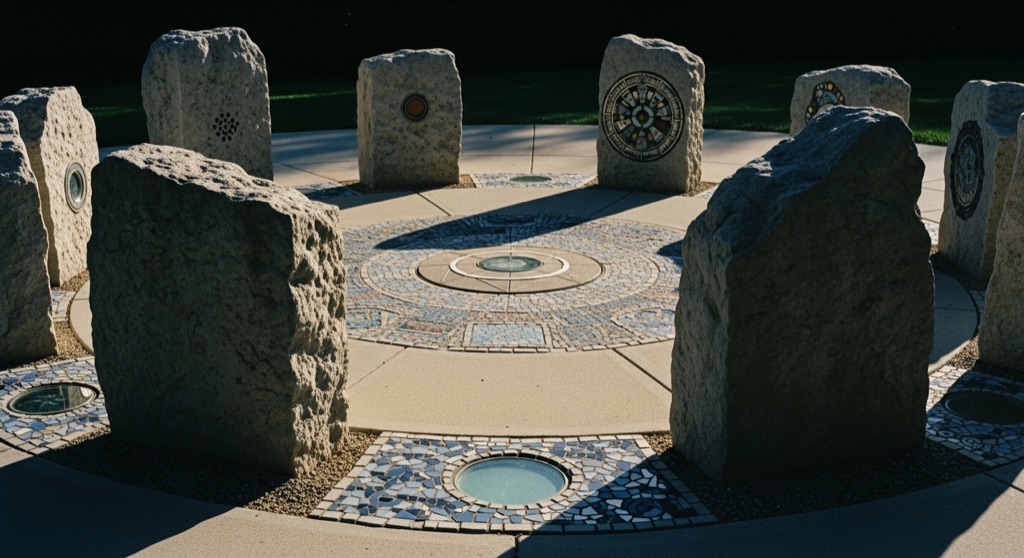
Tucked into the northwest corner of Central Riverside Park, this circle of limestone megaliths, colored glass and mosaics by Wichita artist Steve Murillo (2003) is a working solar calendar. On the equinoxes and solstices the noon sun shoots through a metal eye atop one stone and lights up a glass medallion set in the ground.
→ Three more weird outdoor & roadside oddities in Wichita — never the same twice
The story
In 2003, Wichita artist Steve Murillo placed a ring of heavy limestone megaliths directly into the turf at Central Riverside Park, giving the city its own functioning astronomical instrument. The local moniker "Stonehenge Jr." stuck immediately, but there is no Druidic mythmaking here—it is a calculated solar calendar hiding in plain sight in a suburban public park. Murillo inlaid the standing stones with hand-set zodiac mosaics and fixed three colored glass medallions into the grass inside the ring.
The real mechanics only trigger four times a year. Mounted atop one of the central limestone pillars is a metal eye aperture. On the summer solstice, winter solstice, and the spring and fall equinoxes, the sun reaches its precise zenith around solar noon and shoots a narrow beam of Kansas light straight through the metal eye, hitting the corresponding glass marker set in the soil. Visit on any random Tuesday and you get a quiet circle of carved stones; time it for solar noon on a solstice, and the sky completes the design.
What it's like
Head to the northwest corner of the park near North Nims Avenue and you can walk right up to the circle—there are no gates, turnstiles, or guard rails. On an ordinary day, it is a low-key outdoor spot where you can take your time inspecting the glass work and zodiac tiles on each stone. The only catch is purely weather-dependent: if you are attempting to catch the solstice or equinox light alignment, a single cloud rolling over the Little Arkansas River will block the beam, so clear skies are mandatory.
The move: Time a visit to a solstice or equinox around solar noon to watch the sunbeam hit the buried glass marker, or just hunt the zodiac mosaics on the stones any day.
📍 Before you go It sits in the northwest corner of Central Riverside Park, in the Riverside neighborhood just across the Little Arkansas River from downtown, near North Nims Avenue. There's free park parking close by and no gate, ticket, or reservation needed — it's an open-air public sculpture you can walk right up to on any day the park is open. For the actual light-through-the-eye effect, aim for a solstice or equinox under clear skies, since clouds cancel the show; otherwise visit in soft morning or late-day light to photograph the mosaics. Make a loop of it with the riverside paths, Botanica gardens, and the Wichita Art Museum, all nearby.
- 📍 Riverside
- 💸 Free
- ⚡ Low-key
- 🌗 Outdoors
Hours: Open during park hours; the calendar 'effect' only triggers near solar noon on solstices/equinoxes.
Pair it with
- The Wichita Troll — Follow the river trail south to hunt down another hidden Riverside quirk lurking under a storm grate on the riverbank.
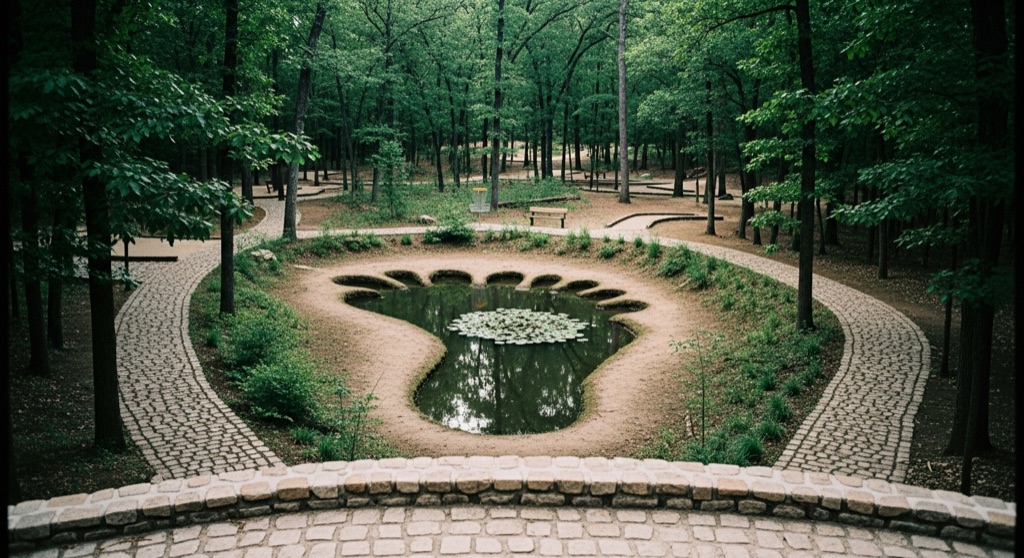
- Giant's Footprint at Oak Park — Head north into nearby Oak Park to see a lily pond carved into the shape of a massive footprint.
- Chainlink Gallery Place — Head into downtown to Douglas Avenue to trade stone celestial tracking for an experimental, open-air artist sandbox.
More weird in Wichita

Good to know
When is the best time to see the calendar effect in action?
Aim for solar noon on a summer or winter solstice or spring or fall equinox under completely clear skies, which is when the sun shoots through the top aperture to light up the buried glass medallion.
Is there an admission fee or ticket needed?
No. It is an open-air public sculpture located inside a city park, free to visit whenever Central Riverside Park is open.
Where exactly in Riverside Park is the circle located?
Look in the far northwest corner of Central Riverside Park, near North Nims Avenue in the Riverside neighborhood just across the river from downtown.
Plan a visit & invite your people →
Further reading: Atlas Obscura · Roadside America · clonehenge.com
last checked: 2026-06-06