Entry No. 39 — the Santa Cruz file — filed under: ruins
Old Lime Kiln Ruins
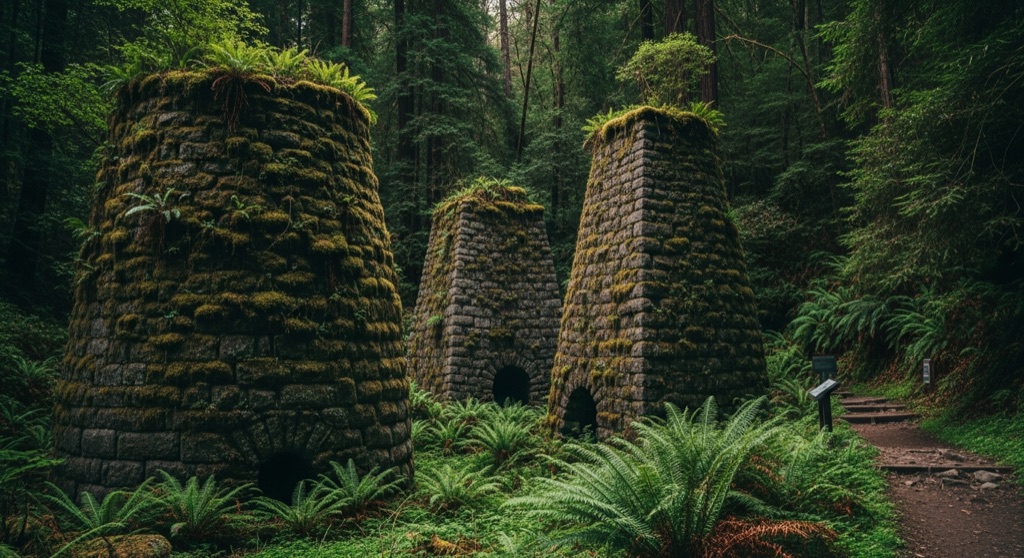
Tucked away in the redwood forest of the Fall Creek Unit of Henry Cowell Redwoods State Park, these moss-covered stone ruins are the remnants of a massive 19th-century lime-burning operation. Established in the 1870s by the IXL Lime Company, the facility heated quarried limestone to produce lime used in mortar and plaster, heavily supplying the rebuilding of San Francisco after the 1906 earthquake. Today, hikers can explore three towering, granite-block kilns, an old powder house, and a nearby barrel mill site, all slowly being reclaimed by ferns and redwoods.
→ Three more abandoned & forgotten places in Santa Cruz — never the same twice
The story
In the 1870s, the IXL Lime Company shoved raw blocks of quarried limestone into giant granite ovens buried deep in this damp redwood canyon, burning timber day and night to cook quicklime. The white powder produced in these hills didn't stay in Felton—it was packed into wooden barrels, hauled out of the mountains, and mixed into mortar to bind 19th-century California together. When the 1906 earthquake reduced San Francisco to rubble, lime cooked in these exact kilns heavily supplied the massive brick-and-mortar effort to rebuild the city from its ashes.
Once the limestone gave out and the industrial fires were abandoned, the canyon did what redwoods always do: it moved back in. Sword ferns filled the hearths, tree roots split the mortar, and thick moss blanketed stone that used to glow red-hot. What's left today looks less like an American industrial complex and more like the ruined stone temples of an overgrown empire—three massive granite kilns looming over the creek, the old stone powder house, and the decaying footprint of the wooden barrel mill.
What it's like
To get there, you'll take a 3.3-mile round-trip hike along the Fall Creek Trail, tracing a year-round creek wrapped in deep redwood shadow and dense banks of ferns. The canyon holds cold, damp air even on hot summer afternoons, so bring a layer and wear boots that can handle mud. The giant stone kilns appear suddenly out of the foliage, cold and mossy. Stick strictly to the marked park trails—these 150-year-old stone blocks are fragile, and state park rangers actively protect the site.
The move: Embark on a scenic, shaded hike along the fern-lined Fall Creek Trail, stopping to photograph the towering, moss-draped stone structures and read the interpretive historical displays together.
📍 Before you go The ruins are located within the Fall Creek Unit of Henry Cowell Redwoods State Park and are legally accessible to the public via well-maintained hiking trails.
- 📍 Felton
- 💸 Free
- ⚡ Low-key
- 🌗 Outdoors
Where: Fall Creek Trail, Felton, CA 95018, USA
Hours: Added 2026-07-20 — confirm current access before you go.
Pair it with
- Pogonip Historic Lime Kiln — Compare the IXL company ruins in Felton with industrialist Henry Cowell's rival lime operation tucked into the woods four miles south.
- Mountain Spirit — Head into downtown Felton after your hike to browse raw geological specimens and crystals extracted from the earth rather than cooked in ovens.
- The River Run at Brookdale Lodge — Keep the dark-wood historic vibe going up Highway 9 with a drink inside the vintage lodge where a living mountain creek cuts right through the dining room.
More weird in Santa Cruz



Good to know
How long is the trail to the kilns?
It's a 3.3-mile round-trip hike along the Fall Creek Trail through the separate Fall Creek Unit of Henry Cowell Redwoods State Park.
What ruins are still visible at the site?
You can examine three towering granite-block kilns, the stone remains of a powder house used to store explosives for quarrying, and the site of the former barrel mill.
Why were these kilns built in the middle of a forest?
Lime burning required three things in abundance: limestone deposits, endless timber for fire fuel, and water power. The IXL Lime Company built here in the 1870s because Fall Creek offered all three in one canyon.
Do I need a ticket or permit to visit?
No ticket is required, as the ruins are located on public land within Henry Cowell Redwoods State Park and legally accessible via maintained trails. Check park access and trail conditions before heading out.
Plan a visit & invite your people →
Further reading: mountainparks.org · modernhiker.com · parks.ca.gov · californiawanderland.com
last checked: 2026-07-20