Entry No. 21 — the Santa Barbara file — filed under: oddities
UCSB Cheadle Center Natural History Collections (Vertebrate Museum)
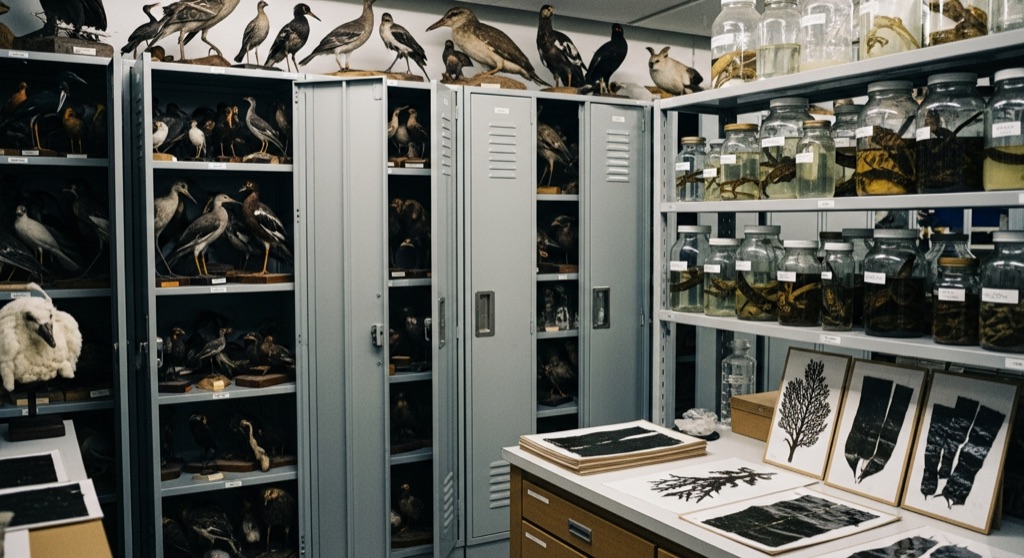
Tucked under the bleachers of Harder Stadium, UCSB's research collection holds hundreds of thousands of specimens — taxidermied birds and mammals stored in tall metal lockers, reptiles floating in jars of ethanol, and pressed seaweed on cardstock. Staff once had to freeze and thaw the entire dried-vertebrate collection to kill off a dermestid-beetle infestation eating through decades of specimens.
→ Three at a time, never the same twice — explore weird Santa Barbara
The story
Most people sitting in the bleachers at Harder Stadium are watching soccer matches or working out, completely oblivious to what is sitting directly beneath their feet. Tucked into Building 578 at Harder South, the Cheadle Center for Biodiversity and Ecological Restoration (CCBER) stores hundreds of thousands of dead things inside cold metal lockers and glass jars. You are walking over preserved birds, taxidermied mammals, pickled reptiles, and pressed seaweed mounted on cardstock without knowing it.
This is a working university archive under the UCSB Office of Research, not a polished public museum with softly lit display cases or a gift shop. Preserving decades of dried animal matter is constant defense work against rot and pests. When a dermestid-beetle infestation once began chewing through decades of specimens, staff had to execute a massive freeze-thaw cycle across the entire dried-vertebrate collection just to kill off the beetles and keep the research archive from turning into dust.
The space serves as an active research repository funded by CCBER's endowment and campus dorm payments. Researchers pull toe-pad samples from vintage quail skins to extract DNA for genetic work, catalog regional vascular plants, and maintain thousands of wet specimens preserved in ethanol jars. It is raw, functional natural history sitting quietly beneath a college sports stadium.
What it's like
Do not expect to wander in off the street while attending a stadium event; access requires planning ahead. You will need to contact curator Greg Wahlert to schedule an advance walkthrough. Inside, the space feels like a quiet, clinical evidence locker smelling faintly of ethanol. You will walk down rows of tall metal lockers, slide open heavy drawers filled with tagged study skins, and look through shelves of jarred reptiles.
The move: Email curator Greg Wahlert to arrange a walk-through of the vertebrate collection — open the metal specimen lockers together, find the shelf of snakes in jars, and see the toe-pad samples students pull from quails for genetic work.
- 📍 Isla Vista / UCSB campus, Goleta
- 💸 $$
- ⚡ Up for anything
- 🌗 Indoors
Where: Harder South, Building 578, UC Santa Barbara, Santa Barbara, CA 93106
Hours: Added 2026-07-20 — confirm current hours before you go.
Pair it with
- The AlloSphere — From dead animal specimens under stadium bleachers to a three-story soundproofed sphere wired for data visualization, pair two of UCSB's most obscure campus facilities.
- Camino Real Marketplace Telescope Nights — Swap jarred reptiles for deep-space optical viewing by heading down the road to look through telescopes set up in a Goleta strip mall parking lot.
- South Coast Railroad Museum at Historic Goleta Depot — Follow up a look at archived wildlife with a quick trip to a 1901 train depot that was severed from its tracks and hauled to a nearby park.
More weird in Santa Barbara
Good to know
Where is the collection located on campus?
It is hidden directly under the bleachers of Harder Stadium in Building 578 (Harder South) on the UCSB campus.
Can I visit without an appointment?
No. The facility is an active research space and requires an advance appointment arranged with staff, such as curator Greg Wahlert.
What kind of items are stored in the collections?
The facility holds hundreds of thousands of specimens, including taxidermied mammals and birds in metal lockers, reptiles floating in ethanol jars, and pressed regional plants on cardstock.
How is the center funded?
It operates through a combination of CCBER's own endowment funds and payments from UCSB campus dormitories.
Plan a visit & invite your people →
Further reading: Official site · dailynexus.com
last checked: 2026-07-20