Entry No. 51 — the San Diego file — filed under: historic
El Cuervo Adobe Ruin
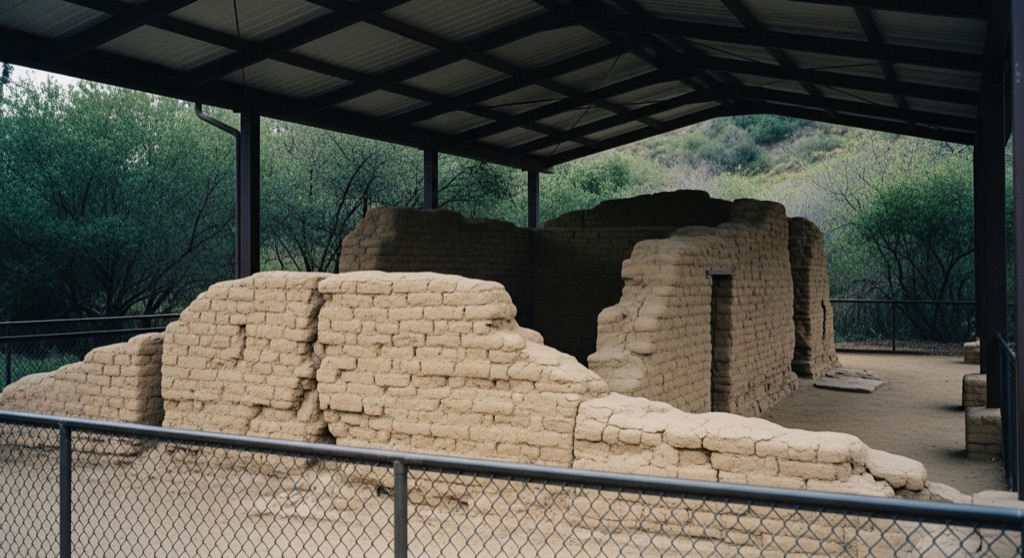
Located at the western end of Los Peñasquitos Canyon Preserve, these 1850s ruins represent one of the oldest existing adobes in Southern California. Originally part of a historic Mexican land grant, the home was eventually abandoned and fell into disrepair. Today, the crumbling mud-brick walls are protected under a modern sheltering roof and surrounded by a protective steel fence.
→ Three more abandoned & forgotten places in San Diego — never the same twice
The story
Most trail-goers heading into Los Peñasquitos Canyon Preserve march straight toward the main waterfall or the restored main ranch house to the east. Keep walking west toward Sorrento Valley, though, and the polished heritage gives way to something far rougher: the sun-dried, melting remnants of El Cuervo Adobe.
Dating to the 1850s, the structure sits on land originally granted under Mexican rule in 1823—the very first Mexican land grant in San Diego County. While other regional adobes got fresh coats of plaster and guided tours, El Cuervo was abandoned to the elements. Decades of rain, canyon wind, and baking heat quietly eroded the mud-and-straw bricks down to ragged, exposed stumps.
To stop the walls from dissolving entirely into the dirt, park authorities eventually placed the entire footprint under a modern sheltering roof and sealed it inside a high steel fence. The result feels less like a historic monument and more like an unexploded relic preserved in mid-collapse—a 170-year-old mud sculpture quarantined in the middle of coastal sage scrub.
What it's like
Park near the western trailhead off Sorrento Valley Boulevard and head east along the canyon path. You'll pass native brush and seasonal wild mustard before reaching the roofed enclosure sitting alone in the clearing. You cannot go inside or touch the earthwork; the cage and roof are strictly there to keep boots off fragile earth and rain off bare clay. It's a quiet, surreal observation stop—bring a lens with some zoom if you want a close look at the straw flecks bound into the bricks, and check trail openings beforehand if there has been recent rain.
The move: Take a scenic hike along the western trails of Los Peñasquitos Canyon Preserve to view and photograph the historic adobe ruins from behind the protective fencing.
📍 Before you go The ruins are located within a public nature preserve, but the fragile adobe structure itself is fenced off and sheltered to prevent trespassing and further deterioration.
- 📍 San Diego
- 💸 Free
- ⚡ Low-key
- 🌗 Outdoors
Where: Sorrento Valley Blvd, San Diego, CA 92121, USA
Hours: Added 2026-07-20 — confirm current access before you go.
Pair it with
- "Snake Path" by Alexis Smith (Stuart Collection, UCSD) — Pair 1850s mud-brick ruins with a 560-foot tile mosaic snake winding up a hillside just a short drive away at UC San Diego.
- "Trees" by Terry Allen (Stuart Collection, UCSD) — Follow an outdoor canyon hike with a walk past lead-sheathed eucalyptus trees that periodically speak and sing on the nearby university campus.
- "Bear" by Tim Hawkinson (Stuart Collection, UCSD) — Contrast fragile, sun-baked mud bricks with an 180-ton teddy bear constructed entirely out of stacked granite boulders.
- Sunny Jim Cave (The Cave Store) — Head from the inland canyon to the La Jolla cliffs to descend a 1902 hand-dug tunnel straight into a ocean cave.
More weird in San Diego


Good to know
Can you walk inside the El Cuervo ruins?
No. The fragile adobe walls are completely enclosed by a steel fence under a protective metal roof shelter to prevent trespassing and further physical decay. You view it entirely from the outside trail perimeter.
How do you get to the adobe ruin?
It is located on the western edge of Los Peñasquitos Canyon Preserve in San Diego. You reach it by hiking in from the western canyon trails starting near Sorrento Valley Boulevard.
What is the historical significance of the site?
The adobe was constructed in the 1850s on land that formed part of Rancho Los Peñasquitos, the first Mexican land grant awarded in San Diego County in 1823.
Plan a visit & invite your people →
Further reading: sandiego.gov · kpbs.org · Reddit
last checked: 2026-07-20