Entry No. 9 — the San Diego file — filed under: murals
Chicano Park
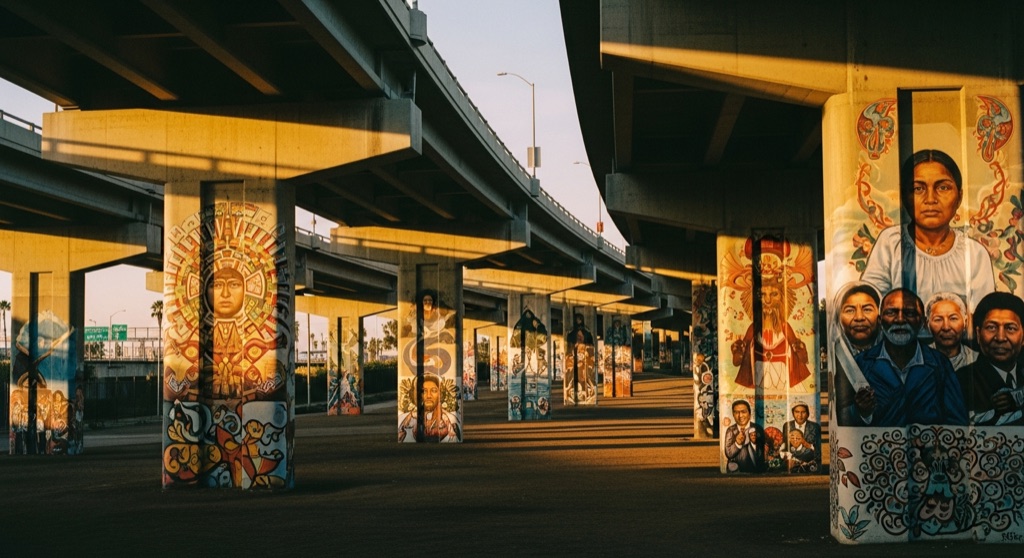
In 1970, Barrio Logan residents occupied a patch of land under the newly built San Diego–Coronado Bridge to stop a CHP station from being built on it — and won, turning the freeway's concrete support pylons into the largest collection of outdoor murals in the United States, now a National Historic Landmark.
→ Three more unusual museums & collections in San Diego — never the same twice
The story
On April 22, 1970, state bulldozers arrived in Barrio Logan to clear a 7.9-acre dirt lot underneath the newly poured concrete pylons of the San Diego–Coronado Bridge. The plan was to build a California Highway Patrol station—another chunk cut out of a neighborhood already severed by Interstate 5. The locals didn't file a petition; they occupied the dirt. Residents formed human chains around the bulldozers, planted trees, raised a flag, and held the land for twelve days until the city surrendered and agreed to turn the lot into a park.
Then came the paint. Starting in the early 1970s, local artists and activists hijacked the massive grey Brutalist support columns holding up the freeway overhead. Under the guidance of the Chicano Park Steering Committee, they covered dozens of towering concrete legs in intense, full-scale murals depicting Aztec myth, immigration history, labor organizing, and civil rights portraiture.
What you're walking through isn't a city-sanctioned sculpture garden designed by urban planners. It's an occupied zone turned open-air cathedral that fought its way onto the National Register of Historic Places. Every massive pillar holding up thousands of commuter cars overhead doubles as a middle finger to the state highway system that tried to crush the neighborhood.
What it's like
You'll hear the low, rhythmic thrum of highway traffic overhead before you see the scale of the art. Walk straight into the shadow of the bridge pylons—the park is entirely outdoors, open 24/7, and free. Golden hour is the sweet spot: late afternoon light cuts horizontally beneath the elevated freeway, illuminating towering depictions of historical figures and indigenous iconography. It's an active community space in a residential neighborhood, so keep it low-key. If you want indoor context, the Chicano Park Museum and Cultural Center sits at 1960 National Ave, but double-check its schedule first since it keeps limited open days.
The move: Walk the park slowly at golden hour when the light rakes across the pylons; the murals cover immigration history, Aztec imagery, and civil-rights portraiture across dozens of columns holding up the freeway overhead — free, self-guided, no ticket needed.
- 📍 Barrio Logan
- 💸 Free
- ⚡ Up for anything
- 🌗 Outdoors
Where: 1949 Logan Ave, San Diego, CA 92113
Hours: Added 2026-07-19 — confirm current hours before you go.
Pair it with
- Bread & Salt — Walk a block down the street to this 45,000-square-foot former industrial bakery turned raw, warehouse-scale gallery space.
- Botanica El Santisimo — Head half a mile north to visit a working botanica run by Don Luis, a Cuban santero who has offered consultations and spiritual cleansings here for over three decades.
- Villa Montezuma — Trade the political street art under the freeway pillars for an 1887 stained-glass Queen Anne mansion built for a self-proclaimed psychic pianist.
More weird in San Diego
Good to know
How much does it cost to see Chicano Park?
It's completely free. The park is a public city park underneath the freeway interchange, accessible anytime with no tickets or entry gates required.
How did the murals get started?
After local residents successfully occupied the land in April 1970 to stop a highway patrol station from being built, artists began painting the bridge's concrete support pylons in 1973 to reclaim the space for the neighborhood.
Is there a museum at the park?
Yes, the Chicano Park Museum and Cultural Center is located nearby at 1960 National Ave. It offers exhibits on the history of the park and neighborhood, though it has limited open hours (closed Monday through Wednesday).
Who manages the park's artwork?
The murals and community events are overseen by the Chicano Park Steering Committee, a grassroots group that originated during the 1970 land takeover.
Plan a visit & invite your people →
Further reading: Wikipedia · Official site · savingplaces.org
last checked: 2026-07-19