Entry No. 42 — the San Antonio file — filed under: ghost town
Berg's Mill Community
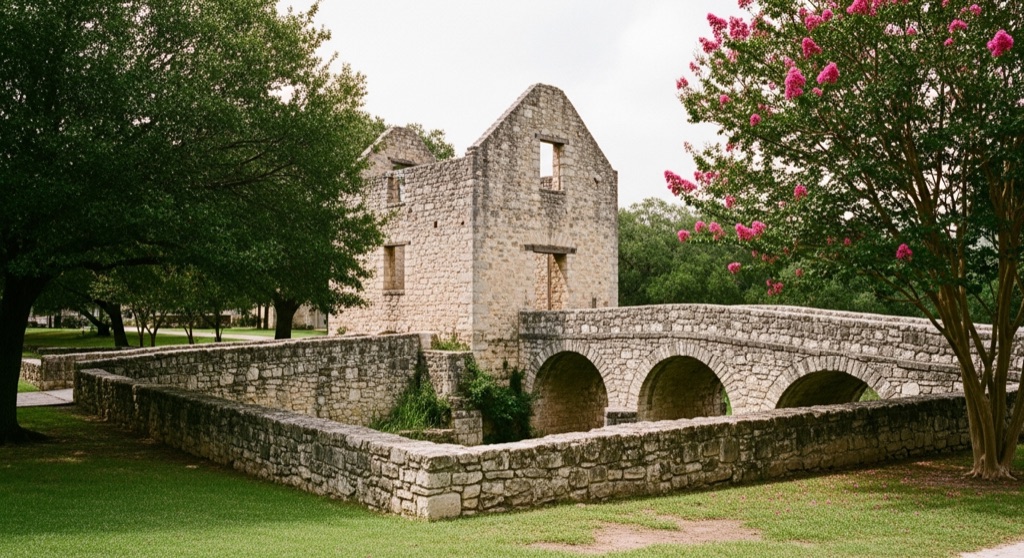
Berg's Mill was a 19th-century settlement that grew around a series of water-powered mills, including a wool-washing mill and a gristmill operated by the Berg brothers. The community once boasted a railroad station, post office, and school, but it was absorbed by San Antonio after World War II and eventually faded from maps by the 1960s. Today, a single sandstone mill ruin and the historic Berg's Mill Bridge remain standing near Mission San Juan Capistrano within the San Antonio Missions National Historical Park.
→ Three at a time, never the same twice — explore weird San Antonio
The story
Most tourists hit the San Antonio Missions National Historical Park strictly for the 18th-century Spanish colonial chapels, completely oblivious to the 19th-century ghost town hiding in the brush right next to Mission San Juan Capistrano. In the 1800s, the Berg brothers harnessed the flow of the San Antonio River to power a string of industrial operations here, including a gristmill and a wool-washing mill. Around those wheels grew the full-fledged settlement of Berg's Mill, complete with its own railroad station, post office, school, and local farming families who worked the surrounding soil.
The community held its ground into the 20th century, but post-World War II urban annexation eventually swallowed it whole into San Antonio. By the 1960s, Berg's Mill had been scrubbed from city maps entirely. Today, almost everything has dissolved back into the riverbank foliage, leaving behind only a single sandstone mill ruin, the old Berg's Mill Bridge, and the lingering strange truth that an entire town vanished inside the bounds of a national park.
What it's like
Follow the paved trails near Mission San Juan toward the riverbank, looking past the manicured mission grounds into the brush. You won't find a polished open-air museum or velvet ropes here—just a crumbling sandstone ruin, a historic bridge, and quiet historical markers setting the scene. The ruins sit on public national park land, making them entirely legal to visit during regular park hours, though you'll want to check current access conditions before trekking out.
The move: Take a scenic stroll along the paved trails of the San Antonio Missions National Historical Park near Mission San Juan, where you can photograph the historic sandstone mill ruins and view the old Berg's Mill Bridge.
📍 Before you go The ruins of Berg's Mill are located on public land within the San Antonio Missions National Historical Park, making them legally accessible to the public during park hours.
- 📍 San Antonio
- 💸 Free
- ⚡ Low-key
- 🌗 Outdoors
Where: Mission Rd, San Antonio, TX 78223, USA
Hours: Added 2026-07-20 — confirm current access before you go.
Pair it with
- Hot Wells Hotel Ruins — Pair these two forgotten 19th-century ruin sites along the Mission Reach to see how both a working mill town and a sulfur spring resort disappeared into the brush.
- San Jose Burial Park (Old Stinson Field Graveyard) — Located just a mile up Mission Road, this historic cemetery makes a fittingly quiet follow-up for exploring forgotten South Side history.
- The Ghost Tracks — Drive a mile and a half south to test San Antonio's most famous South Side urban legend after seeing the real physical ruins of Berg's Mill.
More weird in San Antonio
Good to know
Where are the Berg's Mill ruins located?
They are located along Mission Road near Mission San Juan Capistrano, within the San Antonio Missions National Historical Park.
What remains of the original community today?
A surviving sandstone mill ruin, the historic Berg's Mill Bridge, and historical markers marking the site of the former settlement.
Is it legal to visit the ruins?
Yes. The site sits on public land managed within the national historical park and is legally accessible during standard park hours.
What kind of mills operated at Berg's Mill?
The Berg brothers operated water-powered mills using the San Antonio River, specifically a gristmill for processing grain and a wool-washing mill.
Plan a visit & invite your people →
Further reading: nps.gov · hmdb.org · storymaps.arcgis.com
last checked: 2026-07-20