Entry No. 40 — the Sacramento file — filed under: history
Coloma Jail Ruins
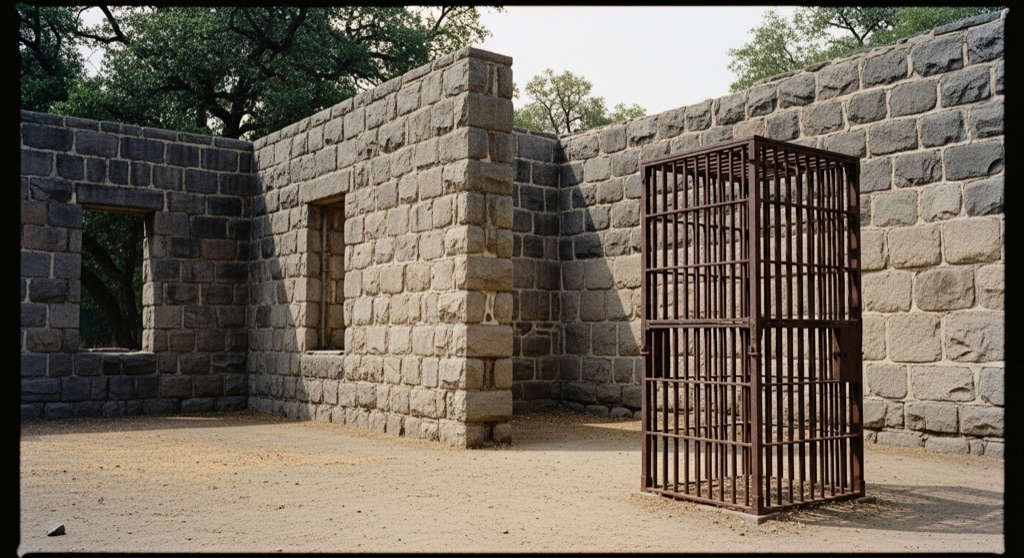
Located within Marshall Gold Discovery State Historic Park, these stone ruins are all that remain of El Dorado County's third jail, completed in 1856. Built of thick granite blocks and steel to hold Gold Rush-era criminals, the prison was decommissioned in 1862 and partially dismantled for building materials. Today, the weathered stone walls and a nearby rusted iron cell stand in an open field as a testament to frontier justice.
→ Three more abandoned & forgotten places in Sacramento — never the same twice
The story
In 1856, after years of settling disputes with makeshift wooden stockades and summary executions, El Dorado County spent serious money on heavy architecture in Coloma. They built a formidable fortress out of thick granite blocks and steel bars, intending it to serve as the region's official third jail for Gold Rush criminals. It was built to stand as a permanent warning to a lawless booming town.
Bureaucracy had other plans. Barely a year after the jail was finished, the county seat was stripped from Coloma and relocated down the road to Placerville in 1857. By 1862, the granite prison was completely decommissioned. With the county government gone, early locals treated the abandoned jail as a free hardware store, dismantling its heavy stone walls piece by piece to build foundations and walls for nearby homes.
What sits in the field today isn't a preserved museum building, but a half-gutted skeleton. The stone outer perimeter stands picked clean by 19th-century scavengers, while a solitary, rusted iron cell cage sits open to the sky—a stark artifact of frontier justice that barely survived six years of actual use.
What it's like
You'll find the ruins standing quietly in an open field off Back Street within Marshall Gold Discovery State Historic Park. There are no ropes or docents hovering around; you can walk right up to the weathered granite footings and look directly through the rusted iron cell bars. Pay the state park's vehicle day-use fee at the main lot, skip the standard gold-panning tour buses near the river, and head back toward the tree line for a much quieter encounter with Gold Rush ruin.
The move: Take a historic stroll through the state park to photograph the weathered stone ruins and the rusted iron cell, then enjoy a scenic picnic nearby along the South Fork of the American River.
📍 Before you go The ruins are located within the Marshall Gold Discovery State Historic Park, which is open daily to the public for a vehicle day-use fee.
- 📍 Placerville
- 💸 Free
- ⚡ Low-key
- 🌗 Outdoors
Where: 324 Back St, Placerville, CA 95667, USA
Hours: Added 2026-07-20 — confirm current access before you go.
Pair it with
- Hangman's Tree Ice Cream Saloon — Pair the stone ruins of Coloma's short-lived jail with an ice cream saloon built over the exact spot where 1840s vigilantes hanged suspects before formal prisons existed.
- Loved To Death on Main — Head down Highway 49 into Placerville to trade Gold Rush granite ruins for taxidermy and oddities at this relocated Science Channel shop.
- Griffith Quarry Museum — Drive west to Penryn to see the actual 1860s stone office of the quarry master who helped turn foothill granite into California infrastructure.
More weird in Sacramento
Good to know
Where are the jail ruins located?
They sit inside Marshall Gold Discovery State Historic Park along Back Street, located off Highway 49 between Placerville and Coloma.
Is there a fee to see the ruins?
Access to the ruins on the park grounds is free, but you will need to pay the California State Parks vehicle day-use parking fee upon entering the park.
Why are the jail walls so dismantled?
After El Dorado County moved its seat to Placerville, the jail was decommissioned in 1862. Nearby residents stripped the granite blocks to use as building materials for local construction.
What are the operating hours?
The historic park grounds are open daily during daylight hours, though you should confirm park hours before heading out.
Plan a visit & invite your people →
Further reading: parks.ca.gov · hmdb.org · Facebook
last checked: 2026-07-20