Entry No. 34 — the Raleigh file — filed under: stargazing
Little River Regional Park Skywatching
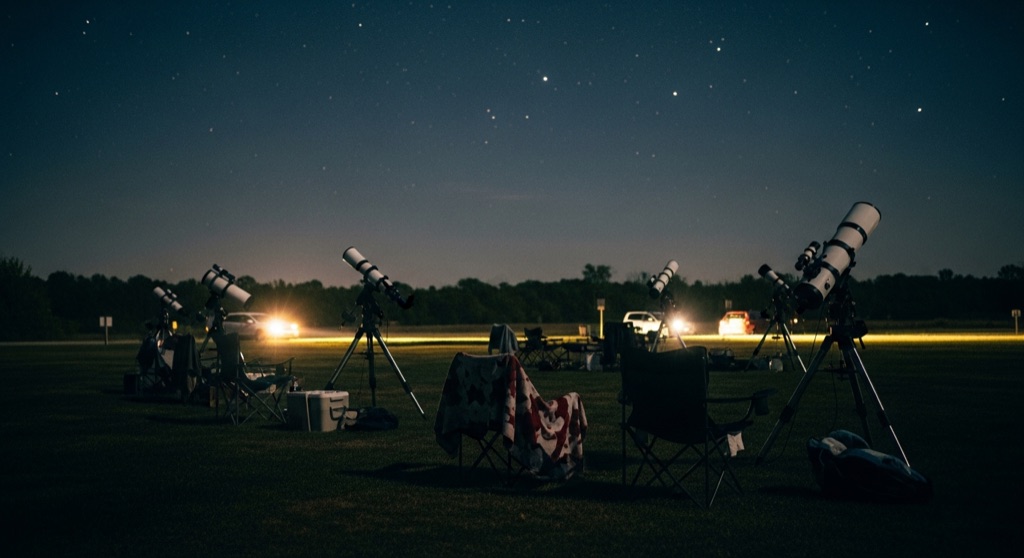
Tucked away on the northern edge of the Triangle where light pollution drops significantly, this regional park serves as a prime observing field. Morehead Planetarium educators and CHAOS astronomical society volunteers set up high-powered telescopes in the meadow for public stargazing.
→ Three at a time, never the same twice — explore weird Raleigh
The story
Right on the line where Durham and Orange counties blur into Rougemont, Little River Regional Park sits in one of the few pockets near the Triangle where light pollution drops significantly. By day, it is a low-key 390-acre park carved out of former timberland and farm plots. But on selected clear nights, when the Morehead Planetarium and the Chapel Hill Astronomy and Observational Society (CHAOS) take over the main meadow, it becomes an unofficial open-air observatory.
You are not looking at digital renders or phone screens here. CHAOS volunteers and planetarium educators haul out serious gear—custom Dobsonians, heavy-duty Schmidt-Cassegrains, and refractors that take up half a trunk. They align the optics on targets millions of miles out, letting you see the faint violet haze of the Orion Nebula, the shadow of Saturn's rings, or the atmospheric bands of Jupiter with your own naked eyes.
What it's like
The unwritten code of skywatching starts at the driveway: kill your high beams and switch to parking lights as soon as you turn in off Little River Park Way to keep from blinding people whose eyes have spent forty minutes adjusting. Pack a heavy blanket and folding chairs, and wrap red cellophane over your flashlight lens—white light is considered a major faux pas on the observing field. The meadow gets noticeably colder than the city early in the evening, so layer up heavier than you think necessary. Lines at the main scopes move steadily, and the volunteer astronomers running them will happily talk your ear off about focal lengths and deep-sky objects while you wait your turn.
The move: Bring camping chairs and a warm blanket, switch your car headlights to parking lights upon arrival, and look through high-powered telescopes to see Jupiter's bands and deep-space nebulae.
- 📍 Rougemont
- 💸 $
- ⚡ Low-key
- 🌗 Outdoors
Where: 301 Little River Park Way, Rougemont, NC 27572
Hours: Added 2026-07-21 — confirm current hours before you go.
⚠ Seasonal or scheduled — always check before you go.
Pair it with
- Satellite Park at Duke Arts Annex — Trade looking at deep-space transmissions for a look at retired earthbound communications tech at this park of painted 1990s dish antennas.
- Arcana Durham — Pair looking outward into the physical void of space with a underground, tarot-themed drink in a Durham basement bar.
- Gene Dillard's Fantasyland (The Mosaic House) — Balance a night stargazing under natural celestial light with a drive past a folk-art home entirely encrusted in reflective glass and mirror mosaics.
More weird in Raleigh
Good to know
Is there an admission fee for skywatching sessions?
No. The skywatching events hosted by Morehead Planetarium and CHAOS are free and open to the public.
What happens if the weather is cloudy or raining?
Skywatching is entirely weather-dependent. Morehead Planetarium evaluates cloud cover and makes a final go/no-go call on their website and social media channels by 4:00 PM the day of the event.
Do I need to bring my own telescope?
No. Volunteers and educators set up multiple high-powered telescopes targeted at specific planets, nebulae, and star clusters for public viewing. However, visitors are welcome to bring their own gear.
Why is red light required on the field?
White light instantly resets dark-adapted human vision, which takes up to 30 minutes to rebuild. Red light allows you to navigate the field without ruining night vision for everyone around you.
Plan a visit & invite your people →
Further reading: moreheadplanetarium.org · nightsky.jpl.nasa.gov
last checked: 2026-07-21