Entry No. 32 — the Portland file — filed under: blacksmithing
Bridgetown Forge
North Portland smith Arnon Kartmazov, trained in Israel and apprenticed under bladesmiths in Japan, teaches knife-forging classes out of a working forge whose own Japanese-style culinary knives turn up in Portland restaurant kitchens.
→ Three more hands-on workshops & classes in Portland — never the same twice
The story
Arnon Kartmazov didn't take the standard American route into metalworking. He learned the craft in Israel before moving to Japan to undergo a traditional apprenticeship under master bladesmiths. That background is why the knives coming out of his North Portland shop carry a distinct geometry: performance-focused, edge-obsessed Japanese culinary steel crafted in an unglamorous industrial bay off North Columbia Boulevard.
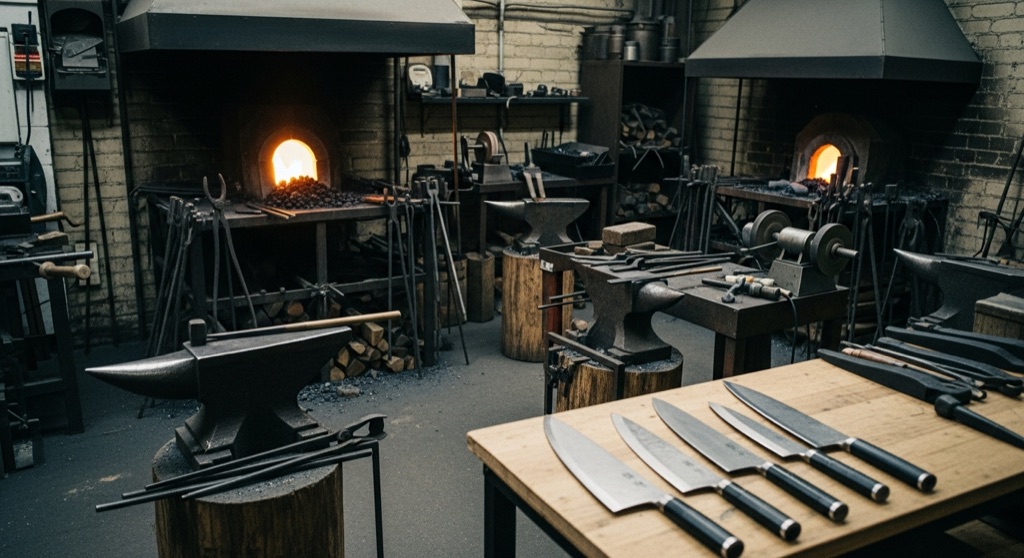
This isn't a boutique showroom with glass display cases. It's an active, soot-dusted working forge tucked into Building A-2 of an industrial stretch, where custom Japanese-style kitchen knives are hammered out and end up in the knife rolls of local chefs across Portland. Between production runs, Kartmazov opens the floor to teach the precise, unforgiving mechanics of shaping high-carbon steel.
The shop runs courses covering basic smithing, tool-making, and tong-making alongside intensive multi-day knife workshops. You aren't watching from behind a rope—you're standing next to an open fire, reading heat by color, and swinging a hammer until raw bar stock turns into a functional blade.
What it's like
Navigate into the industrial complex on North Columbia Boulevard and find Building A-2—you'll hear the power hammer before you step through the door. The forge is raw, loud, and smells like hot iron and fuel. If you're attending a class, drop any idea of easy shortcuts; you'll spend hours managing blade geometry and metal grain while sweating near the heat. Wear strictly natural fibers like thick cotton jeans and closed-toe leather boots—synthetic fabrics will melt if a hot spark lands on them.
The move: Book the multi-day knife-forging class as a pair (locals report paying around $800 for two) and each pound out your own culinary knife from raw steel to take home.
- 📍 Kenton / North Portland
- 💸 $$
- ⚡ Up for anything
- 🌗 Indoors
Where: 1812 N Columbia Blvd, Portland, OR 97217
Hours: Added 2026-07-20 — confirm current hours before you go.
⚠ Seasonal or scheduled — always check before you go.
Pair it with
- Paul Bunyan Statue — Stretch your aching forearms right down Columbia Boulevard under the gaze of Kenton's 31-foot concrete lumberjack.
- Local Art Glass — Trade the anvil for a blowpipe half a mile away at this glassblowing hot shop set inside an old pickle factory.
- McMenamins Chapel Pub — Wash down the forge dust with a pint inside a restored 1930s mortuary less than two miles south.
More weird in Portland


Good to know
Do I need prior blacksmithing experience to take a class?
No. The shop offers entry-level basic smithing, tool-making, and tong-making classes for novices alongside its multi-day culinary knife workshops.
What kind of knives are produced here?
Bridgetown Forge specializes in high-performance Japanese-style culinary knives, using techniques Kartmazov learned during his apprenticeship in Japan.
How much does a multi-day knife-forging class cost?
Locals report paying around $800 for a pair to take the multi-day knife workshop together, though you should check the official calendar for exact class pricing and availability.
What should I wear for a class at the forge?
Wear natural fibers (100% cotton or wool) and sturdy closed-toe shoes or boots. Avoid synthetic materials like nylon or polyester, which melt when hit by hot forge scale.
Plan a visit & invite your people →
Further reading: Official site · travelportland.com · pcc.edu
last checked: 2026-07-20