Entry No. 27 — the Pittsburgh file — filed under: history
Allegheny Observatory
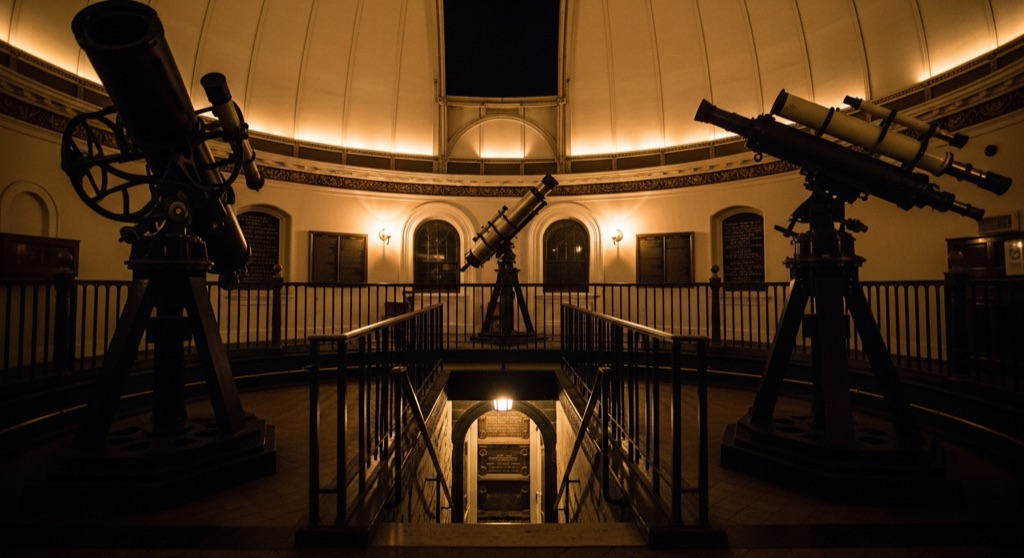
Perched atop a hill in Riverview Park, this historic 19th-century observatory offers free, reservation-only night tours where visitors can peer through antique refractors and visit the crypt of its former directors.
→ Three more after-dark & night-sky spots in Pittsburgh — never the same twice
The story
High above the North Side in Riverview Park sits a massive Greek Revival Palace of science that looks like it was plucked out of Gilded Age Europe. Built between 1900 and 1912 for the University of Pittsburgh's astronomy department, Allegheny Observatory was funded by local industrial titans who wanted an observatory that matched the city's steel-fueled ego. But the real soul of the building belongs to John Brashear, a former millwright turned master lensmaker whose telescopes helped map the moons of Saturn and measure the speeds of distant stars.
What makes this place genuinely eerie isn't just the century-old brass wheels, hand-cranked domes, or the dark-stained oak wainscoting that smells like machine oil and cold marble. It is what sits directly underneath the 30-inch Thaw Refractor dome. In the dark masonry crypt down in the basement lie the ashes of John Brashear, his wife Phoebe, and former director James Edward Keeler. Brashear’s brass plaque carries an inscription taken from a poem by Sarah Williams: 'We have loved the stars too fondly to be fearful of the night.' You are literally stargazing standing directly above the remains of the astronomers who built the lenses.
The instruments aren't museum props—they are mechanical relics you actually look through. During summer night tours, staff slide back the massive iron dome shuters to reveal the night sky through the 13-inch Fitz-Clark Refractor, an iron-and-brass telescope dating back to 1861 that survived a infamous 1872 ransom kidnapping before being reinstalled.
What it's like
Tours are completely free, but getting a slot requires military precision when booking opens in the spring. You'll arrive at Riverview Park in the dark, park along the winding access road, and walk up the stone steps into a dimly lit, marble-lined rotunda. The tour takes you through historic classrooms filled with antique scientific apparatus, down into the basement crypt where Brashear rests, and up into the unheated telescope domes. Because the domes must match the outside air temperature to prevent heat ripples from distorting the view, you need to dress like you're going winter camping, even on a summer evening. If it rains or clouds over, you won't see deep space, but the eerie midnight walk through an empty 19th-century scientific vault is worth the trip alone.
The move: Snag a rare ticket for a Thursday or Friday night tour, dress in warm layers, and look for Jupiter's bands through the 13-inch Fitz-Clark Refractor before paying respects in the basement crypt.
- 📍 Riverview Park
- 💸 $
- ⚡ Low-key
- 🌗 Outdoors
Where: 159 Riverview Ave, Pittsburgh, PA 15214
Hours: Added 2026-07-21 — confirm current hours before you go.
⚠ Seasonal or scheduled — always check before you go.
Pair it with
- Randyland — Balance out the cold, silent stone rotunda of 19th-century astronomy with a daytime walk through Randy Gilson's hyper-colorful North Side folk art garden.
- Bicycle Heaven — Swap turn-of-the-century optical engineering for floor-to-ceiling mechanical vintage bike chaos just down the hill in the Northside warehouse district.
- Saint Anthony's Chapel — Pair the astronomers' basement crypt with Troy Hill's chapel housing thousands of 19th-century reliquaries and saintly remains.
More weird in Pittsburgh
Good to know
How much does it cost, and how do I get tickets?
Tours are completely free, but you must reserve a spot in advance. Tour season runs from April through October on select Thursday and Friday nights, and reservations typically open in early spring via phone or Pitt's astronomy department website.
Can children attend the night tour?
Yes, but night tours are recommended for ages 7 and up due to the 2-hour duration, dark conditions, steep stairs, and technical nature of the presentations.
Is the observatory wheelchair accessible?
Main floor areas and the rotunda are accessible via a ramp, but accessing the historic telescope domes and the basement crypt requires navigating steep, narrow staircases.
What happens if it's cloudy or raining on the night of my tour?
Tours run rain or shine. If clouds block the view, staff replace stargazing with an extended tour of the building, historical artifacts, domes, and crypt.
Plan a visit & invite your people →
Further reading: physicsandastronomy.pitt.edu · northsidechronicle.com · Reddit
last checked: 2026-07-21