Entry No. 49 — the Philadelphia file — filed under: history
Scott's Mill Bridge ruins
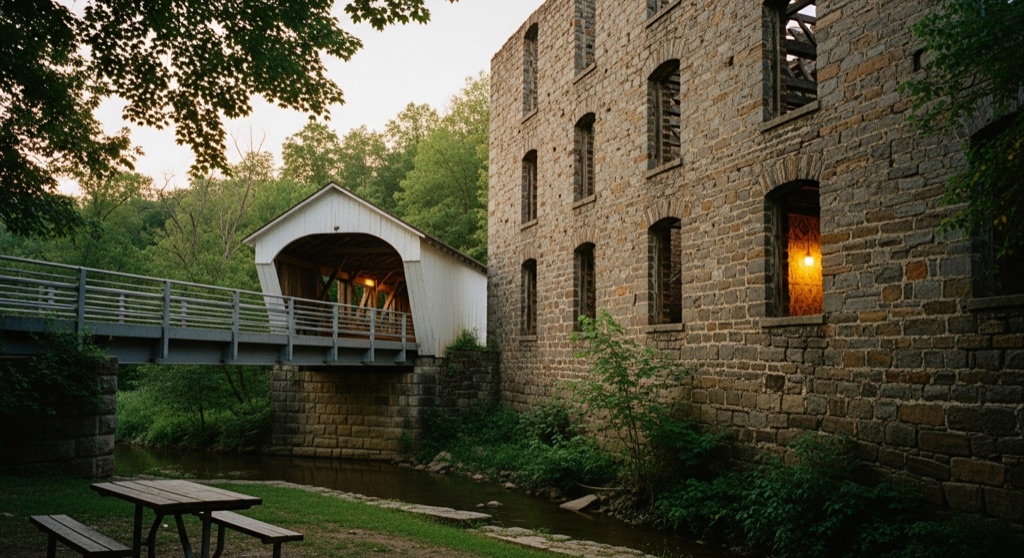
Located within the Fair Hill Natural Resources Management Area, this site preserves the remnants of a bustling 19th-century industrial hub along Big Elk Creek. The primary feature is the roofless, three-story stone shell of Scott's Grist Mill, which once ground flour and feed. Directly adjacent, the modern pedestrian bridge still rests on the original 1855 stone abutments of the historic covered bridge that washed away in 1946.
→ Three more abandoned & forgotten places in Philadelphia — never the same twice
The story
Deep inside the Fair Hill Natural Resources Management Area, Big Elk Creek cuts past a silent three-story monolith that casual trail-walkers easily miss. This roofless stone shell is all that remains of Scott's Grist Mill, a 19th-century industrial nerve center that once ground flour and animal feed for the surrounding agricultural hub.
Just steps away from the shell, look closely at the footbridge footings. In 1855, masons built heavy stone abutments across Big Elk Creek to carry a wooden covered bridge. That timber span carried mill traffic across the water for nearly ninety years until floodwaters swept it away in 1946. Today, the park’s modern pedestrian bridge rests directly atop those original 1855 stone foundations, letting you cross the exact same creek threshold right alongside the old dam remnants.
What it's like
You'll reach the site by hiking or biking the Yellow Trail through the state park. The atmosphere along Big Elk Creek is quiet and shaded, but keep your distance where marked: climbing inside the open-air mill shell is strictly restricted due to masonry instability. Bring sturdy boots if it has rained recently, as the dirt trails hugging the creek turn to slick mud fast.
The move: Hike the scenic Yellow Trail along Big Elk Creek to the bridge crossing, where you can take photos of the towering stone mill walls and enjoy a quiet picnic by the water.
📍 Before you go The ruins and bridge are located along public trails within the Fair Hill Natural Resources Management Area, a state-managed park. Visitors can legally hike or bike directly to the site, though entering the interior of the unstable mill structure itself is restricted.
- 📍 Elkton
- 💸 Free
- ⚡ Low-key
- 🌗 Outdoors
Where: M5MF+R9, Elkton, MD 21921, USA
Hours: Added 2026-07-20 — confirm current access before you go.
Pair it with
- Newlin Grist Mill — Blacksmithing Classes — Follow up a trek past Scott's ruined mill shell with a hands-on blacksmithing workshop at an intact, water-powered 1704 grist mill site.
- Salem County Insane Asylum — Double down on 19th-century architectural history by crossing state lines to see New Jersey's only surviving 1870 county asylum.
- Duffy's Cut Memorial — Trade the industrial decay along Big Elk Creek for a roadside marker commemorating a forgotten 1830s railroad tragedy in Chester County.
More weird in Philadelphia
Good to know
Can you go inside the Scott's Mill ruin?
No. While public trails lead directly to the base of the structure, entering the interior of the three-story stone shell is restricted due to structural instability.
How do you access the site?
Follow the Yellow Trail within the Fair Hill Natural Resources Management Area along Big Elk Creek. The trail is open to both foot traffic and bicycles.
What happened to the covered bridge that used to stand here?
Built in 1855, the wooden covered bridge spanned Big Elk Creek until floodwaters washed it away in 1946. The current footbridge sits directly on its original 1855 stone abutments.
Plan a visit & invite your people →
Further reading: dnr.maryland.gov · Official site · apps.mht.maryland.gov
last checked: 2026-07-20