Entry No. 82 — the Oklahoma City file — filed under: after-dark
Love's Planetarium at Science Museum Oklahoma
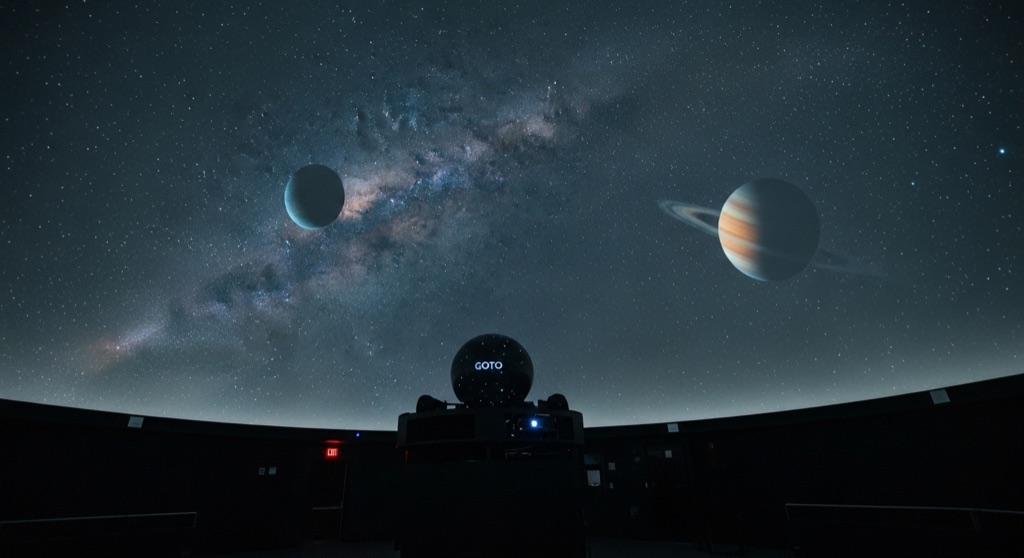
This hybrid dome reopened in September 2024 with a GOTO Orpheus star ball and a 4K projection rig the museum says uses more 4K projectors than any other planetarium in the country. The system renders roughly 8 million stars plus nebulae and clusters across the dome, mixing optical star-field realism with digital fly-throughs. Some shows are live presentations led by planetarium staff rather than canned reels, and there's no upcharge beyond museum admission. It's the most immersive indoor night sky in the metro.
→ Three more after-dark & night-sky spots in Oklahoma City — never the same twice
The story
Most planetariums picked a side decades ago: either stick with the analog, beetle-shaped optical star ball that projects pinpricks of true light against a dark dome, or scrap it for digital projectors that can fly through galaxy clusters but turn black space into a lukewarm grey glow. Love’s Planetarium, which reopened inside Science Museum Oklahoma in September 2024, refused the trade-off. They installed a hybrid system combining a GOTO Orpheus optical star ball with a high-density 4K digital projection rig.
What that means when you sit down is roughly eight million distinct points of light rendered with crisp, pinpoint optical accuracy, overlaid with digital imagery that can pull you off Earth and fly you out past the solar system. It mimics the deep-sky clarity of a rural black-sky preserve, engineered right inside a museum building in OKC's Adventure District.
The real draw isn't just the hardware specs—it's that they frequently hand the dome controls to human beings. Rather than running canned, pre-recorded voiceovers on loop, museum staff lead live sky tours, manually navigating constellations and deep-space objects in real time. Better yet, access isn't locked behind an upcharge ticket; show entry is folded straight into regular museum admission.
What it's like
As soon as you walk into Science Museum Oklahoma, scan the QR code signs in the lobby to secure your planetarium seats for the day—the live shows tend to fill up fast. Aim for a seat in the middle or upper-back rows for the widest dome angle without craning your neck. Check the day's schedule carefully before booking: you want a staff-led live show rather than a pre-recorded reel if you want the full real-time fly-through experience.
The move: Recline under the dome for a staff-led live sky tour, then lean back as the projectors sweep you out past the planets and into the Milky Way.
📍 Before you go Shows run on the museum's daytime/evening schedule; reserve a seat via the QR codes on arrival and check the day's lineup for live vs. recorded shows and any after-hours events.
- 📍 Adventure District, OKC
- 💸 $
- ⚡ Low-key
- 🌗 Outdoors
Where: 2020 Remington Pl, Oklahoma City, OK 73111
Hours: Added 2026-06-23 — confirm current hours before you go.
Pair it with
- American Pigeon Museum & Library — Pair your trip into deep space with a visit to North America's only museum dedicated to fancy and homing pigeons, less than a mile away in the Adventure District.
- Pierre Fauchard, 'Father of Modern Dentistry' Statue — Follow up your dark-sky cosmic tour with a brief outdoor stop to see an 18th-century French dental surgeon standing in period dress on NE 13th.
- Five More Minutes at Sauced on Paseo — Transition from digital galaxy mapping to free-play vintage arcade games tucked behind a pizza joint in the nearby Paseo Arts District.
- The Daley — Head to the Paseo after an evening show to unwind behind a unmarked door at this low-lit neighborhood cocktail haunt.
More weird in Oklahoma City

Good to know
Is there an extra fee for planetarium shows?
No, planetarium shows are included with general admission to Science Museum Oklahoma, though you must reserve a seat time on-site using the lobby QR codes.
How do I make sure I get a live show?
Check the show schedule posted on-site or via the museum's daily schedule on arrival. Look specifically for presentations marked as live or staff-led rather than recorded media.
What technology makes this planetarium different?
It uses a hybrid system pairing an optical GOTO Orpheus star ball (which casts ~8 million sharp optical stars) with a multi-projector 4K digital system for deep-space fly-throughs.
Where is the planetarium located?
It is located inside Science Museum Oklahoma at 2020 Remington Pl in the Adventure District of northeast Oklahoma City.
Plan a visit & invite your people →
Further reading: Official site · hoodline.com · Wikipedia
last checked: 2026-06-23