Entry No. 38 — the New York City file — filed under: outdoor-weird
Hua Mei Bird Garden
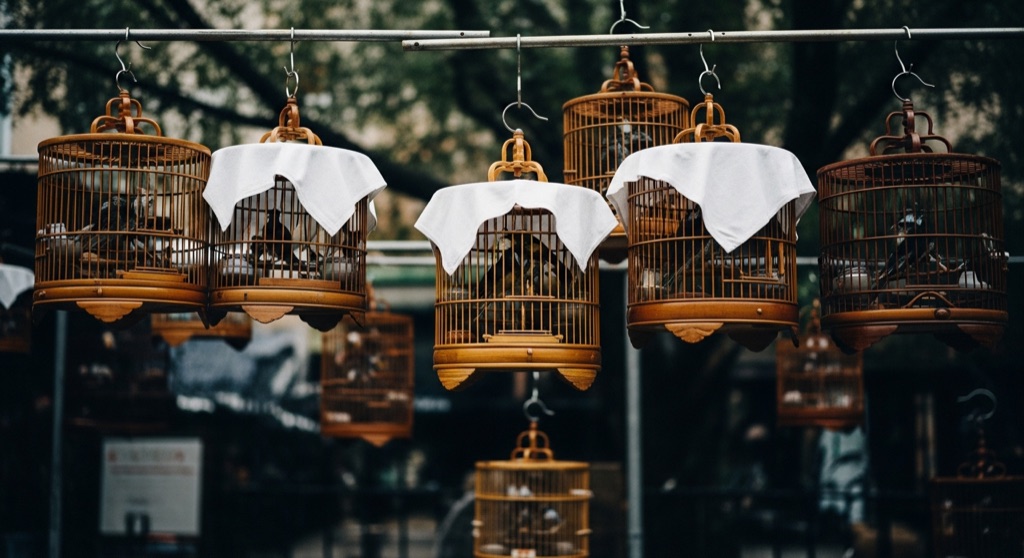
At the northern part of Sara D. Roosevelt Park, a community garden hosts a decades-old morning ritual: Chinese men arrive carrying ornate bamboo cages and hang their Hua Mei songbirds from hooks, posts, and tree branches, often draped with a white cloth. The Hua Mei is a fighting thrush from southern China, said to have been favored by emperors, that sings for females and battles other males. The garden has run this way since 1995, when three men petitioned the Parks Department to set aside this semicircular spot for the birds.
→ Three at a time, never the same twice — explore weird New York City
The story
If you wander through the northern strip of Sara D. Roosevelt Park near Delancey and Forsyth around sunrise, you'll spot older men walking silently with ornate bamboo cylinders wrapped in white cloth. They aren't taking pets for a casual walk; they are heading to a semicircular patch of ground that three local bird keepers convinced the Parks Department to set aside back in 1995. This is the Hua Mei Bird Garden, a piece of southern Chinese tradition operating on its own quiet clock right on Chinatown's edge.
The birds inside the cages are Hua Mei—a species of Chinese thrush historically prized by emperors. They are famous for two things: complex, aggressive singing and ferocious territorial instinct. The white cloths keep them calm during the transit from nearby apartments. Once the cages are hooked onto park fences, branches, and iron posts, the covers come off, triggering an immediate, competitive chorus as the males sing to claim territory and out-vocalize their neighbors.
While the birds compete above, the regulars—some, like long-time collector Yui Kang, who have kept songbirds for over fifty years—sit on benches comparing hand-carved bamboo cages, trading feeding tips, and sipping tea. There are no signs, ticket booths, or schedules posted. It is an ephemeral, self-organized morning ritual that vanished into the neighborhood by the time the rest of the city wakes up for brunch.
What it's like
Show up early—ideally right at dawn or shortly after on a clear morning. By mid-morning, the cages are recovered and everyone disperses, leaving behind only empty park hooks. Keep a respectful distance and lower your voice; this isn't a petting zoo or a scheduled show, but an authentic community routine. Walk along the northern end of Sara D. Roosevelt Park near Forsyth Street, listen for the rapid cascade of thrush songs, and watch the owners assemble their delicate bamboo perches over quiet morning conversation.
The move: Show up early on a weekend morning to listen to the hanging songbirds and watch the regulars compare cages over tea.
📍 Before you go The bird gathering is an early-morning event, best caught soon after dawn; the birds and owners disperse by mid-morning.
- 📍 Lower East Side / Chinatown, Manhattan
- 💸 Free
- ⚡ Up for anything
- 🌗 Outdoors
Where: Sara D. Roosevelt Park, Delancey St near Forsyth St, New York, NY
Hours: Added 2026-06-23 — confirm current hours before you go.
⚠ Seasonal or scheduled — always check before you go.
Pair it with
- Attaboy — Located barely a block away on Eldridge Street, this un-signposted cocktail spot offers a sharp nocturnal counterpart to the garden's dawn gathering.
- Chinatown Fair Family Fun Center — Pair a quiet morning of bird-listening with a quick stroll south down Mott Street to visit Chinatown's legendary 1944 arcade.
- Apothéke — Follow up Chinatown's morning avian ritual with an evening drink tucked away on historic Doyers Street.
More weird in New York City
Good to know
When is the best time to see the birds?
Right after dawn on clear mornings. The birds and their owners usually pack up and leave by mid-morning.
Where exactly is the garden in the park?
It occupies a semicircular spot in the northern section of Sara D. Roosevelt Park, near Delancey and Forsyth Streets.
Is there an admission fee?
No, it is a public community garden area inside a municipal New York City park and completely free to visit.
Why are the bird cages covered in white cloth?
The fabric keeps the territorial thrushes calm during transport; removing the cloth at the park prompts the birds to begin singing.
Plan a visit & invite your people →
Further reading: citylore.org · Official site · pps.org · placematters.net · The New York Times · vanishingnewyork.blogspot.com
last checked: 2026-06-23