Entry No. 75 — the New Orleans file — filed under: ruins
De La Ronde Ruins
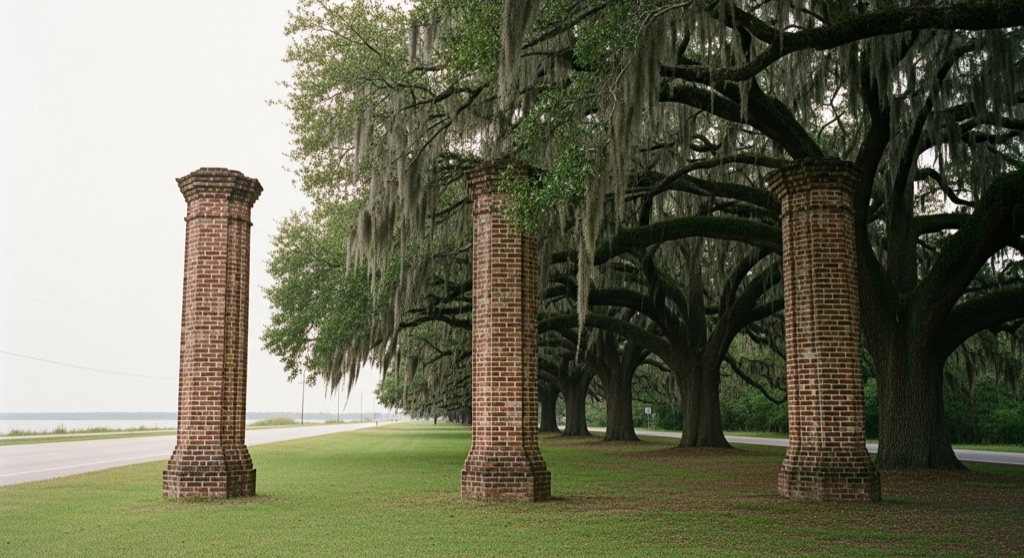
Built in 1805 by Colonel Pierre Denis de la Ronde, this grand plantation home served as a British headquarters and field hospital during the Battle of New Orleans in 1815. The mansion survived both the War of 1812 and the Civil War but was destroyed by fire in the late 19th century. Today, only a series of weathered brick pillars and a nearby double row of live oaks remain, standing in the median of the busy St. Bernard Highway.
→ Three at a time, never the same twice — explore weird New Orleans
The story
You didn't hear it from us, but the last surviving structural remnant directly involved in the Battle of New Orleans isn't preserved inside a museum park—it is stranded square in the median of Louisiana Highway 46. Built in 1805 by Colonel Pierre Denis de la Ronde, commander of the Third Regiment of Louisiana Militia, the manor house was the anchor of a grand estate often called Versailles, complete with a sugar mill, quarters, and a massive avenue of live oaks extending toward the river.
When British forces advanced on Chalmette in late 1814 and early 1815, they commandeered De La Ronde's estate for their field headquarters and surgical hospital. The home endured cannon fire, outlasted the War of 1812, and stood through the Civil War, only to be gutted by an accidental fire in the late 19th century. What survived were the thick brick piers and arch foundations, left standing while modern Chalmette grew up around them.
Eventually, highway engineers paved St. Bernard Highway directly down both sides of the ruin, stranding the red brick pillars inside the neutral ground. Specialist crews from Bayou Preservation were later brought in to stabilize the crumbling 1800s brickwork, keeping this stranded piece of war history anchored firmly between lanes of commuter traffic.
What it's like
You will spot the weathered brick pillars and mossy live oaks sitting directly inside the highway median near Paris Road. Do not try to sprint across four lanes of traffic or climb the protective fence; the site is fully enclosed to preserve the historic masonry and keep you out of harm's way. Park on a adjacent side street or lot nearby, walk down the public sidewalk, and snap your photos from behind the fence line. It is a strange, five-minute roadside stop where 1800s military history sits directly in the crosshairs of suburban traffic.
The move: Park safely nearby and walk along the roadside sidewalk to photograph the historic brick pillars and the majestic, moss-draped De La Ronde Oaks.
📍 Before you go The ruins are located in the median of a busy highway (LA-46) and are enclosed by a protective fence, making them viewable from the roadside or nearby sidewalk but unsafe to enter.
- 📍 Chalmette
- 💸 Free
- ⚡ Low-key
- 🌗 Outdoors
Where: 135 W St Bernard Hwy, Chalmette, LA 70043, USA
Hours: Added 2026-07-20 — confirm current access before you go.
Pair it with
- House of Dance & Feathers — Stop by Ronald W. Lewis's backyard museum in the Lower Ninth Ward on your way back into the city to trade war ruins for living neighborhood culture.
- Music Box Village — Pair a quiet look at Chalmette's stranded highway pillars with an exploration of musical, artist-built shacks in the Bywater.
- Dr. Bob's Folk Art — Head five miles upriver after your roadside history fix to browse Dr. Bob's iconic bottle-cap signs and folk art studio.
More weird in New Orleans



Good to know
Can you go inside the fence to touch the ruins?
No. The ruins are enclosed by a protective security fence in the highway median and are strictly viewable from the roadside sidewalk.
Where are the ruins located?
They sit in the median (neutral ground) of LA-46 at 135 W St Bernard Hwy in Chalmette, Louisiana, near Paris Road.
What role did this building play in the Battle of New Orleans?
The 1805 mansion served as the command headquarters and field hospital for the British army during the 1815 conflict.
Why is only the brickwork left standing?
While the mansion survived combat during the War of 1812 and outlasted the Civil War, a fire destroyed the main house in the late 19th century, leaving only the brick piers.
Plan a visit & invite your people →
Further reading: hmdb.org · Wikipedia · nola.com · bayoupreservationllc.com · tracesofwar.com
last checked: 2026-07-20