Entry No. 14 — the Monterey file — filed under: lighthouse museum
Santa Cruz Surfing Museum
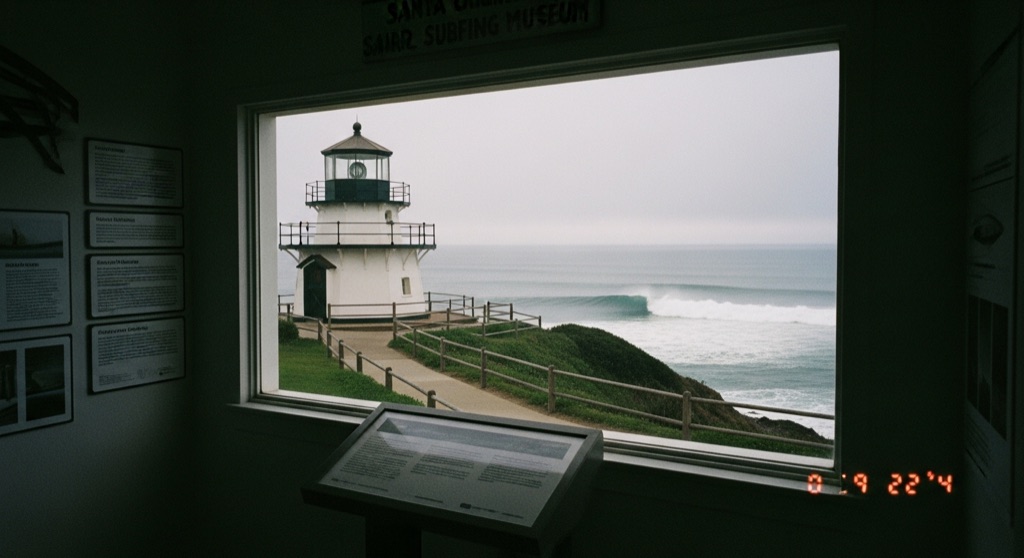
The world's first surfing museum, opened in 1986 inside the Mark Abbott Memorial Lighthouse — built to honor a young surfer who drowned in 1965 at nearby Pleasure Point, while the museum itself perches above the famed Steamer Lane break. Boards inside trace over a century of local surf history, from 1930s-40s hollow redwood planks to modern shortboards, with a plaque honoring the three visiting Hawaiian princes who first surfed in Santa Cruz in 1885.
→ Three more unusual museums & collections in Monterey — never the same twice
The story
In the summer of 1885, three teenage Hawaiian princes—David Kawānanakoa, Edward Keliʻiahonui, and Jonah Kūhiō Kalanianaʻole—were attending boarding school in San Mateo when they decided to carve boards out of native California redwood planks. They carried those heavy wooden slabs down to the mouth of the San Lorenzo River, rode the Monterey Bay swells, and introduced ocean surfing to mainland North America. A century later, in 1986, Santa Cruz claimed its turf officially by opening the world's first surfing museum right on the bluffs above Steamer Lane.
The museum lives inside the Mark Abbott Memorial Lighthouse, a small brick structure built by grieving parents after 18-year-old surfer Mark Abbott drowned at Pleasure Point in 1965. Inside the single round room, you'll find the concrete physical record of wave-riding evolution: massive, hollow redwood boards from the 1930s and 40s that weighed close to a hundred pounds, early fiberglass shortboards, and historical photographs documenting local surf lineage. Outside the windows, modern surfers are actively dropping into the exact same cold-water breaks traced by the artifacts inside.
What it's like
You walk along the bluffs of West Cliff Drive to reach the lighthouse perched on Lighthouse Point. The museum itself is a tiny one-room exhibit space—you can read every wall plaque and examine every board in under fifteen minutes. Admission is free, though it fills up quickly on sunny weekend afternoons. Step inside to check out the vintage gear and memorial plaques, then grab a spot on the cliffside railing outside to watch surfers negotiate the rocks and swells at Steamer Lane.
The move: Free, Thursday–Monday, noon–4pm (5pm in summer): duck into the tiny lighthouse-museum together, then sit on the point outside and watch surfers ride Steamer Lane, the exact break the museum was built to overlook.
- 📍 Lighthouse Point, Santa Cruz
- 💸 $
- ⚡ Up for anything
- 🌗 Indoors
Where: 701 West Cliff Drive, Santa Cruz, CA 95060 (inside the Mark Abbott Memorial Lighthouse)
Hours: Added 2026-07-20 — confirm current hours before you go.
Pair it with
- Pogonip Historic Lime Kiln — Trade the ocean breeze for dense redwood canopy by driving three miles inland to hunt down these crumbling 19th-century stone kilns tucked into Pogonip Open Space.
- Giant Artichoke — Follow Highway 1 south into Castroville to match coastal subculture history with vintage 1960s roadside kitsch.
- Pacific Grove Museum of Natural History — Head across Monterey Bay to swap surf artifacts for a wall packed with 409 mounted bird specimens and a rare California condor.
More weird in Monterey
Good to know
How much does admission cost?
Admission is completely free, though donations are welcomed to support the museum's upkeep.
What are the museum's operating hours?
The museum is generally open Thursday through Monday from noon until 4:00 PM (extending to 5:00 PM during summer months). Always confirm current hours before heading over.
Why was the lighthouse built?
The Mark Abbott Memorial Lighthouse was constructed by the parents of Mark Abbott, an 18-year-old local surfer who tragically drowned at nearby Pleasure Point in 1965.
Who were the first people to surf in Santa Cruz?
Three visiting Hawaiian princes—David Kawānanakoa, Edward Keliʻiahonui, and Jonah Kūhiō Kalanianaʻole—first surfed Santa Cruz waters in 1885 using custom redwood boards.
Plan a visit & invite your people →
Further reading: Official site · Wikipedia
last checked: 2026-07-20