Entry No. 37 — the Monterey file — filed under: ruins
Historic Lime Kilns
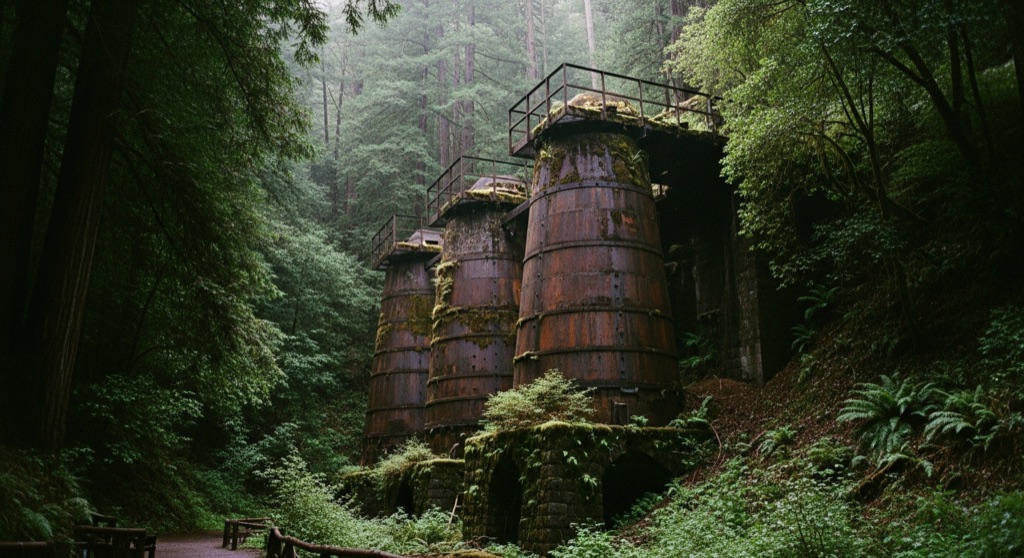
Tucked deep within a redwood canyon in Limekiln State Park, these four massive, rusted iron-and-stone furnaces are the ruins of a late-19th-century industrial operation. Built in 1887 by the Rockland Lime and Lumber Company, they were used to extract lime from limestone to supply cement for San Francisco's construction boom. Today, the towering, moss-covered structures stand abandoned and are slowly being reclaimed by the forest.
→ Three at a time, never the same twice — explore weird Monterey
The story
In 1887, the Rockland Lime and Lumber Company shoved a heavy industrial footprint right into a damp, secluded Big Sur canyon. The objective wasn't timber for its own sake, but chemistry: high-heat extraction of lime from native limestone deposits, cooked down inside four giant iron-jacketed stone furnaces and hauled out to sea to supply mortar for San Francisco's late-19th-century building boom.
The operation was brutal and brief. Once the local limestone pockets and immediate wood fuel were exhausted just three years later in 1890, the company walked away, leaving four towering metal-bound structures to decay in the gloom. Over a century later, the four cylinders still stand inside Limekiln State Park, rusting under thick coats of moss while redwoods slowly envelop their stone foundations.
What makes the canyon uncanny is the raw juxtaposition of heavy Victorian metallurgy and ancient coastal forest. You trace Limekiln Creek through a quiet green canopy, only to drop right onto four silent, iron-clad chimneys looming above the ferns like industrial relics from an abandoned settlement.
What it's like
You access the kilns via a short, shaded trail starting near the Limekiln State Park campground, crossing over small creek bridges beneath towering coastal redwoods. The terrain along the canyon floor is manageable, though damp footings, slick mud, and slippery creek rocks are standard. Always double-check park access conditions before making the trek down Highway 1—coastal landslides and winter storm damage routinely trigger park closures, but when open, arriving early in the morning gives you the best chance of viewing fog weaving through the rusted furnaces in solitude.
The move: Take a scenic hike along the shaded Limekiln Trail through towering coastal redwoods to photograph the historic, rusted furnaces and enjoy a picnic by the creek.
📍 Before you go The kilns are located within Limekiln State Park and are legally accessible to the public via a well-maintained hiking trail.
- 📍 Big Sur
- 💸 Free
- ⚡ Low-key
- 🌗 Outdoors
Where: Big Sur, CA 93920, USA
Hours: Added 2026-07-20 — confirm current access before you go.
Pair it with
- Deetjen's Big Sur Inn — Pair industrial canyon ruins with a stop at these hand-built 1920s redwood cottages tucked 19 miles north along Highway 1.
- Henry Miller Memorial Library — Follow up a hike through 19th-century ghost ruins with Big Sur's famously ungovernable arts hub buried in the redwoods.
- The Phoenix Shop (Nepenthe) — Trade the dark, rusted canyon depths for ocean views and Edmund Kara's oak trunk sculpture near Nepenthe.
More weird in Monterey
Good to know
How many kilns are at the site and when were they built?
There are four iron-bound stone kilns, constructed in 1887 by the Rockland Lime and Lumber Company.
Why were giant lime kilns built deep inside a Big Sur forest?
They were built to process local limestone into quicklime, which was shipped north to supply cement and mortar during San Francisco's rapid construction boom in the late 1800s.
How do you reach the kilns?
They are located within Limekiln State Park off Highway 1 and reached via the short Limekiln Trail that follows the canyon creek.
Do I need to check park access before going?
Yes, Big Sur state park access and Highway 1 conditions change frequently due to weather and slides, so confirm current trail status with California State Parks before heading out.
Plan a visit & invite your people →
Further reading: Wikipedia · californiathroughmylens.com · inspiredimperfection.com · hikespeak.com
last checked: 2026-07-20