Entry No. 63 — the Missoula file — filed under: ghost town
Granite Ghost Town State Park
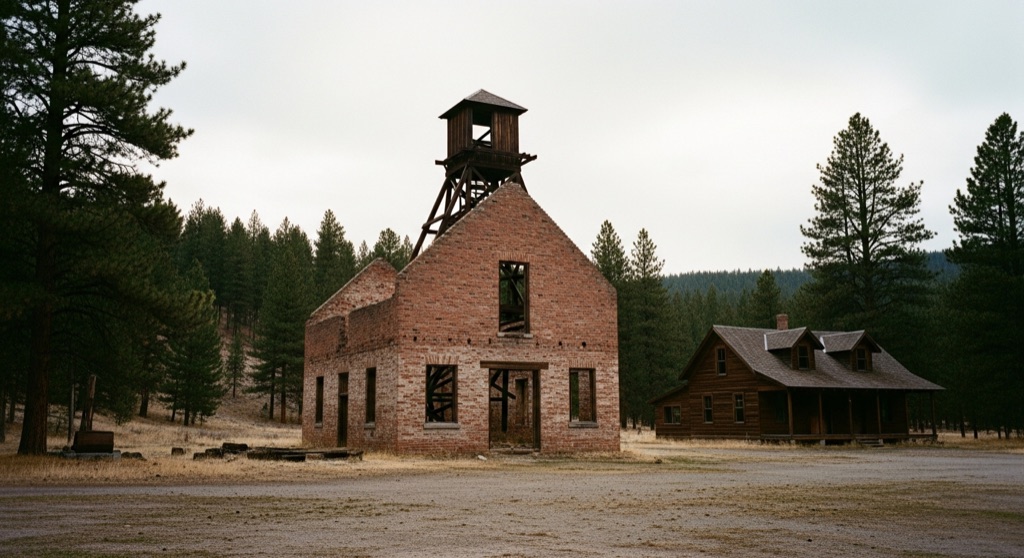
Established after silver was discovered here in 1872, Granite quickly grew into a bustling boomtown known as the 'Silver Queen' before collapsing after the silver panic of 1893. Today, the abandoned mountain site is preserved as a state park, featuring the skeletal brick ruins of the Miners' Union Hall and the well-preserved superintendent's house. Visitors can wander the quiet, pine-forested ruins where over 3,000 miners and their families once lived.
→ Three at a time, never the same twice — explore weird Missoula
The story
In 1872, silver was struck high on the mountain slopes four miles southeast of Philipsburg. Almost overnight, Granite mushroomed into a roaring boomtown dubbed the 'Silver Queen,' supporting over 3,000 miners and their families. They built a densely packed community out of timber and brick high in the timberline, anchoring their lives around the massive veins of ore beneath the rock.
The fall was even faster than the rise. When the Silver Panic of 1893 crushed the silver market, the town emptied out almost instantly as mines shuttered and wages dried up. Today, the forest has taken back most of the settlement, leaving behind stark, roofless ruins half-buried in pine needles.
What remains is preserved as a free, self-guided state park. The showstopper is the towering, skeletal brick shell of the Miners' Union Hall standing open to the sky, alongside the surprisingly intact superintendent's house and dozens of stone foundations scattered through the trees.
What it's like
The journey up the mountain is part of the filter. You'll tackle a steep, narrow, heavily rutted road out of Philipsburg that genuinely demands a high-clearance vehicle if you don't want to scrape your undercarriage. At the top, you'll find quiet, pine-shaded trails with zero commercial polish—just ruins, history, and mountain air. Pick your way carefully around the unstable brickwork, wear sturdy shoes, and confirm mountain road access before head up in shoulder seasons.
The move: Take a scenic, rugged drive up the mountain to hike the pine-shaded trails, photograph the towering brick ruins of the Miners' Union Hall, and enjoy a quiet picnic among the historic foundations.
📍 Before you go The site is a designated Montana State Park that is free and legally open to the public for self-guided exploration, though the access road is rugged and requires high-clearance vehicles.
- 📍 Philipsburg
- 💸 Free
- ⚡ Low-key
- 🌗 Outdoors
Where: Granite State Park, Philipsburg, MT 59858, USA
Hours: Added 2026-07-20 — confirm current access before you go.
Pair it with
- Garnet Ghost Town — Compare Granite's skeletal brick ruins with Garnet's intact wooden cabins to see two very different sides of Montana's 19th-century mining rush.
- Anaconda Smelter Stack (The Big Stack) — Trace the path of Montana's mineral boom from Granite's silver panic to the staggering 585-foot brick copper stack in nearby Anaconda.
- Old Montana Prison Ghost Tours — Pair an open-air mountain ghost town with a walk through the 1871 stone cellblocks and gallows yard in Deer Lodge.
More weird in Missoula

Good to know
How much does it cost to visit Granite Ghost Town?
It is a designated Montana State Park that is completely free and legally open to the public for self-guided exploration.
What kind of car do I need to reach the park?
The four-mile access road running southeast from Philipsburg is unpaved and rugged; a high-clearance vehicle is strongly recommended.
What major ruins are visible at the site?
The main focal points are the windowless, four-story brick walls of the Miners' Union Hall and the well-preserved superintendent's house, along with scattered stone foundations.
Where is the ghost town located relative to nearby towns?
Granite is located four miles southeast of Philipsburg, roughly a 45-minute drive from Missoula.
Plan a visit & invite your people →
Further reading: fwp.mt.gov · evansoutdooradventures.com
last checked: 2026-07-20