Entry No. 11 — the Milwaukee file — filed under: cemetery
Calvary Cemetery
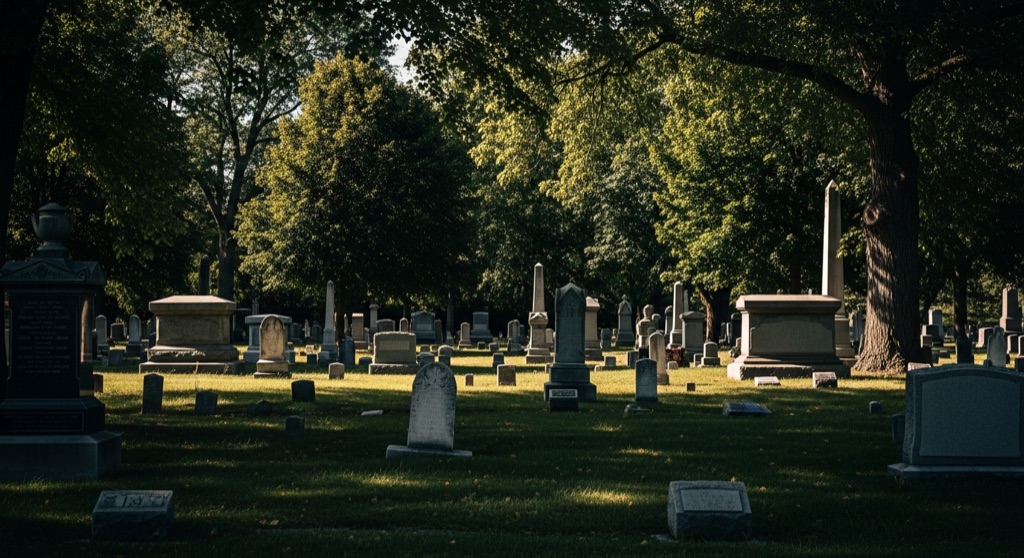
Established in 1857 as Milwaukee's first official Catholic burial ground, this hillside cemetery features an 1897 Victorian Gothic gatehouse and graves of Irish immigrants lost in the catastrophic 1860 Lady Elgin steamboat disaster on Lake Michigan.
→ Three at a time, never the same twice — explore weird Milwaukee
The story
In September 1860, the sidewheel steamer Lady Elgin was rammed by a schooner in Lake Michigan during a gale, sinking off Highwood, Illinois, and killing over 300 passengers. Most were Irish Americans from Milwaukee's Third Ward—specifically members of the Union Guards militia and their families returning from a political rally in Chicago. Calvary Cemetery had opened just three years prior in 1857 on a glacial bluff above the Menomonee Valley. When washed-up bodies began drifting ashore over the following weeks, this hillside became their primary resting place, cementing the cemetery as a repository of early Milwaukee tragedy.
Walk through the 1897 cream-brick Victorian Gothic gatehouse off Bluemound Road and climb toward Jesuit Hill, the highest point on the grounds. Here sits the 1899 St. Francis Xavier Chapel, designed by local architect Erhard Brielmaier out of regional Cream City brick. Surrounding the hilltop chapel are priests, bishops, and early civic heavyweights like Milwaukee co-founder Solomon Juneau, whose remains were reinterred here from an earlier churchyard. Lower on the slopes, scattered among weathered markers, sit headstones carrying simple, harrowing carved inscriptions: 'Lost on the Lady Elgin.'
As the oldest Roman Catholic cemetery in the Archdiocese of Milwaukee, Calvary's 75 rolling acres double as a stone census of 19th-century immigrant Milwaukee. You can trace ethnic shifts across distinct sections where Irish, German, and Polish families were buried according to their home parishes. The ridge also offers a surreal perspective on urban development: standing among quiet 19th-century monuments while overlooking the rush of traffic along Interstate 94, which cut through the base of the valley directly below the cemetery in the 1960s.
What it's like
Enter through the gatehouse at 5503 West Bluemound Road. The terrain rises sharply up Jesuit Hill, so wear shoes that handle uneven, grassy inclines. The gatehouse interior and hilltop chapel remain locked during standard visits unless unlocked for special historic tours, but the grounds are open daily for quiet walking. It is a peaceful, active cemetery frequented mostly by dog walkers, birdwatchers, and history seekers. Head toward the older plots on the slope to spot the Lady Elgin headstones before the late sun dips below the ridge line.
The move: Walk up Jesuit Hill to admire the cream-brick chapel and search the older burial plots for weathered gravestones inscribed with 'Lost on the Lady Elgin.'
- 📍 Merrill Park
- 💸 $$
- ⚡ Up for anything
- 🌗 Indoors
Where: 5503 W Bluemound Rd, Milwaukee, WI 53213
Hours: Added 2026-07-21 — confirm current hours before you go.
Pair it with
- St. Joan of Arc Chapel — Pair Milwaukee's oldest Catholic cemetery with a 15th-century French chapel rebuilt stone-by-stone just down Bluemound Road on Marquette's campus.
- People of the Road Monument — Descend Calvary's hill into the Menomonee Valley to view these massive steel silhouette monuments along the Hank Aaron State Trail.
- Forest Home Cemetery & Arboretum (Newhall House Monument) — Continue exploring 19th-century Milwaukee disaster history at Forest Home Cemetery, home to the mass grave from the 1883 Newhall House hotel fire.
- Tres Ojos — Head south across the valley to West Milwaukee for custom spellwork, candles, and herbal supplies in an intimate neighborhood shop.
More weird in Milwaukee
Good to know
Where is Calvary Cemetery located?
It is located at 5503 West Bluemound Road in Milwaukee's Merrill Park neighborhood, situated on a bluff directly north of I-94 and the Menomonee River Valley.
What is the history of the Lady Elgin graves?
On September 8, 1860, the steamship Lady Elgin sank in Lake Michigan after a collision, drowning over 300 people—mostly Irish immigrants from Milwaukee's Third Ward. Many victims were buried here, and several gravestones explicitly state 'Lost on the Lady Elgin.'
Are the gatehouse and hilltop chapel open to go inside?
No, both the 1897 gatehouse and the 1899 St. Francis Xavier Chapel are typically locked, though you can view their Cream City brick architecture from the outside while exploring the grounds.
Who designed the historic buildings on the property?
Architect Erhard Brielmaier designed both the 1897 Romanesque/Victorian Gothic gatehouse and the 1899 chapel on Jesuit Hill.
Plan a visit & invite your people →
Further reading: Wikipedia · urbanmilwaukee.com
last checked: 2026-07-21