Entry No. 6 — the Louisville file — filed under: cemetery
Eastern Cemetery
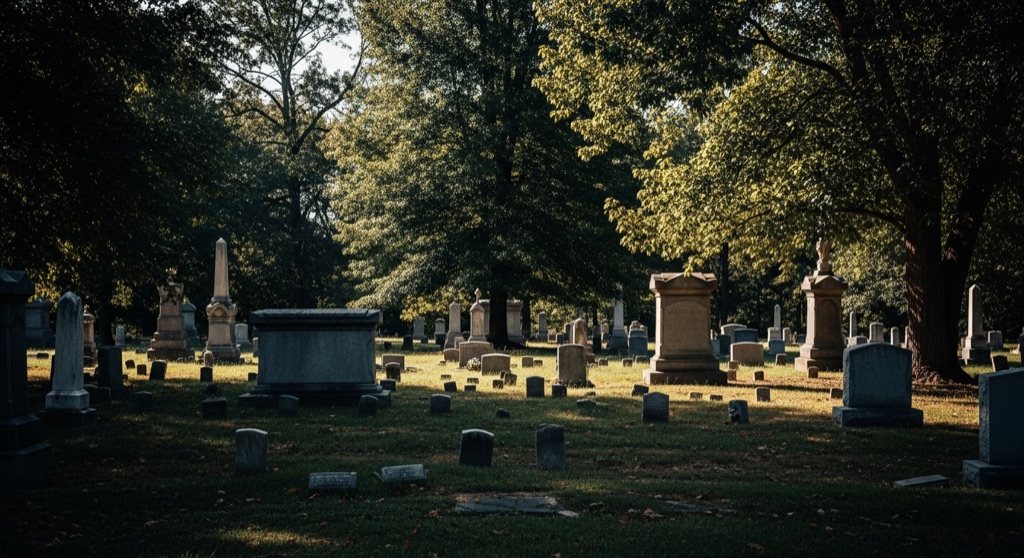
Abutting Cave Hill, this overgrown 1840s burial ground holds a dark local history of extreme grave recycling, where an estimated 138,000 bodies were stacked up to five deep in roughly 16,000 plots. Left unmaintained after a 1989 whistleblower scandal dissolved its management, the grounds are now kept accessible by volunteer preservationists.
→ Three more haunted places & dark-history spots in Louisville — never the same twice
The story
Directly across the perimeter fence from the manicured, Victorian elegance of Cave Hill lies 28 acres of unrestrained chaos. Documented in the 1840s as one of Louisville’s earliest burial grounds, Eastern Cemetery holds a dark local history of industrial-scale grave recycling. For more than a century, site operators quietly re-sold occupied plots, digging down into existing graves to stack new caskets directly on top of old ones.
By the time the machinery stopped, an estimated 138,000 bodies had been packed into roughly 16,000 marked plots—stacked up to five deep in places. Headstones were routinely uprooted, broken, or repositioned to make room for fresh burials, creating a disorienting landscape where headstones display conflicting eras and names that don't match the dirt beneath them.
A whistleblower scandal finally exposed the operation in 1989, leading to court battles that ultimately dissolved the cemetery's management entity. Abandoned by corporate owners and left off the city's maintenance budget, the grounds spent decades reverting to forest. Today, a non-profit volunteer group called the Friends of Eastern Cemetery works to keep the brush back, clear fallen branches, and hold back nature from swallowing the crumbling 1891 Romanesque wake house whole.
What it's like
You’ll find the entrance off Baxter Avenue, marked by a simple brick pillar and metal sign. Walking the grounds feels like stepping onto a forgotten battleground between wilderness and stone: gravestones tilt at impossible angles, half-sunk into soil that settled unevenly over multi-layered vaults. Dress in sturdy boots, as the unpaved terrain is full of hidden dips and treacherous footing. The interior of the derelict 1891 red-brick wake house is off-limits due to structural decay, but you can inspect its Romanesque arches from the outside. Stick strictly to daytime visits, tread carefully around fragile markers, and stay out of the way if local volunteers are out with mowers.
The move: Take a quiet daytime walk past the crumbling 1891 Romanesque wake house to observe the chaotic, overlapping gravestones, then grab coffee up Baxter Avenue.
- 📍 Phoenix Hill / Highlands
- 💸 $$
- ⚡ Up for anything
- 🌗 Indoors
Where: 641 Baxter Ave, Louisville, KY 40204
Hours: Added 2026-07-21 — confirm current hours before you go.
⚠ Seasonal or scheduled — always check before you go.
Pair it with
- Cave Hill Cemetery & Natural Cave Spring — Walk right next door to contrast Eastern’s wild, overcrowded plots with the immaculate lawn landscapes and Victorian monuments of Cave Hill.
- Unorthodox — Head half a mile down Barret Avenue to browse preserved bone specimens and dark art that echo the cemetery's memento mori atmosphere.
- Planet of the Tapes — Walk three blocks up the road for a quiet drink in a dark venue that doubles as a cult VHS archive.
- Shrine of Saints Magnus and Bonosa — Continue your tour of morbid local history 0.6 miles away at a sanctuary holding the full skeletal remains of two 3rd-century Roman martyrs.
More weird in Louisville
Good to know
How did so many bodies get buried in so few plots?
For over a century, cemetery operators illegally reused land by digging into existing graves to stack new caskets up to five deep, often discarding or moving old headstones in the process.
Why isn't the city maintaining Eastern Cemetery?
When the 1989 whistleblower scandal dissolved the cemetery's governing board, the site was left without an owner or an endowment fund. Because it remains private property, official municipal upkeep fell through administrative cracks, leaving care to volunteer groups.
Can you go inside the 1891 wake house?
No. The red-brick Romanesque structure is heavily degraded and structurally unsafe, so you must view it from a distance.
Is there an admission fee or set hours?
There is no fee to enter. The grounds are accessible during daylight hours, but you should double-check current access guidelines before visiting as volunteer restoration work is ongoing.
Plan a visit & invite your people →
Further reading: Wikipedia · explorekyhistory.ky.gov · Official site · lpm.org
last checked: 2026-07-21